Jennifer Steen Booher

Buy Some Damn Art

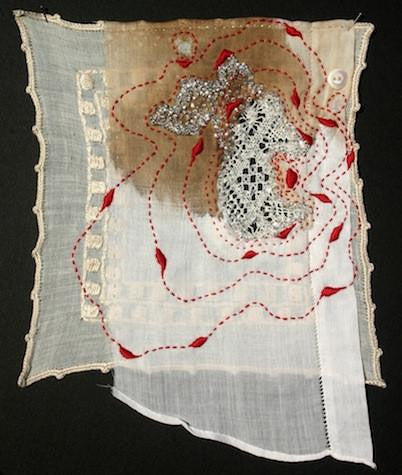
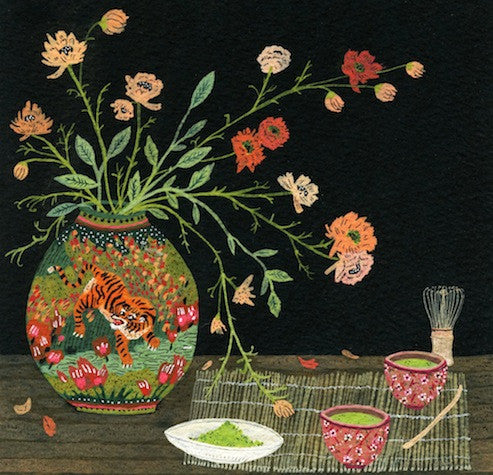
Isn’t that the best gallery name ever? Buy Some Damn Art is the online gallery of Kate Singleton, also known for her blog Arthound.  Kate launches a new show every week or so, and the work is up for six weeks. She has some amazing pieces right now, ranging from Erin Endicott’s embroidered work:
Erin Endicott, Sutra 1, via Buy Some Damn Art
to Becca Stadtlander’s colorful paintings:
Becca Stadtlander, Making Matcha, via Buy Some Damn Art
and, opening tomorrow, a special edition of six photos from the Beachcombing series! I’m nervous and excited about finding myself in such creative company.
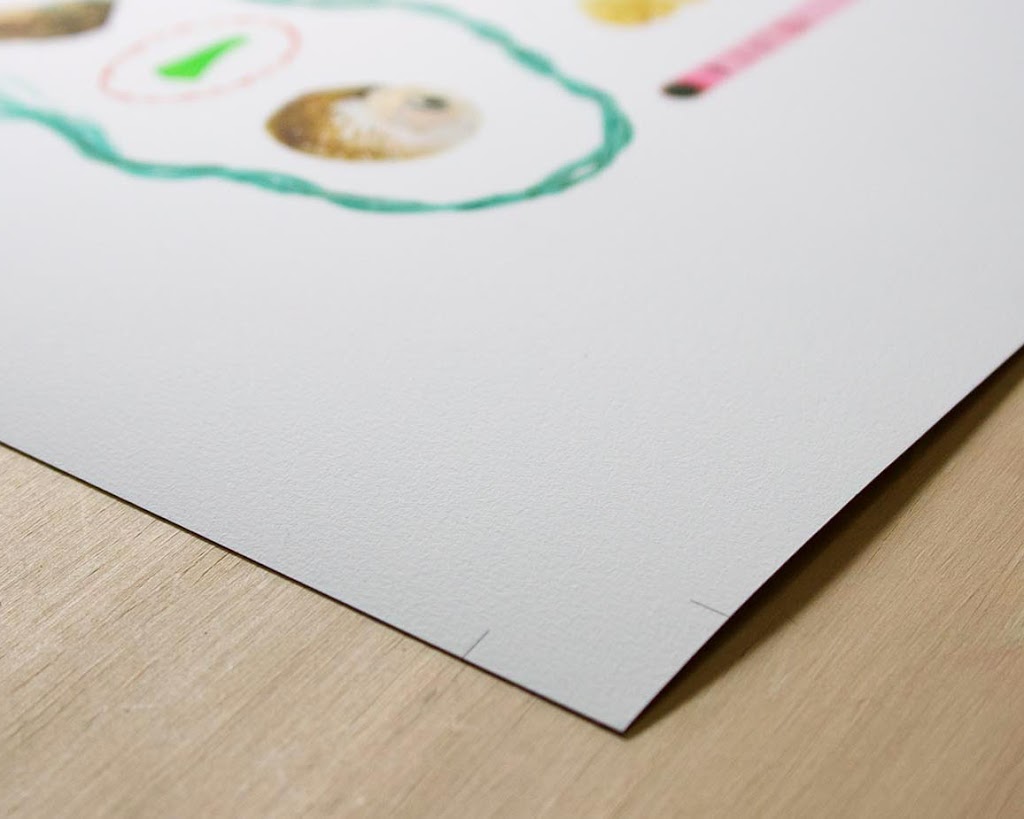
 Here’s the skinny on the show: there will be 6 photos, giclee printed at 20″x20″ with Epson Ultrachrome archival inks on 100% cotton rag Somerset Velvet paper. This is the most beautiful paper – it’s a thick, bright white cotton rag that’s been really popular with printmakers, especially for etching. It’s become equally popular for photographs – the surface is so velvety soft that it gives really rich detail and color. It’s fairly expensive, as you might expect, so I don’t use it often and don’t offer it in my shop, but I just love the way photos feel on this stuff. Art geek moment!

See the little lines at the corners? The 20×20 photo is printed on a 22×22 sheet, and those lines are registration marks – the extra room and the marks make placing a mat much simpler.

Share

Frost

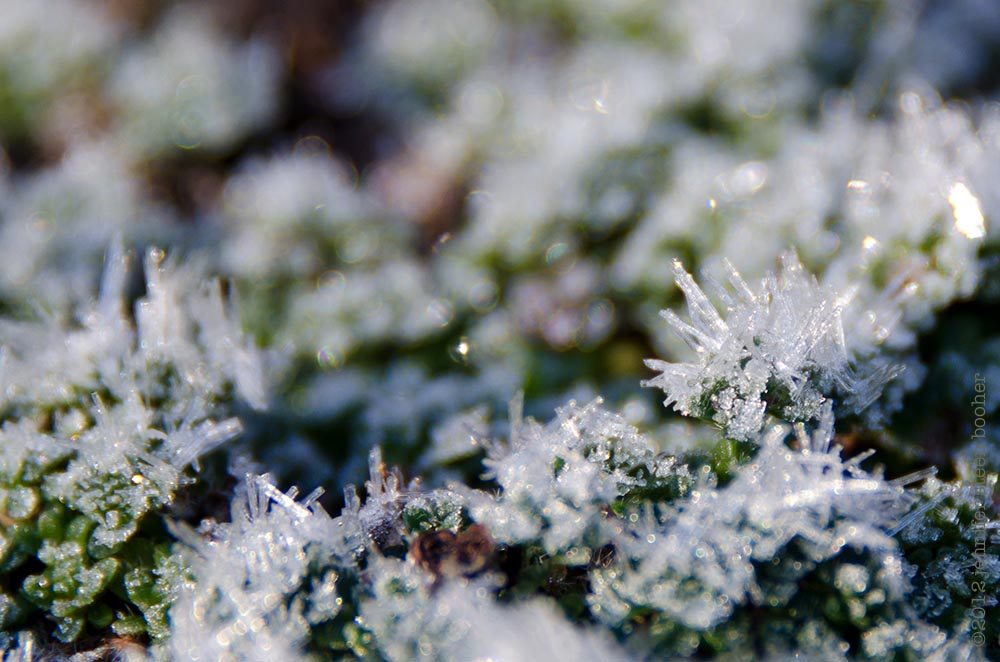
feathery ice crystals
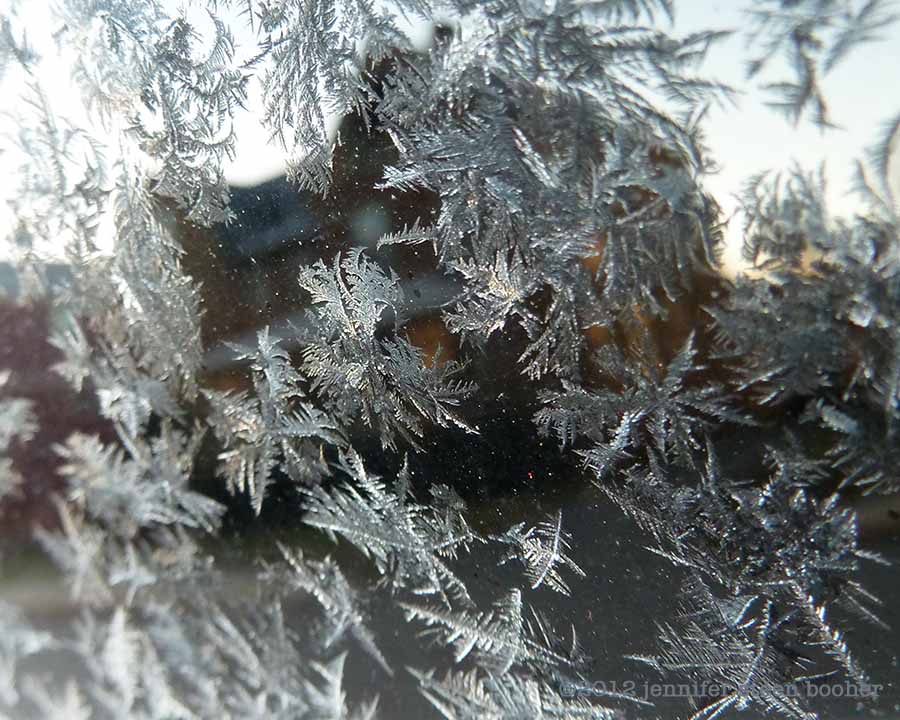
 There was some very peculiar frost on my car’s spare tire this morning. It looked like tiny feathers, or petals, standing up at a 45º angle. Kind of like ruffled fish scales? It must have a name. Everything has a name, if you ask the right person. The rest of the car was covered in ordinary flat frost, like this:
window frost fern frost ice winter frozen
 A couple of weeks ago I found hoarfrost in the garden:
frost ice crystals sparkle twinkle bokeh
Frost is formed when water freezes directly from the air onto a surface that has cooled below freezing (it doesn’t form dew first).  I think hoarfrost and rime form when the water vapor itself is supercooled, which means it’s still vapor but is below freezing point, and it freezes instantly to anything it touches.
frost hoarfrost ice crystal winter frozen
 To me, hoarfrost is needle-like, as opposed to the flat sort. Since even I can tell the difference between two types of frost, there’s got to be a name for my feathery frost flakes.
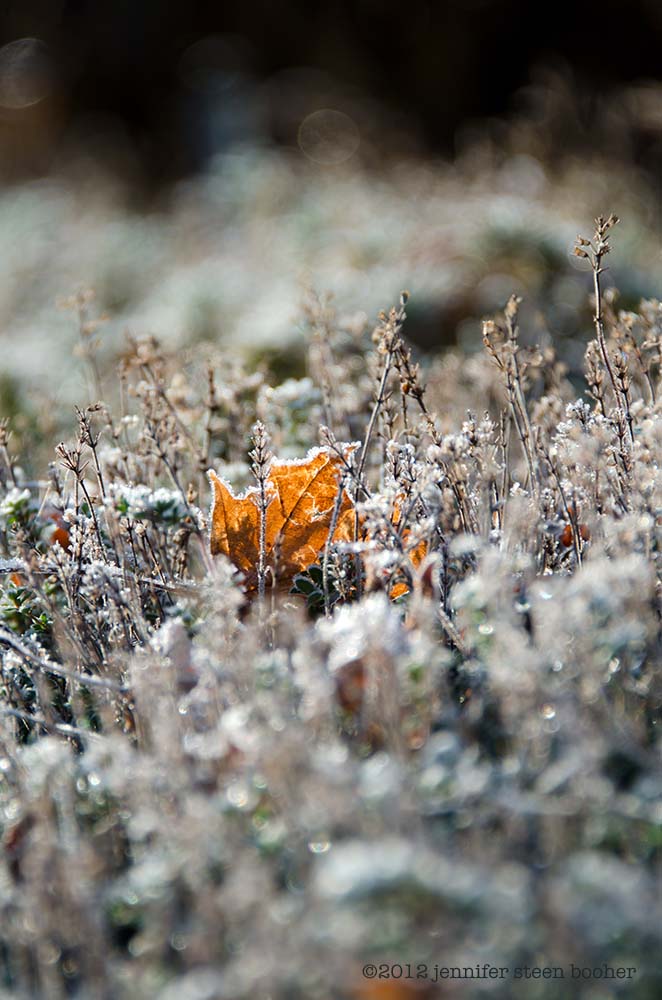
ice crystal hoarfrost leaf edge thyme maple winter Maine
 I’ve found a few interesting web sources on frost: one is at CalTech, another is here, and the last is at Britannica.
frost dusting ice crystal red leaf sparkle winter frozen maine garden
 And then there’s the National Snow and Ice Data Center, for the serious ice nerd, where I just learned the awesome term cryosphere.
Share

Wolf Moon

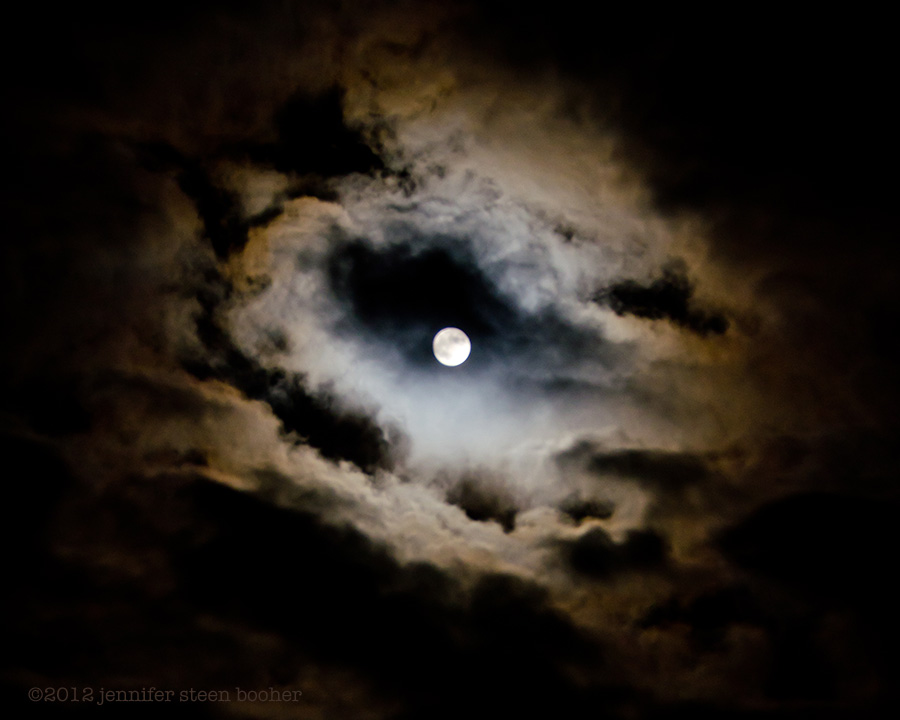
Well, it isn’t really a wolf moon – that’s the January full moon – but boy, doesn’t it look like it’s escaped from a werewolf movie? We couldn’t help howling at it!
 That’s my neighbor’s house over there.

 
This one made me think of William Blake and Gustave Dore – apocalyptic swirlings and hosts of angels readying for battle.
Share

Flames

 As the temperatures drop in the late fall, Mainers play a game of one-upsmanship called “We haven’t turned our furnace on yet.”
 It’s played by … not turning on your furnace even though the nights are dropping below freezing. You can’t get through October without a woodstove, though, or you risk bursting a pipe. The fire keeps the house just warm enough, but you don’t have to burn all that expensive heating oil. The bedrooms are icy, so you wear a hat and fleece socks to bed, but the living room is toasty warm.
The winner saves money and gets bragging rights. We’ve never made it through to Thanksgiving, but it’s so warm this year maybe we’ll set a personal record!

November 5

Temperatures dropped abruptly with a big storm on the way. Game over, furnace on.

Share

Leaf Peeping

I finally took a walk with my camera to catch the last of the fall colors.
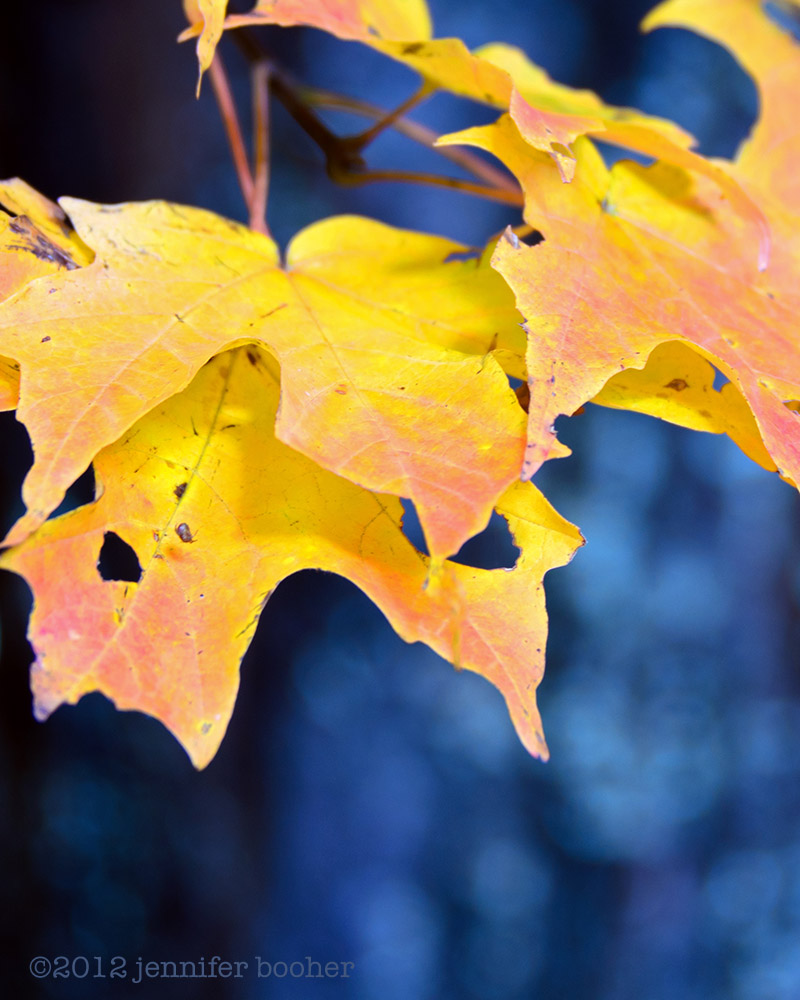
The birches and poplars have finished, the red maples are going bare from the top down, the sugar maples are clinging to their last leaves, the oaks are going straight to brown, and the Norway maples are just starting to turn gold.
 The Burning Bushes (Euonymus alatus) are going bare, but the berries are still vivid.
This Euonymus turned pink instead of red!

 This is a Northern Toothed Polypore tree mushroom colony (Climacodon septentrionale). It isn’t fall foliage, I know, but it’s still amazing! Must have been over two feet across…

Share

The Orionids

Satellite moving through Orion

 Last night was the peak of the annual Orionid meteor shower, and I persuaded some friends to go star-hunting with me very early this morning. There were three reasons for going in the morning:
1. It rained all day Saturday so the evening sky was invisible.
2. The moon set around midnight, and you can see stars better without the moon.
3. The scheduled peak of the shower was just before dawn.

So at 3:30 this morning I peeled myself out of bed to check the sky. It was a warm night for October, with a light breeze. There were clouds on the horizon but the sky was clear, so I woke my daughter (everyone else in the family flatly refused to wake up that early) and we went to get our friends. I had hoped to watch the display from the top of Cadillac Mountain, where we would have had a 360• view and as little light pollution as you can get on the East Coast, but as we turned onto the access road we climbed into a thick fog. Given the height of the mountain, it could have been a low-lying cloud. I’m an optimist, so I dragged everyone to the top, hoping it would clear, but in the end we turned back and settled for the view from Kebo golf course, where there was too much light, but at least a wide view of the sky.

The Orionids are called that because they originate near the constellation Orion, which here in Maine in October is in the southern part of the sky. We set up our chairs, the kids huddled into blankets, and began watching. It certainly isn’t about instant gratification – meteors go so fast you usually see the movement, not the light. Stare into the part of the sky where you expect to see them. Eventually there will be a streak of motion, and everyone will gasp, “Ooh!” while the people who blinked just then will say, “Drat, I missed it!” We probably saw a dozen over the course of half an hour, by which time my daughter was ready to go back to bed.

The streak of light in the photo is probably a satellite, not a meteor, but it is going straight through Orion (it’s just below his belt.) I’m still trying to figure out what the five-star constellation is up there in the upper right of the photo. Canis Major, maybe? or  part of Taurus? Constellation maps always make it look so simple, but when I’m staring at the sky there’s just so much more there!

Astrophotography notes for the curious:
ISO 200
28 seconds
f/4.0
(tripod and wireless shutter trigger)

Share

Animal, Vegetable, Mineral (The Common Ground Fair)

It’s bald, but I think it’s supposed to be like that. Who breeds bald chickens?

The Common Ground Fair is held near the end of September ever year in Unity, Maine. It’s run by the Maine Organic Farmers and Gardeners Association, which should tell you right off this is not the kind of fair with ferris wheels and fried dough.

Quail eggs

Well, no, there is fried dough, but it’s made with whole wheat flour and sweetened with honey or maple syrup. No refined white sugar at the Common Ground! (Plenty of salt, though, so that’s going to have to be the mineral I promised in the title.) I love the CGF, and I’m not sure why, because it’s terribly expensive (for a fair) and since I’m always there with kids I don’t get to go to all the interesting lectures and workshops. Maybe it’s because the animals and produce get star billing? Or because the food is usually amazing? Or there’s such a variety of interesting people to watch?

chicken
A colorful, not-bald chicken. Much prettier. Well, he’s a rooster, so I guess he’s handsome, not pretty.

This year, the 6th graders went to the fair on a school field trip and I went along as a chaperone. I love chaperoning field trips – I usually learn a lot, both about whatever we’re studying and about the kids I’m watching. I’m always torn between photographing and chaperoning, but I haven’t lost any kids yet, and I usually come home with one or two shots worth posting.

Our trip to the fair was a little less organized than our usual National Park trips, though (god bless park rangers, they are so good at crowd control!), and even though I only had six girls who have been best friends since kindergarten, getting them around the fair was like herding cats. The minute we entered, they all headed straight for the rabbit barn, but once we wore out the bunnies (and I flatly refused to let anyone buy a baby rabbit to bring home on the school bus) it was utter chaos. This one wanted these particular french fries and that one saw a doll and wanted to find the booth selling them, and that other one wanted to try hula hoops…. complete madness.

red, crimson, scarlet, yellow
heritage corn varieties
Until we got to the produce section, that is, and the girls discovered these:
squash, yellow, green
Miniature gourds! There were also tiny pumpkins, only a couple of inches tall, and itty bitty honey bears …

oh, I was all set for at least fifteen minutes of peacefully photographing vegetables while the girls zoomed from one booth to another squealing over doll-sized squash. (Apparently the very latest thing in 6th-grade coolness??) So what with one thing and another, I have lots and lots of vegetable photos. Fortunately, the Common Ground Fair farmers specialize in heritage varieties, which are very colorful:

scarlet, red, Native American, Indian Corn
there was red corn, 
 
 purple carrots,

turquoise tomato basket
 orange and red cherry tomatoes,
common ground fair
 blue squash,
carved pumpkin
 and romantic pumpkins! 
(This was done by scratching the words into the pumpkin when it was small. As it grew it produced woody tissue in the cuts.)
Hungry yet?
Share

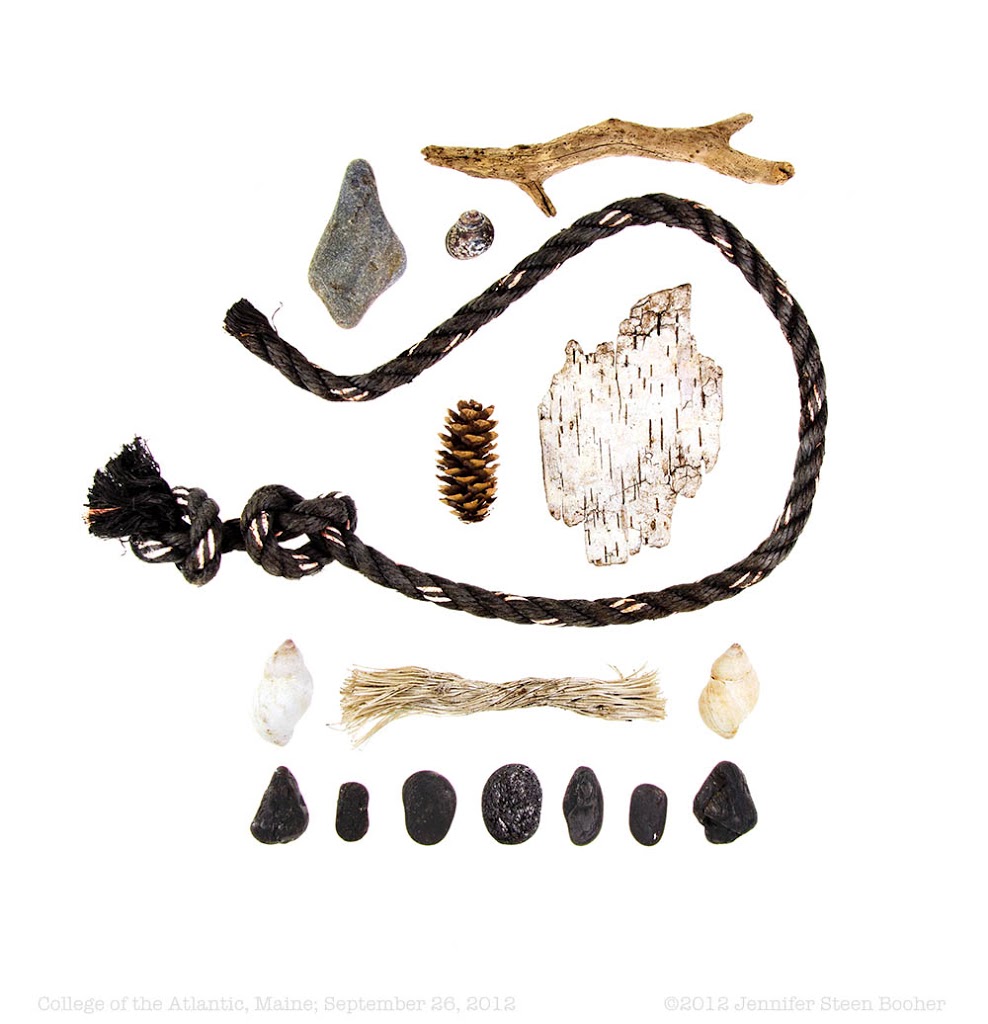
College of the Atlantic (Beachcombing series No.66)

beach stone, driftwood, rope, birch bark, whelk shells, and periwinkle

The College of the Atlantic has one of the most spectacular campuses in the world. Fact! It was patched together from several grand old estates so it still has a couple of Victorian “summer cottages” and even some remnant gardens by Beatrix Farrand. And then there’s the view – it’s set on a bluff overlooking Frenchman Bay, with granite ledges, cliffs, a sturdy dock and a small pebble beach. One of these days I’ll have to give you a photo tour. I end up there more often than I’d expect since my friend Eddie runs a tour boat from the college dock, and my husband keeps Eddie’s sound system running smoothly. So either I’m waiting for a boat ride, as in this post, or waiting for my husband, as I was today.

For some reason, there is always a lot of sea coal on this little beach, and last time I wrote about it, I’d been killing time by drawing on stones.

When I finished beachcombing this time (which didn’t take long because at high tide the beach is just big enough to hold the school kayaks) I played with stones again.

Happy rocks!

In the still life: Fishing ropes, schist beach stone, Dog Whelks (Nucella lapillus), sea coal, driftwood, Common Periwinkle (Littorina littorea), cone (possibly Hemlock), birch bark (Betula papyrifera)

Share

Rainbows, September 4, 2012

Our family had gathered to celebrate my father-in-law’s birthday when we were distracted by the drama unfolding in the sky.

First a fragment of rainbow began to spring upward from Ironbound Island. Then a second rainbow shot off at a funny angle. It was a reflection rainbow, a very rare phenomenon that occurs when the sunlight forming a primary rainbow reflects off a very large and still body of water. All rainbows are full circles (cones, really) of which we only see a portion. The center of a reflection rainbow is above the horizon, whereas the primary rainbow’s center is below it, which is why that arc is at such an unexpected angle.

The base of the arch was so crisp we could see the point where it ‘touched’ the water. It looks so physical that it’s hard to comprehend the optical effect that’s happening. Did you know that because rainbows are an optical effect, they only exist in our own eyes, and no two people truly see the same rainbow? It isn’t like fog, which is a physical thing. If there were no viewers, there would be no rainbow. Contemplating the physics of rainbows is my personal Twilight Zone. Try to imagine the giant cone of light refracting through the raindrops and concentrating itself on your pupil. Always makes me blink.

The primary rainbow kept growing, and a classic double rainbow appeared, except we already had the reflection rainbow, so it was a triple show.

After half an hour or so, the rainbow spanned the whole bay. The other end touched down somewhere near town. Talk about good omens – I think my father-in-law is in for a very special year!

Share

South of Welshpool Wharf, Campobello; June 10, 2012

It was our last day on Campobello Island and I set out to explore the area south of the wharf. My husband is an amazing trumpet player and wanted to practice, so he stationed himself near the wharf building, which was deserted since it was Sunday morning.
The clouds scudded overhead and the light changed rapidly from cold grey to warm gold,
and I poked through the detritus on the beach as the Harry James Trumpet Concerto echoed through the crescent-shaped bay.

I’ve never had a musical accompaniment before – it was beautiful.


I had plenty of company. There were the usual seagulls,

and a pair of cormorants,

several spiders,

and a moth.

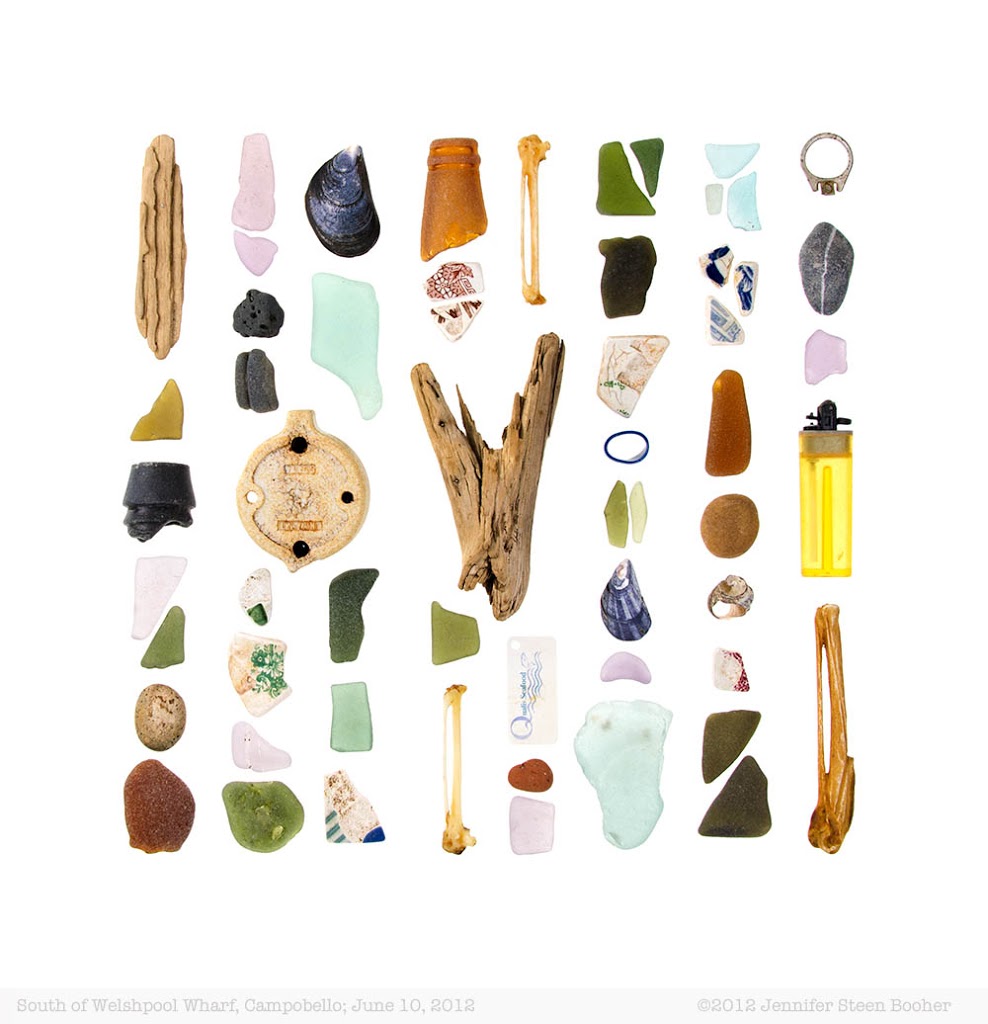
And as you can see from the first photo, there was an amazing amount of sea glass!

In the still life: Driftwood, sea glass, granite and schist beach stones, Blue Mussel (Mytilus edulis), industrial ceramic cover, possibly from the Bryant Electric Co. (1888-present), porcelain, bird bones, seafood industry label, lobster-claw band, Rough Periwinkle (Littorina saxatilis), soda can pull tab, and plastic lighter

Share