The Coast Walk Project

Blog

Bonus post: The Christmas Walk


web©-IMG_3250

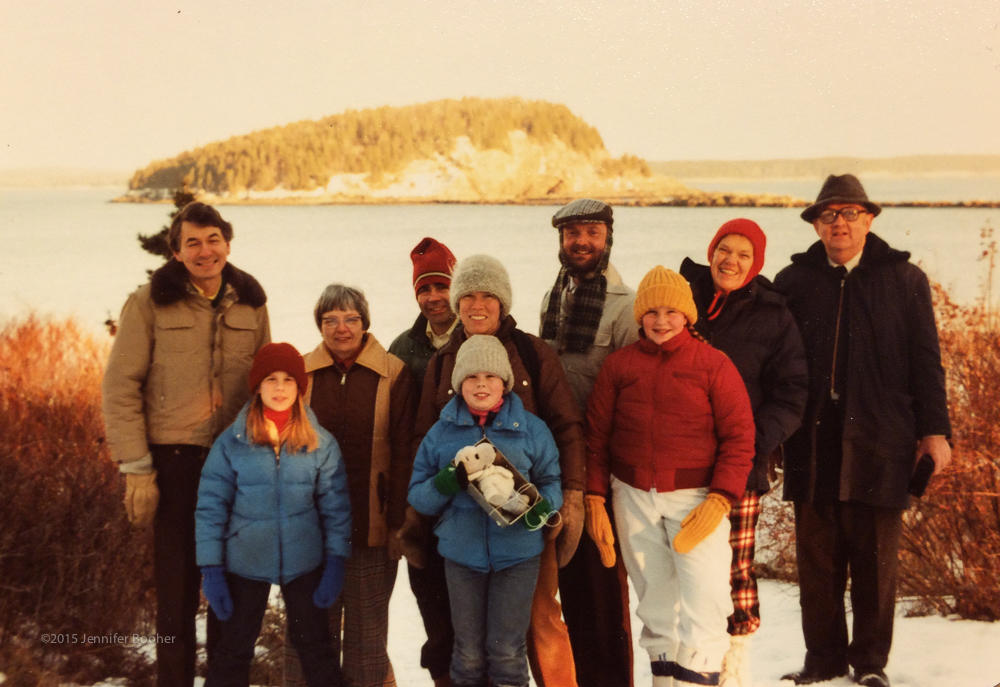
1976: Wendy Booher, Megan Smith, Heather Smith, Brian Booher

According to my mother-in-law, it started like this:

Way back in December 1972, when she and her husband were new arrivals in Bar Harbor with two young children, they walked into the old Acadian Sandwich Shop one evening. Chad and Marion Smith, who also had two young children, were the only other customers there. Megan, the youngest Smith, was in an infant seat on the table, and Wendy and Heather forged a friendship rampaging around the empty restaurant. Mary doesn’t remember what Brian was doing, but knowing him I’m sure if he wasn’t actively rampaging he was instigating it.

web©-IMG_3251

1981: Bob Chaplin, Heather Smith, Anna Ryan, Chad Smith, Marion Smith, Megan Smith, Dean Booher, Wendy Booher, Hilda Roderick, Tom Roderick

Either way, the families became friends, and in 1974 they all agreed that with four little kids hyped on Christmas cookies and presents, it would be crucial to get out of the house on Christmas Day. More or less in self-defense, they planned a group walk on the Shore Path.

web©-IMG_3252

1987:  Back row: Bob Chaplin, Dean Booher, Brian Booher, Connie Blaney, Michael Blaney, Wendy Booher, Dennis Weber.  Middle row: Cathy Dorrity, Jeannie Higgins in blue hat, Heather Smith, ? on crutches, Michelle Blaney, Danielle Blaney in pink scarf, Deb Weber in yellow coat, Megan Weber, Kara Blaney in white hat.  Front rows: Marion Smith in white hat, ? in grey vest, Anna Ryan, Deborah Page, Megan Smith, Brian Weber sticking tongue out, Chad Smith, David Blaney.

The tactic worked (at least for the grownups) and the Christmas Walk was born. For the next forty-odd years, at noon on Christmas Day, the Boohers, Smiths, and a growing group of family and friends bundled up and walked the Shore Path. I think my first year was 1989, when I started dating Brian. The Boohers are hardier folk than my own people (we Steens tend to curl up with a good book when left to ourselves), and the Christmas Walk happens whatever the weather. We’ve trekked trough deep snow, no snow, sheer ice, no ice, stiff winds, no wind, bitter cold, pouring rain, freezing rain, and snowstorms. Now and then there’s even sunshine! Sometime before I joined the group had started bringing hot chocolate and cookies for a picnic at the walk’s midpoint (usually the Bar Harbor Inn.) This picnic also happens regardless of weather.

web©-IMG_3253

1998: 32 people, not even gonna try

In 1998, Brian and I brought along the Christmas Walk’s second generation – that’s me holding 7-month-old Christopher in the front row. The people at the ends of the rows are holding their arms out to include absent friends.

web©-IMG_3254

2000: I count 43 people, including multiple infants – Tabitha, almost 2 months old, is zipped up inside my coat at far left, which is why I look like a whale.

This year it was 33ºF (0ºC) with a stiff wind from the east and a wind chill of 22ºF (-5ºC).  It was the smallest group we’ve had since 1976! As the kids grew up, went to college, got jobs, married, and started their own families they moved all around the country, and Brian is the only one who has moved back to town. The other three are scattered from Utah to Madrid, and only occasionally make it back for Christmas. As the second generation grows up, we’ll see where they settle, but since the oldest is only 18, the third generation is still (ahem, had better be) a ways off.

2016: Me, Anna Ryan, Carol Woolman, Dean Booher, Brian Booher, Bob Chaplin, Mary Booher, and Tabitha Booher.

Anyway, consider yourself invited for 2017: remember, it’s noon on Christmas Day – bundle up – bring cookies – send me a message and I’ll tell you where we’re meeting!

Save

Save

Save

Save

Save

Save

Save

Save

Save

Save

Save

Share

Coast Walk 15: Seal Harbor to Bracy Cove

Seal Harbor Beach, Maine, sunrise

October 20, 2016: 6:30am-12pm. Started just about sunrise, 46ºF (8ºC), slight breeze from shore, a few clouds. Warmed up a bit as the sun rose and turned into a gorgeous autumn day. Black Backed Gull, 4 Loon, 5 Great Cormorants (they might have been Double-Crested Cormorants) 2 crows, and an unidentified dead fish.

cw15map-web

Please note that the whole Point is private property. And many, many thanks to Sue Ferrante-Collier and to Steve Pinkham for their assistance in contacting people for permission to cross these properties!

web-_dsc6572-edit

Walker: Kenn Chandler, builder. I met Kenn through the MDI Photo Club, where he is the outings coordinator. He was one of the first people outside of my family to discover the Coast Walk, and when you’ve just started an insanely complex and time-consuming project, having a stranger come up to you and say, “Are you the one doing the Coast Walk? I love it!” makes you feel like a rock star. Kenn has a very special place in my heart!

SealHarborSunrise

We met at the Seal Harbor beach just as the sun was rising, and headed out toward the western point. The tiny island in the center of the photo above is called Little Thrumbcap, and I’ve wanted to explore it ever since I first saw it. (‘What’s a Thrumcap?‘)

web-_dsc6582-editKenn moved to the island in 1971: “My Grandma, Winifred Dole Mann, had a summer place in Southwest Harbor.  My family always came up for visits in the summer and loved it.  Her driving skills had deteriorated pretty badly and she was pleaded with to stop driving.  When she was 90 she threw her drivers license in the fire on Christmas of 1971  and whined that she was giving up her freedom.  She wanted someone to help her in her retirement to Maine.  Both my sister Janet and I volunteered and it wasn’t long before my love affair with Maine and the island were established.”

web-_dsc6592-edit

“When we came to Southwest Harbor to visit my Grandma, we were on vacation for the most part.  We used to fish a lot in Norwood Cove from the old wooden punt, sometimes to eat and sometimes for fun.  A couple times my sister and I were instructed to catch enough flounder for the family for dinner.  It was easy fishing.  We would pick a few mussels and put them on hooks with sinkers, let them down to the bottom (4-6 ft deep) and reel them in as fast as we could.  Everyone was quite pleased.  That is, until I read your Coast Walk 3 about the overboard discharge.  It makes sense though, bottom feeders, but who wants to look a gift horse (or fish) in the mouth?”


web-_dsc6632-edit

Kenn and I had a conflict of opinion on the Point’s name – I had always called it Dodge Point (because of Dodge Point Road) but he knows it as Crowninshield Point. I poked around and found that the Dodges had a house there in the 1860s, and Commander Crowninshield built a house out at the very tip in 1885.

George N. Colby, 1887

George N. Colby, 1887

Maps show both names, but as you can see on the map at the beginning of this post, Google calls it Crowninshield, so I guess Kenn won that round.

Edward L. Rand, 1893

Edward L. Rand, 1893

Bates, 1917

Waldron Bates, 1917

We couldn’t see it from the shore, but I knew we were passing pretty close to St Jude’s Episcopal church. Built in 1887, it was the first church in Seal Harbor. It’s part of the Parish of St. Mary and St. Jude, which is based in Northeast Harbor, and still holds services in July and August.

Photo from Vandenbergh and Shettleworth, Revisiting Seal Harbor.

St. Jude’s.  Photo from Vandenbergh and Shettleworth, Revisiting Seal Harbor.

Another landmark that’s just out of sight from the shore is the congregational church, which was built in 1902.

Bechtle, Isabel K., A Church for Seal Harbor, Northeast Reprographics, Bangor, ME, 2002

photo from Bechtel, A Church for Seal Harbor

Putting together what I’ve read in the history of both churches (see Works Cited), it sounds like up to that point, Seal Harbor was geographically isolated from the other towns on MDI and more closely related to the Cranberry Islands (it’s a straight shot across the water to Islesford.) While Northeast Harbor residents could row across the Sound to Southwest for Sunday services, Seal Harbor people don’t seem to have gone to church regularly. In 1887, when St. Jude’s was built, 100 out of 118 residents were unbaptized. (Hansen, p.24) The increasing summer population seems to have reached a tipping point in the 1880s, and a church became a necessary amenity.

Photo courtesy of the Seal Harbor Library

(Undated photo of Crowninshield Point.) Photo courtesy of the Seal Harbor Library

web-_dsc6601-edit


web-_dsc6611-edit

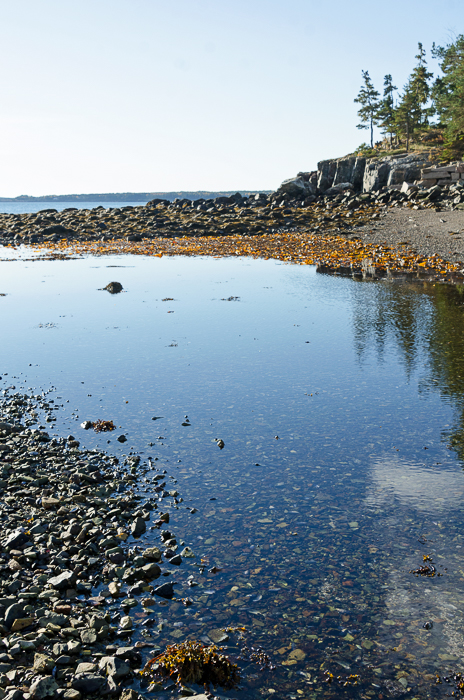
Our progress was very slow at first, not just because of the thick seaweed but because we are both photographers and walking into the rising sun made for some glorious back light:_dsc6638-web

web-_dsc6634-edit

web-_dsc6701-edit

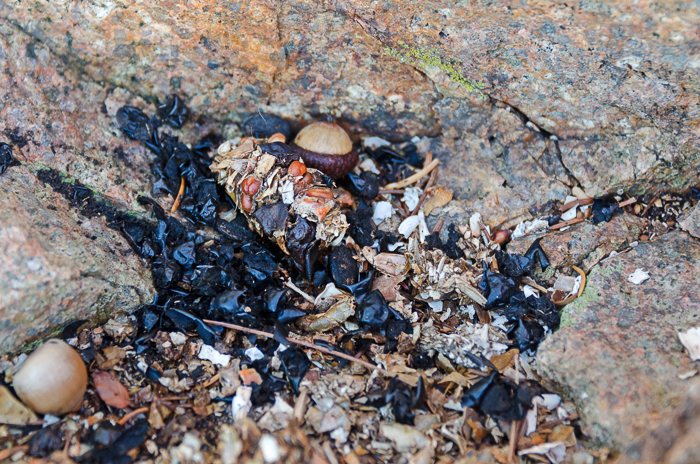
We ran across a stash of the scat that’s been puzzling me – I think it’s either otter or raccoon – this time with lots of berries in it as well as crab shells. (I have other photos with more crab shells but this post is already wicked long!)

web-_dsc6626-edit

We watched a Great Blue Heron catch a crab:

web-_dsc6664-edit

and tear it apart:

web-_dsc6681-edit

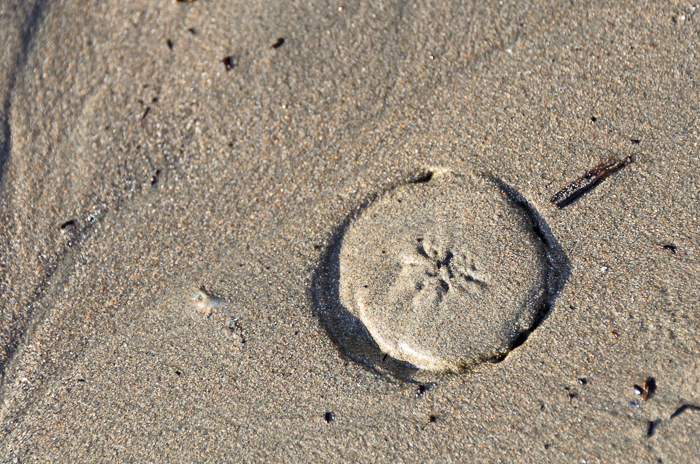
We also spotted several sand dollars trying to dig themselves into the sand:

web-_dsc6686-edit

In spite of all the distractions, we eventually reached the tip of the point, and Thrumbcap Island:

web-_dsc6704-edit

web-_dsc6716-edit

web-_dsc6726-edit

web-_dsc6776-edit

web-_dsc6769-edit

web-_dsc6747-edit  web-_dsc6731-edit

web-_dsc6795-edit

The geology out on the point was remarkable – we were clearly back in the Shatter Zone:

web_dsc6754-edit

web_dsc6802-edit


As we worked our way around the outer edge of the point, we crossed a beautiful little cobble beach:

web-_dsc6803-edit

web-_dsc6814-edit

web-_dsc6824-edit

web-_dsc6830-edit

web-_dsc6833-edit

web-_dsc6845-edit

And then we finally rounded the point and looked into Bracy Cove:

web-_dsc6865-edit

There’s enough history here that Bracy Cove is going to get its own post – there’s no trace of it now, but this was a town before Seal Harbor was! Tune in next time for that post…

Meanwhile, more cool geology:

web_dsc6858-edit

web_dsc6867-edit


Halfway along the point, we reached the Harbor Club:

Photo courtesy of the Seal Harbor Library

The Harbor Club. Photo courtesy of the Seal Harbor Library

The main building was designed by Duncan Candler, who also did Skylands and the boathouse on Little Long Pond.

Seal Harbor Club ca. 1926. Photo from Vandenbergh and Shettleworth, Revisiting Seal Harbor.

The Harbor Club in 1927. Photo from Vandenbergh and Shettleworth, Revisiting Seal Harbor.

The club opened in 1926 with a swimming pool (which soon became a heated pool) and tennis courts. Rental cottages were added in 1956 (tenants had to be approved by the club board).

Image from Heckscher, The Harbor Club, 1995.

Image from Heckscher, The Harbor Club, 1995.

There’s a surprisingly awesome book about the club at the Seal Harbor Library – much more readable and entertaining than the church histories! I kind of wanted to quote long passages from it here but I’ll have to give you just a small taste:

Image from Heckscher, The Harbor Club, 1995.

Image from Heckscher, The Harbor Club, 1995.

Image from Heckscher, The Harbor Club, 1995.

Image from Heckscher, The Harbor Club, 1995.

Image from Heckscher, The Harbor Club, 1995.

Image from Heckscher, The Harbor Club, 1995.

Lately I seem to be digressing more than usual in my research, or maybe I’m just sharing more of those digressions with you. Here’s a classic: while writing the bibliography for this post I accidentally googled the name of the Harbor Club history’s author, August Heckscher, and discovered that he was a journalist, arts administrator, sailor, and remarkably, a master printmaker whose atelier, The Printing Office at High Loft (run from his summer home in Seal Harbor) produced enough artist books to have its own archive at the New York Public Library.  You can read more about him in this Chebacco article.

from Carl Little, "August Hecksher, A Man About the World - and Mount Desert Island,"

from Carl Little, “August Hecksher, A Man About the World – and Mount Desert Island,”

web-_dsc6883-edit

web-_dsc6898-edit

A vivid patch of red maple, sumac, and wild roses gave us a last flurry of fall color photos:

web_dsc6890-edit

web-_dsc6891-edit

web-_dsc6915-edit

web-_dsc6894-edit

And six hours after we started, we were shuffling wearily up the stones of Bracy Cove to our car.

web-_dsc6916-edit

Kenn: “I distinctly remember pulling on to the seawall at Bracy Cove and parking to watch the waves and listen to the popples roll around in storms.  I first did this with my Grandma in her 1968 Ford Custom so that would have been in the early to mid 70’s.  I also remember cruising by in my GMC pickup and seeing over the top of the seawall all the way along.  We had a huge winter storm sometime around 1980 that covered the road in stones and left a seawall maybe 8 feet high all across the beach.  The state came out with snowplows to push the rocks off the road.  There was no parking anywhere on the water side of the road there for many years after that.”

_____________________________________________________

WORKS CITED

Bechtle, Isabel K., A Church for Seal Harbor, Northeast Reprographics, Bangor, ME, 2002.

Colby & Stuart, hand-drawn “Map of Mount Desert Island,” 1887.  Original in the Northeast Harbor Library Archives.

Hansen, Gunnar, Not a Common House: A History of St. Mary’s-by-the-Sea, privately printed, 1981. (pdf available for download at the link)

Heckscher, August, The Harbor Club, A History, Augusta, ME, J.S.McCarthy Co., 1995.

Little, Carl, “August Heckscher, A Man About the World – and Mount Desert Island,” Chebacco: The Magazine of the Mount Desert Island Historical Society,
Vol. VIII, 2006-2007. (pdf available for download at link)

Stebbins, George, “Random notes on the early history and development as a summer resort of Mount Desert Island and particularly Seal Harbor,”(typescript of a speech), August 1938. [MSS in Northeast Harbor Library Archives.]

Vandenbergh, Lydia and Shettleworth, Jr., Earle, Revisiting Seal Harbor and Acadia National Park, Arcadia Publishing, Charleston, SC, 1997.

Save

Save

Save

Save

Save

Save

Save

Save

Save

Save

Save

Save

Save

Save

Save

Save

Save

Save

Save

Save

Save

Save

Save

Save

Save

Save

Save

Save

Save

Save

Save

Save

Share

Great news! 2017 Kindling Fund Grants Awarded

You guys, I got a grant! Woohoo, wireless microphones at last! No more interviews lost to waves and wind noise! Exclamation points for all!

Many, many thanks to SPACE Gallery, the administrators of the fund. You can learn more about the Kindling Fund and the other 2017 grant recipients here: http://kindlingfund.org/announcing-2017-kindling-fund-grantees/

There will, of course, be a party (aka an awards reception) on Tuesday, January 10, from 5:30-7:30pm at SPACE Gallery in Portland, Maine. I can’t wait to meet the other artists. Everybody come!

______________

UPDATE: Dec. 21

The party date has changed to January 24.

Share

Addenda: Completely irrelevant 19th-century newspaper stories

You guys know I do a lot of research for this project, right? I stumble across an overwhelming number of fascinating articles and photos that have nothing to do with the coast of MDI, and usually I just put them to one side and try to stay on topic, which right now would be the stretch between Seal Harbor and Bracy Cove. I’m working on it, really I am: I spent some quality time with the archives of the Northeast Harbor Library, and found all kinds of relevant stuff. I just could not resist sharing these gems from the newspaper archives with you.

The Island Herald, Northeast Harbor, Sept.2, 1904. Image courtesy of the Northeast Harbor Library

The Island Herald, Northeast Harbor, Sept.2, 1904. Image courtesy of the Northeast Harbor Library

The Island Breeze, Southwest Harbor, July 21, 1897. Image courtesy of the Northeast Harbor Library Archives.

The Island Breeze, Southwest Harbor, July 21, 1897. Image courtesy of the Northeast Harbor Library Archives.


The Island Herald, Northeast Harbor, Maine, Friday, August 26, 1904. Image courtesy of the Northeast Harbor Library

The Island Herald, Northeast Harbor, Maine, Friday, August 26, 1904. Image courtesy of the Northeast Harbor Library


The Island Breeze, Southwest Harbor, August 25, 1898. Image courtesy of the Northeast Harbor Library Archives.

The Island Breeze, Southwest Harbor, August 25, 1898. Image courtesy of the Northeast Harbor Library Archives.


The Island Herald, Northeast Harbor, Maine, Friday, August 26, 1904. Image courtesy of the Northeast Harbor Library

The Island Herald, Northeast Harbor, Maine, Friday, August 26, 1904. Image courtesy of the Northeast Harbor Library


The Island Breeze, Southwest Harbor, June 16, 1897. Image courtesy of the Northeast Harbor Library

The Island Breeze, Southwest Harbor, June 16, 1897. Image courtesy of the Northeast Harbor Library


The Island Breeze, Southwest Harbor, July 21, 1897. Image courtesy of the Northeast Harbor Library Archives.

The Island Breeze, Southwest Harbor, July 21, 1897. Image courtesy of the Northeast Harbor Library Archives.


The Island Herald, Northeast Harbor, Sept.2, 1904. Image courtesy of the Northeast Harbor Library

The Island Herald, Northeast Harbor, Sept.2, 1904. Image courtesy of the Northeast Harbor Library

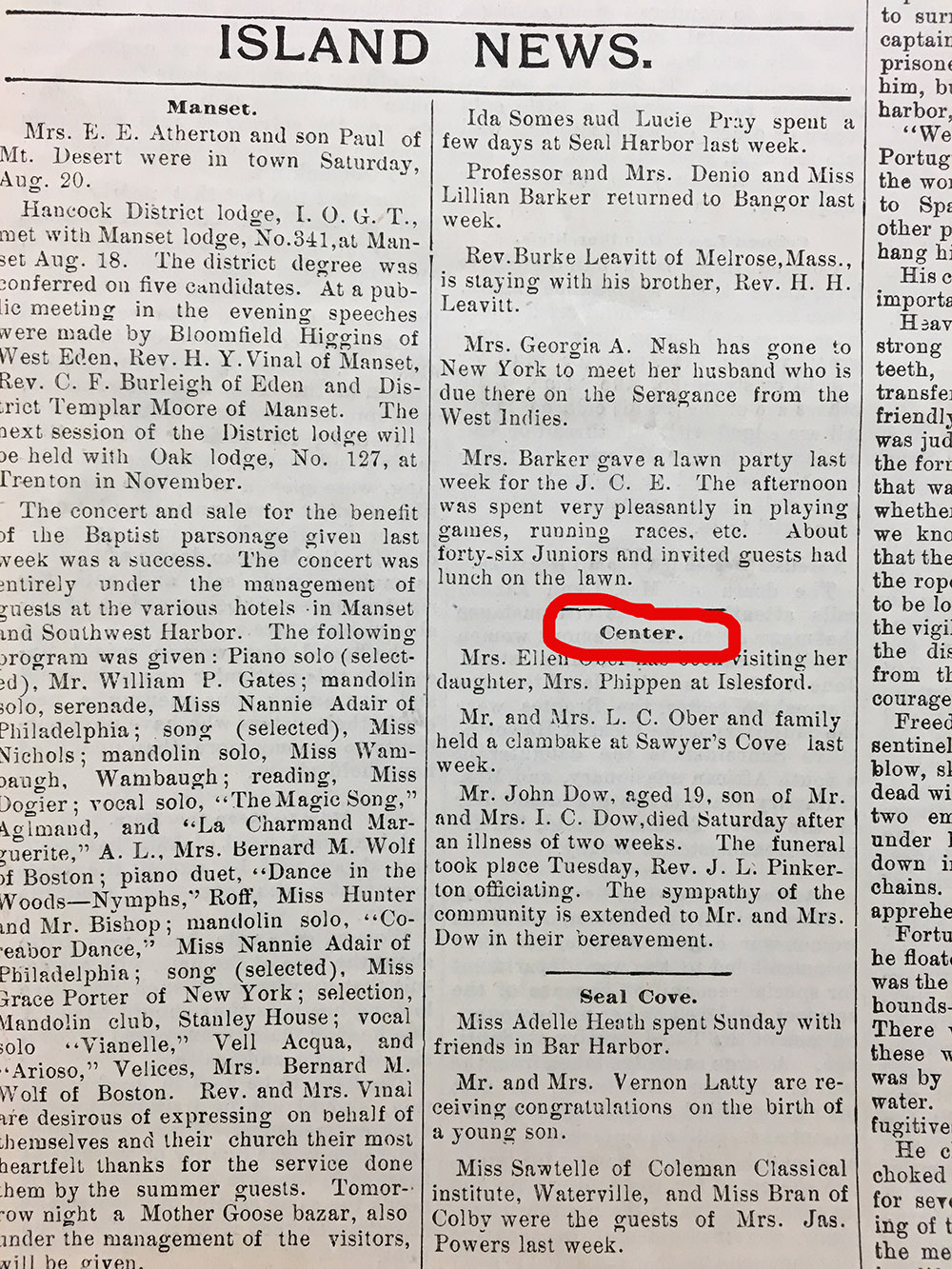
And this one sent Hannah Stevens (the library’s archivist) and myself off on a hunt to find the lost island town of Center:

The Island Breeze, Southwest Harbor, August 25, 1898. Image courtesy of the Northeast Harbor Library Archives.

The Island Breeze, Southwest Harbor, August 25, 1898. Image courtesy of the Northeast Harbor Library Archives.

Which we eventually found on an enormous, hand-drawn map dated 1887:

Hand-drawn "Map of Mount Desert Island," Colby & Stuart, 1887. Image courtesy of the Northeast Harbor Library

Hand-drawn “Map of Mount Desert Island,” Colby & Stuart, 1887. Image courtesy of the Northeast Harbor Library

Center even had its own post office! Clearly I’ll be investigating this when I reach the Seal Cove area.

Hand-drawn "Map of Mount Desert Island," Colby & Stuart, 1887. Image courtesy of the Northeast Harbor Library

Hand-drawn “Map of Mount Desert Island,” Colby & Stuart, 1887. Image courtesy of the Northeast Harbor Library

This map, by the way, is about 6′ tall and filled with this kind of insane detail for the entire island. I spent a long time staring at it, and you’ll be seeing details of it in pretty much every post for the rest of my life this project.

Save

Save

Save

Share

Update and Addenda, November 6, 2016

Seal Harbor Beach, Maine, sunrise

On October 20, Kenn Chandler and I hiked around Crowninshield and Dodge Point from Seal Harbor Beach to Bracy Cove. There’s a lot of history in that area, so it’s taking me a long time to write up, plus I keeping finding all kinds of interesting things about areas I’ve already written about, so this is just a short update post to let you know things are still moving behind the scenes. It took about 4 months to gather permissions to hike this section, and I am so grateful to the people who helped – special thanks to Sue Ferrante-Collier and Steve Pinkham! Stay tuned for that post, and to tide you over, here are a few cool finds for Schooner Head:

Addenda for Coast Walk 7: Schooner Head

from "Opulence to Ashes: Bar Harbor's Gilded Century" by Lydia Vandenbergh

The Lynam farm. Photo from “Opulence to Ashes: Bar Harbor’s Gilded Century” by Lydia Vandenbergh

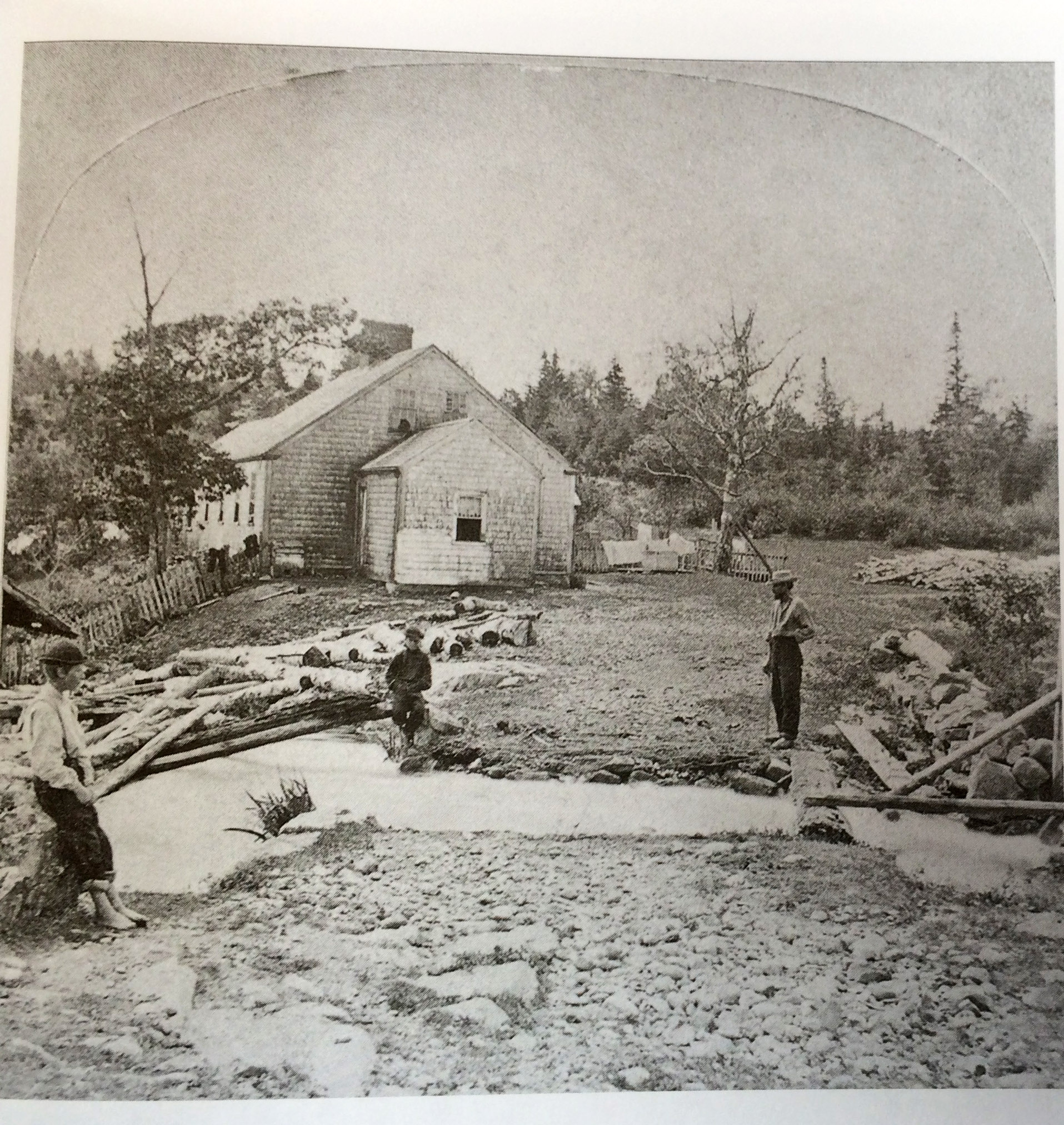
The first European settlers on Schooner Head were William Lynam and Hannah Tracy. Married in Gouldsboro, they moved to MDI in 1831 and started a hundred-acre farm on Schooner Head. [As a side note, can I say how much it irritates me when history books say that male settlers came to the island and brought their wives with them? I don’t think any pioneer farm survived unless it was a joint enterprise, so can we please just start saying ‘they’ instead of ‘he?’]  There were few inns on the island until later in the 19th century, and the earliest tourists often boarded with local families, including the Lynams. Several of the early artists who visited (including Frederic Church, I think) stayed here.

from "Opulence to Ashes: Bar Harbor's Gilded Century" by Lydia Vandenbergh

Outbuildings of the Lynam farm, with a fish oil press in the foreground. Photo from “Opulence to Ashes: Bar Harbor’s Gilded Century” by Lydia Vandenbergh.

from "Opulence to Ashes: Bar Harbor's Gilded Century" by Lydia Vandenbergh

Sawmill on the Lynam farm. Photo from “Opulence to Ashes: Bar Harbor’s Gilded Century” by Lydia Vandenbergh

'Schooner Head and Lynam Farm,' Frederic E. Church, 1850-51. From "The Artist's Mount Desert" by John Wilmerding

‘Schooner Head and Lynam Farm,’ Frederic E. Church, 1850-51. From “The Artist’s Mount Desert” by John Wilmerding

Charles Tracy, a New York lawyer and one of the earliest tourists to MDI, kept a diary of his visit here in 1855. Here are his descriptions of Schooner Head and the Lynam family:

from "The Tracy Log Book 1855" edited by Anne Mazlish

from “The Tracy Log Book 1855” edited by Anne Mazlish

from "The Tracy Log Book 1855" edited by Anne Mazlish

from “The Tracy Log Book 1855” edited by Anne Mazlish

You may already know some of this, but a whole web of connections spreads out from that 1855 visit. Charles Tracy’s daughter Fanny, who traveled with him, later married J.P.Morgan. She brought him to Mount Desert Island for their honeymoon, they built a house here, and most of the senior members of his firm (the ‘Morgan Men’) started summering here and building houses. The Morgans bought Great Head for their daughter, Louisa Satterlee (see Coast Walk 8) – her children donated it to the National Park.  Alessandro Fabbri, whose WWI transatlantic radio station we talked about in Otter Creek, was the son of one of those Morgan Men. So the web goes from brown bread at the Lynam farmhouse to Gilded Age cottages along West Street to submarines in Otter Cove. Crazy, isn’t it, what one tourist started?


Works Cited

Mazlish, Anne, ed., The Tracy Log Book 1855: A Month in Summer, Acadia Publishing Co., 1997.

Vandenbergh, Lydia, Opulence to Ashes: Bar Harbor’s Gilded Century, Downeast Books, 2009.

Wilmerding, John, The Artist’s Mount Desert, Princeton University Press, 1995.

Save

Save

Save

Save

Share

Coast Walk 14: Seal Harbor Town Dock to Seal Harbor Beach

web-_DSC3170-Edit


CW 14 copy

December 21, 12-2pm. 49 degrees, blustery and overcast with patches of sun. Sun glowing grey behind clouds, ice seeping out of some ledges.


web-_DSC3132-Edit

Walkers: Brenda Beckett, PA-C, MDI Hospital, & Captain, Acadia Photo Safari; Howie Motenko, Software Engineer, Jackson Laboratory, & photography expedition leader, Acadia Photo Safari. Howie is also working on a long-term photography project called Painting Islands. Brenda first joined the Coast Walk in February 2105.

Image from "Northeast and Seal Harbors, Mount Desert, Maine" souvenir photo booklet, courtesy of the Northeast Harbor Library

Seaside Hotel at left and Glencove hotel at right. Image from “Northeast and Seal Harbors, Mount Desert, Maine” souvenir photo booklet, courtesy of the Northeast Harbor Library.

The last Coast Walk ended at the Seal Harbor Town Dock, and since then I’ve done a ton of research on the area. If you haven’t seen it yet, I just published an ‘Addenda’ page with everything I learned about the eastern part of the harbor that I wish I’d found before the walk from Hunters Beach. Let’s start today’s walk with a a quick primer on Seal Harbor history (mostly from Revisiting Seal Harbor, bibliography at bottom of post) before we start on the Coast Walk proper:

• The first European settler was John Clement of Bucksport. Clement was a cooper and built a workshop on the beach in 1809 and a house on Ox Hill. The house burned in 1817, and the Clements rebuilt close to the beach.

•First ‘town’ area was at Bracy Cove in the 1860s. More about that when we get to Bracy Cove.

Seaside-web

‘Seaside House,’ the Clement family boarding house. Photo from Vandenbergh and Shettleworth, Revisiting Seal Harbor

• In 1875 the Clement family quit coopering and fishing and remodeled their home as a boarding house for 10 boarders, calling it ‘Seaside House.’ They promoted Seal Harbor as less fashionable, slower paced and more rustic than Bar Harbor, and it gained a reputation as an intellectual resort. Scientists, artists, musicians, and writers gathered in the public rooms. The Clements were very successful, enlarged the inn several times, and eventually built a much larger, fancier place called the ‘Seaside Inn’ to distinguish it from the ‘Seaside House.’ You can see both here:

Photo courtesy of the Seal Harbor Library

The Seaside Inn is at left, and the Seaside House is at right. No idea who the house in the middle belonged to. Photo courtesy of the Seal Harbor Library.

•In 1884 Captain Edwin Lynam and Robert Campbell opened the Glencove Hotel at the other end of the beach. This one was apparently even more appealing to the intelligentsia, and “the scholarly atmosphere was said to be such that bellboys often conversed with guests in Latin. ” (May, Johns Hopkins Magazine, 1995) On a side note, the article quoted is an essay on Thomas Eakins’ visit to Seal Harbor while painting a portrait of Dr. Henry Rowland, and has some great anecdotes about life in Seal Harbor in 1897. The full text is online – check it out.

Image from "Northeast and Seal Harbors, Mount Desert, Maine" souvenir photo booklet, courtesy of the Northeast Harbor Library

Image from “Northeast and Seal Harbors, Mount Desert, Maine” souvenir photo booklet, courtesy of the Northeast Harbor Library

webMap1887GeorgeNColbyDetail

Detail of George N. Colby map, 1887, showing the location of the hotels and stores.


web_DSC5480-Edit

The town dock as it is now. I took this photo in August because I hadn’t gotten a good one on the December walk. I’m sorry about all the time-jumping. Pretend we’re in a TARDIS, ok?

Which brings us at last to the town dock, which was built in 1882 as a landing for the Eastern Steamship Company, which provided weekly service from Rockland on the Mount Desert.

steamer-SH-Lib-Web-1-

I believe this is the ‘Mount Desert,’ which was a side-paddle steamer. Photo courtesy of the Seal Harbor Library.

In 1893, a group of businessmen, including George Cooksey, built the Golden Rod to run daily circuits between the Mount Desert Island resorts, and in 1903 the steamer J.T.Morse was brought into service and ran until 1933, when autos became the main form of transport to the island.

Steamship-Wharf-SH-Lib-Web-263

The J.T. Morse at the Seal Harbor dock sometime before 1920. Photo courtesy of the Seal Harbor Library.

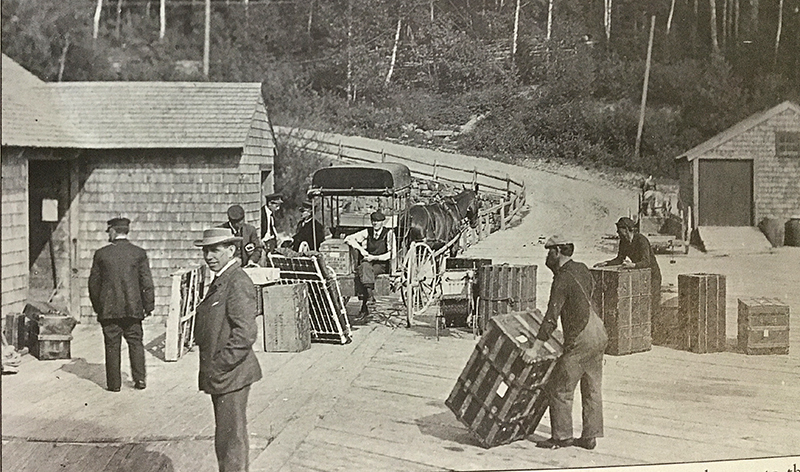
Photo from Vandenbergh and Shettleworth, Revisiting Seal Harbor, 1997.

Unloading trunks and baggage circa 1905. Photo from Vandenbergh and Shettleworth, Revisiting Seal Harbor, 1997.

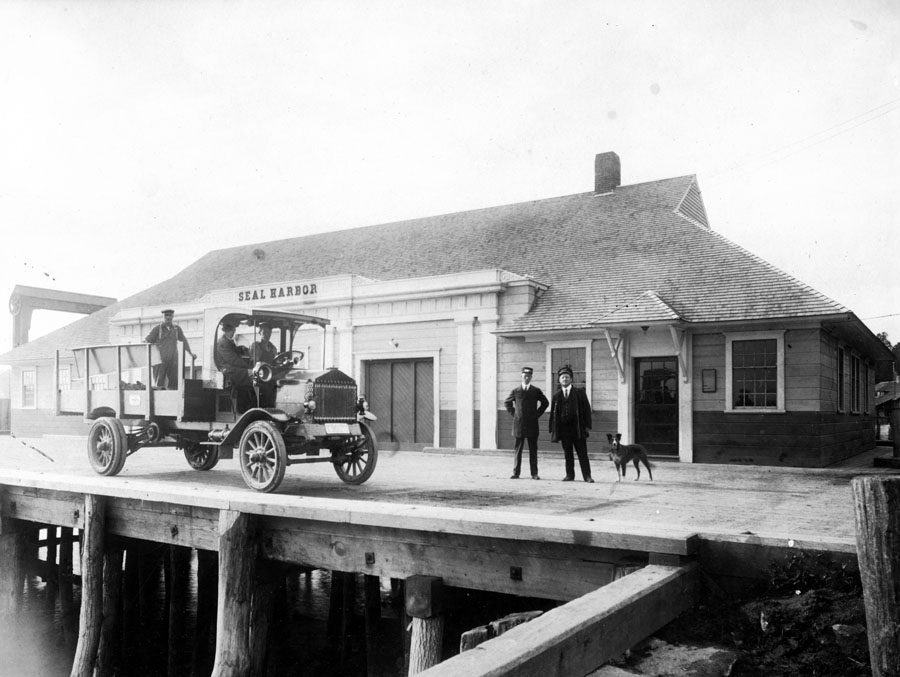
Photo courtesy of the Seal Harbor Library.

The Eastern Steamship wharf circa 1920. Photo courtesy of the Seal Harbor Library.

After the steamship era passed, the wharf became the Acadia Pier in the mid-1930s. It sounds something like the current Islesford Dock – a seafood restaurant and boating destination. The Acadia Pier was popular until WWII gas rationing killed a lot of tourism. It was dismantled in 1945, bought by the town at some point and rebuilt as the town dock.

Photo from Vandenbergh and Shettleworth, Revisiting Seal Harbor, 1997.

Photo from Vandenbergh and Shettleworth, Revisiting Seal Harbor, 1997.

Photo from Vandenbergh and Shettleworth, Revisiting Seal Harbor, 1997.

Photo from Vandenbergh and Shettleworth, Revisiting Seal Harbor, 1997.

OK, I’m exhausted and we haven’t even started the walk yet – let’s go!

Brenda, Howie and I met on a raw, blustery, overcast afternoon at that incredibly historic town dock, slid and scrambled over the wall and picked our way down the slope. The shore was covered with a thick mat of rockweed, so walking required enormous concentration and it was difficult to stay close enough to each other for my phone to pick up our conversation. The howling wind drowned out most of what the phone did catch, so I only have a few bits to share with you.

web-_DSC3125-Edit

J: Looks like there’s been a lot of lobster feasting over here.

B: Why would somebody throw their cooked lobsters [on the shore]? … There’s a dumpster up there in the summer, and I bet some of the trash gets blown over here.

J: Or seagulls [carry it].

Fountain1909-SH Lib Web 35-

The horse trough was installed to celebrated Seal Harbor’s centennial in 1909. The seal head spigot was added the following year. Photo courtesy of the Seal Harbor Library.

I mentioned that I was looking for old photos of the harbor area, and it turns out that Howie had been helping scan and clean up old negatives for the library.

B: Yeah, Lance [Funderberk] gave him some old photos of Seal Harbor, historic photos. … It’s the public library, that’s who has the collection, and Howie was helping.

H: He gave me the digital negatives to try to improve them.

J: Sure. Is it the Northeast Harbor library that has them?

H: No

B: The Seal Harbor

J: Oh! Oh my gosh, I always forget there’s a library here!

B: Yeah, they have a whole collection. And it’s a really cool picture with these rocks … and don’t you see the yacht club also?

H: That might be a different picture.

Well, that short conversation led me into a whole maze of connections! First, I found the photos on the library website, but the website has very little information about where the photos came from, who took them, and who the people in them might be. Phone calls to the library weren’t helpful – the people I spoke to told me to talk to Lance Funderberk. So finally I emailed Lance, and we will get together sometime next month to chat about that. I also found out that Lance and his wife Anne are a great source of stories and history from Seal Harbor, so I’m really looking forward to talking with them!

The next step was to make up for having forgotten the Seal Harbor Library’s existence by visiting, and on August 16, I finally made it there.

web_DSC5470-Edit

The library was built in 1899 for $1000, on land donated by George Cooksey (him again) and Charles Clement, and was designed by William Partridge of New York.

library-SH-Lib-Web-298

Photo courtesy of the Seal Harbor Library.

web_DSC5469-Edit

Other than a small addition on the west side, it seems to be much the same.

web-IMG_0611-ed

The harbor is a lot busier in August than it was in December.

web-IMG_0613-ed

I could only get the whole library in by using a panorama photo, hence the distortion.

web-IMG_0608-ed

I spent a couple of happy hours in this room looking through books stamped “do not circulate,” and took several others home with me. I wish I could say that my high-school self would have been amazed at the amount of research I do now, but truth is I’ve always been a total geek. It’s hard to say which I enjoy more; climbing up granite ledges in the dead of winter, or unearthing the perfect photo in the bottom of a box in the archives.

Anyway, back to December’s Walk:

web-_DSC3123-Edit

We squeezed past the foundations of the Yacht Club, which was built in 1912. The stone pilings are held in place on the bedrock ledges with steel pins:

web-_DSC3155-Edit

Oops, time for more historic photos.

SH Lib Web 576YachtClub

Photo courtesy of the Seal Harbor Library

SH Lib Web 577YachtClubPorch

Photo courtesy of the Seal Harbor Library

Photo courtesy of the Seal Harbor Library

Photo courtesy of the Seal Harbor Library

My son taught sailing at the yacht club this past summer, and I drove him to work most mornings, so I got very familiar with this view:

IMG_0646 IMG_0666

And I was also able to photograph the rockweed-covered boulders we slid over at low tide back in December at high tide in August:

Strands of rockweed (Ascophyllum nodosum) float at high tide in

It’s a forest, isn’t it?

And back to December again:

Knowing that Brenda collects heart-shaped rocks, I pointed this one out to her:

web_DSC3130-Edit

J: Heart-shaped?

B: … Half a heart.

J: Half-hearted.

30 crows

J: Wow, look at all the crows. Holy cow! I have NEVER seen so many. [Ed.note: I counted 56 crows in one of my photos.] Last week I saw a raven and two eagles down here.

B: There was an eagle’s nest at the point.

J: Must have been the same ones.

B: Sometimes we’d be getting ready to go on the Photo Safari and I’d see them. One time Howie was up on the dock and I was down in the boat, so I just texted him, ‘Eagle soaring overhead.’ So he was meeting a guy and he was like, ‘oh look up, take pictures!’

J: Oh that’s awesome. Happy customers, right?

We spotted puddles of old tar in the cracks of the ledge:

web-tar_DSC3140-Edit

And noted the appearance of patches of sand among the boulders:

web-_DSC3189-Edit

J: … Look how much more sand there is. It’s small rocks over sand. And it changes right at that dock.

B: We walked all the way out there one time when it was I think a full moon low tide, and it was sandy pretty much all the way.

J: So sand all the way out to the town dock?

B: Yeah. Because you can see there’s sand right out there.

J: Oh yeah.

B: I mean there were a few areas where we had to walk around a couple rocks.

J: Well the tide’s still on its way out.

And it’s time to go off on our next tangent, which is called ‘Why is there sand on the Seal Harbor Beach?’

Answer: Glaciers.

Photo from Braun, Geology of Mount Desert Island, 2016.

Photo from Braun, Geology of Mount Desert Island, 2016.

First off, the southern end of Jordan Pond is a glacial moraine. That’s an area where the front edge of the glacier paused for a while and dropped debris in a concentrated area. A moraine often acts as a dam for a pond, but at Jordan Pond the meltwater flowing under the glacier “cut a channel through the moraines and deposited a delta in the ocean.” (The Geology of Mt. Desert Island, 2016, p. 62.) Not the current ocean, because the land is about 200 feet higher now than it was at the time of the glacier – this ancient delta is farther north, closer to the pond. Below the sea-level elevation at the time of the glaciers (220 feet), the land was covered with marine mud. Sea level started dropping as the glacier retreated, about 16,500 years ago. “Stanley Brook from its headwaters to the beach is incised into thirty to forty feet of marine mud with a clayey silt texture. This material is quite weak and erodible, both by gullying by running water and slope failures … A distinct thirty- to forty-foot scarp in the marine mud … runs along the eastern side of the valley (lavender color in Figure B-18). The houses on the the western side of Route 3 sit on top of the scarp.” (p.129)

web_DSC5683-Pano-Edit

One drawback to photographing in summer is that the leaves hide the shape of the land. I hiked up along the brook, but never found a spot where I could photograph the scarp. In the panorama above, you can see a little of how steeply the land rises at the right. The edges of the brook look like this far up into the woods – undercut and eroding:web_DSC5663-Edit

So the headwaters of the existing Stanley Brook cut through an ancient delta of sand and gravel deposits, and the rest of the brook is running through deposits of marine mud on the ancient sea floor. All of which means the brook is slowly moving all that ancient sand and gravel and mud downstream to the beach, and all of us playing in the sand on the beach are continuing a process that’s more than 20,000 years old.

web-kids-IMG_0441

Yup. And back to the Coast Walk again.

web-_DSC3174-Edit

J: So I don’t think I’ve talked to you guys in ages. How was the boat this year?

H: The boat was very busy. Very busy, too busy, we didn’t really have any time for ourselves.

J: Are you still enjoying it? Like if you could scale it back a little?

H: Yeah, that’s the plan. We’ll see. I mean, it’s good. It’s not hard and you make a little money at it. It’s just constant, and people won’t take no for an answer. …

B: We had a lot of people that would say ‘I don’t see that you have any safaris for Saturday, or it’s full, but [can’t you fit us in]?

web-_DSC3197-Edit

B: Do you want a crab shell?

J: If it’s not smelly.

B: It’s a little smelly.

J: Yeah. Smelly crab shells don’t get better they just get riper.

B: When you open up the box or the bag two weeks later, and you’re like, ‘peeew!’

J: Yeah, and everything in it now stinks of crab.

web-_DSC3221-Edit

J: It’s funny how completely it changes.

H: Well, yeah, this is just the beach part of the cove.

J: How completely the geology changes.

B: Yeah, it totally changes because all of this

H: I’m not sure if they don’t stock the rocks there, or put the rocks there, to help keep the erosion down.

J: Well I think those rocks have been put there but long ago. … Don’t they replenish the sand in the spring?

H: No. What they do in the spring and all summer is they have a guy who rakes it. So there’s no seaweed.

B: Yeah, but I’ve never seen him trucking in sand or anything. You can see that between the manmade walls there’s a little ledge there. And then if you look at it, there’s two hills, this is the little valley and there’s the stream here so maybe that’s where everything collected. Because on our street, Jordan Pond Road, the people on the right, they’re all ledge, and our side of the road is all fill, and we’re on a sandy lot.

H: So, Jenn, do you know about the Seal Harbor Village Improvement Society.

web-_DSC3210-Pano-Edit

J: No, tell me.

H: So it’s been around for a hundred years, and I guess a hundred years ago every village had their own paths, and they were maintained [by the society].

J: Yeah, Bar Harbor has a VIS.

H: Yeah, and they’re probably making those paths now again, right? They’re rejuvenating some of these paths around town, to the park. So there’s a few paths sprinkled around Seal Harbor, and that’s sort of their primary mission. And at some point Rockefeller gave Seal Harbor that village green. I don’t know if there was something on it and it got torn down…

web-_DSC3208-Edit

Live sand dollars burying themselves in the sand.

J: There was a hotel over here.

H: That was over there.

J: No, there was one at this end, too.

H: So maybe that was it, there was a hotel and he bought the land after. So now there’s this thing where they try to get all the people in Seal Harbor to donate a little money for their cause and they have this one guy, Larry, who maintains the area, and they pay him. They cover his health insurance and they pay him year-round. So he’s the guy that hauls the seaweed off the beach in the mornings with his tractor.

B: He mows the lawn and trims the trees.

H: So in the end it winds up that there are really wealthy people, you know, and they just want to see that in perpetuity for their grandkids. So they pay really well. We might give ten bucks or somethings, but the really wealthy people fund this guy’s existence.

B: Because the town won’t maintain it

H: Not to the level they want

B: So the town would mow the lawn, basically, of the green, because it’s a town green, but the Village Improvement Society wants to make it look nicer.

H: So I guess the town actually pays a little bit too, towards the guy. …

web-_DSC3257-Edit

J: Bar Harbor has to do that [kind of maintenance] for the parks and everything. Maybe not quite as park-like…, but it’s a tourist thing.

H: But that’s more like the town wants it. Here it’s more about the wealthy people up on the hill want it for the beauty of the village.

B: So their grandkids can play ball on the green.

J: Well you have to admit, it is a really pretty green.

B: It is a pretty green, and a lot of people use it, which is nice. And a lot of people use the beach – oh they pay for the bathrooms, too.

J: Which are, I have to say, the prettiest public bathrooms ever. … How many bathrooms do you see with columns?

bathrooms-SH-Lib-Web-275

Photo courtesy of Seal Harbor Library.

web_DSC5661-Edit

OK, so speaking of the Seal Harbor Green, there are some stories there. First off, it’s another John D. Rockefeller, Jr. project [him again.] Second, they basically relocated the commercial district to make space for it. Most of the buildings on Main Street now were originally much closer to the harbor. For example:

Photo from Vandenbergh and Shettleworth, Revisiting Seal Harbor, 1997.

Photo from Vandenbergh and Shettleworth, Revisiting Seal Harbor, 1997.

In 1919, Rockefeller bought the old Glencove Hotel, tore it down, and gave the land to the town. I think you can see a corner of the Glencove sticking out from behind the market in the photo above.

Image courtesy of the Seal Harbor Library.

Image courtesy of the Seal Harbor Library. This photo is also reproduced in
Revisiting Seal Harbor where the caption identifies the man on the left as John Tracy, a stonemason for B.W. Candage and Sons.

The stone coping is still there, although it is less dramatic since the ditch is gone and the street level is higher: only the top six inches or so still show. From The Cultural Landscape Foundation website: “Once the site was prepared, the Seal Harbor Village Improvement Society (VIS) created a park with an open lawn affording panoramic harbor views, deciduous shade trees, benches, and a granite-block retaining wall making the sloping site more usable for recreation.”

Image courtesy of the Seal Harbor Library.

The green under construction, with the Seaside Hotel visible in the background. Image courtesy of the Seal Harbor Library.

“An adjacent town-owned beachfront parcel was improved as an extension of the green by famed doctor and summer resident Edward K. Dunham.” [Remember him?]

Image courtesy of the Seal Harbor Library.

“Dunhams tree-planting on village green.” I believe that’s Dr. Dunham standing at center. Image courtesy of the Seal Harbor Library.

“He began work on the project with Beatrix Farrand, which was continued by his widow in 1922 after his sudden death. Farrand’s design includes a terrace with a curved stone wall flanked with rugosa roses and blackberries; the project was dedicated in Dunham’s memory.”

Image courtesy of the Seal Harbor Library.

Construction of the Farrand-designed garden.  Image courtesy of the Seal Harbor Library.

Image courtesy of the Seal Harbor Library.

I want that bench.  Image courtesy of the Seal Harbor Library.

Image courtesy of the Seal Harbor Library.

Someone must have climbed into a tree to take this photo. Image courtesy of the Seal Harbor Library.

web_DSC5589-Edit

It is almost invisible now, hidden from the road and from the beach by thick hedges of rugosa roses. But the stonework is still stunning:

web_DSC5594-Edit

And back to the Coast Walk again, where we got distracted by all the gull footprints in the sand, and we noticed this:

web-_DSC3230-Edit

the prints of a gull’s wing feathers where it beat the sand while taking off. You see similar prints in the snow where an owl or hawk has tried to snatch some little rodent.

We also noticed a lot of these, which I think are lugworm castings, or something similar. I’d love to learn more about them, but don’t know who to ask yet.

web-_DSC3224-Edit

And the last bit of our conversation was drowned out by a helicopter. At first, we were worried because if you sight a helicopter around the island it’s usually the Lifeflight, and it means bad news for someone. We watched it land (in the field where the Seaside Inn once stood), realized it was a private flight, and guessed it might be people arriving for the Christmas holidays. Whew!web-_DSC3251-Edit

And that’s the end of Coast Walk 14, except for two last digressions: Cormorants and Salters.

web_DSC5627-Edit

These cormorants have been hanging out on an unused Yacht Club float in the middle of the harbor all summer.

And this is from an article by Catherine Schmitt in the 2007 Friends of Acadia Journal:

“Even brook trout, commonly considered a fish of remote, cool mountain rivers, wander into the sea on occasion. These sea-run brook trout, also known as salters, historically ranged as far south as Cape Cod, coastal Connecticut, and Long Island, although many populations have disappeared. … Three or four major areas in Acadia are known to host salters today, including Stanley Brook, where a team of scientists from federal and state agencies and the University of Maine are studying the movements of sea-run brook trout in an attempt to better manage the species and understand the overall health of small coastal ecosystems. … Brook trout in clear, cool, clean coastal streams such as Stanley Brook occasionally venture into salt water, especially when they are young. Last July, Letcher and his crew caught 40 sea-run trout off the beach at Seal Cove. In October they didn’t catch any. His theory is that the fish are heading upriver to spawn in the fall. But it’s also possible that the fish are residents of the stream and simply like to wander into the sea once in a while— likely for food, as sea-run trout grow much faster than their freshwater counterparts. In salt water, trout take on a rainbow of hues that distinguish them from fish that stay in fresh water; Stanley Brook salters are purple, green, brown, and silver when they return to upstream reaches. By fall, their colors have faded as they put all their energy into spawning. Letcher has tagged the fish with little wires that send out unique signals, which are detected by two receivers placed beneath the Route 3 bridge.”

Anyone know the results of that study?

_______________________________________________________

Addenda

6/30/16 You may know that Beatrix Farrand worked extensively with John D. Rockefeller, Jr. on the design and plantings of the carriage roads and bridges in the park. There’s a new book out that goes into meticulous detail about that work, including her collaboration with the Millers (of Miller Gardens.) Pages 64-65 discuss the plantings around the Stanley Brook bridge.

Brouse, Roxanne. The Public Spirited Beatrix Farrand of Mount Desert Island. Beatrix Farrand Society Press, 2016. [Printed by Oddi Printing, Iceland.]

8/1/17 There is a model of the J.T. Morse in the Great Harbor Maritime Museum, Northeast Harbor.

_______________________________________________________

Works Cited

Northeast and Seal Harbors, souvenir booklet, no author, publisher, or date, Mount Desert, ME. (Northeast Harbor Library special collections.)

Braun, Duane and Ruth, Guide to the Geology of Mount Desert Island and Acadia National Park, North Atlantic Books, Berkeley, CA, 2016.

May, Stephen, ” One Summer in Seal Harbor,” Johns Hopkins Magazine, June 1995.

Schmitt, Catherine, “The Salters of Stanley Brook,” Friends of Acadia Journal, Summer 2007.

Vandenbergh, Lydia and Shettleworth, Jr., Earle, Revisiting Seal Harbor and Acadia National Park, Arcadia Publishing, Charleston, SC, 1997.


Save

Save

Save

Save

Save

Save

Save

Save

Save

Save

Save

Save

Save

Save

Save

Save

Save

Save

Save

Save

Save

Save

Save

Save

Save

Save

Save

Save

Save

Save

Save

Save

Save

Save

Save

Save

Save

Save

Save

Save

Save

Save

Save

Save

Save

Save

Save

Save

Save

Share

Addenda, August 28, 2016

I’ve found LOTS of information and several interesting photos of areas I’ve already passed through. I’ll be adding them into the posts where they belong, but am also posting them here so you don’t miss seeing them.

Addendum for Coast Walk 13, Part 1: Photos of the old Seal Harbor Shore Path. Tim Garrity and I stumbled across a section of this walk with the iron pins still intact.


Seal Harbor's Shore Path. Photo courtesy of the Seal Harbor Library. Dunham Collection No.578

Seal Harbor’s Shore Path. Photo courtesy of the Seal Harbor Library. Dunham Collection No.578

Photo courtesy of the Seal Harbor Library. Dunham Collection No.579

Photo courtesy of the Seal Harbor Library. Dunham Collection No.579. I also found this photo in Revisting Seal Harbor, which says this is Alice Dow. (p.51)


Addenda for Coast Walk 13, Part 5 :

I briefly mentioned that Cooksey Drive had been built by George Cooksey, but I’ve since found that he was instrumental in developing Seal Harbor both as a town and as a summer colony, so we should give him a little more attention.

Photo from Vandenbergh and Shettleworth, Revisiting Seal Harbor, 1997.

George Borwick Cooksey (right) with his wife, Linda Dows. Photo from Vandenbergh and Shettleworth, Revisiting Seal Harbor, 1997.

Most of my information comes from Lydia Vandenbergh and Earle Shettleworth, Jr.’s book (full citation below.) Cooksey was a wealthy grain merchant from New York. It sounds like his wife’s family, the Dows, summered in Seal Harbor (although I’m not clear on their original connection to SH, the Dows women keep popping up in my research.) Cooksey bought Eastern Point and Ox Hill in 1891, planning to create a resort development. In 1891 he also built a house, ‘Glengariff,’ on the eastern side of the harbor, at the tip of what is now Ringing Point. [More about that house in Coast Walk 14.]

Photo from Vandenbergh and Shettleworth, Revisiting Seal Harbor, 1997.

George Cooksey’s ‘Glengariff.’ Photo from Vandenbergh and Shettleworth, Revisiting Seal Harbor, 1997.

Vandenbergh and Shettleworth call it the first major Shingle-Style house in Seal Harbor. Between 1891-95, he built roads, most notably Sea Cliff Drive [now Cooksey Drive],  installed sewer and water lines, formed a realty company to sell lots, and sold lots to several family and friends who built cottages. In poor health, he moved back to NY and died in 1922. Seal Harbor already had a reputation as a more intellectual summer resort than Bar Harbor, and Cooksey’s friends appear to have reinforced that. I came across this photo in V&S’s book:

web-Dunham

Their caption reads, ” New York biochemists Edward Dunham (above) and Christian Herter … needed not only a room of special equipment but also space for animals such as geese, monkeys, and mice. Their laboratory adjacent to their cottages became central to their study of meningococcus. Family members were commandeered: children … fed the lab animals and chased them when they escaped… . After Herter’s death in 1910, ‘Miradero’ laboratory continued to be used by its scientific owners, including Henry B. Dakin, the inventor of the Dakin antiseptic solution, and later Dr. James B. Murphy, the eminent cancer researcher for New York’s Rockefeller Institute.” (p.80)

And didn’t that send me off on a series of tangents! I wondered if they were involved with founding either the Jackon Lab or the MDI Bio Lab. [Spoiler, no.] First I had to find out who Dunham and Herter were. There’s a bio of Dunham here. I couldn’t find anything online about Herter’s work, but V&S describe him as “a physician, medical professor, and scientific researcher, specializing in diseases of the nervous system. He was among the first to merge scientific investigation with medical science, and he advocated that medical schools and hospitals establish research laboratories.” So they were prominent physicians and research scientists, and each of them married a Dows, so they were Cooksey’s in-laws: Dunham married Mary Dows, Herter married Susan Dows. Out of curiosity, I looked up Henry Dakin, and according to the Social Register he married Susan Dows Herter after Herter died. Then I looked up James Murphy, and while I couldn’t find any connection to Cooksey or the Dows family, my web searches were dominated by the scandal occasioned when his son’s wife divorced him to marry Nelson Rockefeller. Phew! So none of that is directly relevant to the Coast Walk, other than establishing that there was good reason for Seal Harbor’s intellectual reputation, but it sure made for some interesting reading.

Also, Edward Dunham pops up again when we get to the Seal Harbor Green, so remember him.


Addenda for Coast Walk 14, Ringing Point Again:

OK, remember ‘Glengariff,’ George Cooksey’s house? It was bought by E.B. Dane in 1909, torn down, and rebuilt much larger.

Photo courtesy of the Seal Harbor Library

Photo courtesy of the Seal Harbor Library

Much larger! [More about the house and gardens on the Downeast Dilettante’s blog.] At 244′ long, it dominated the Seal Harbor skyline on the east:

SH Lib Web 563Glengariff

Photo courtesy of the Seal Harbor Library.

The Danes had a similarly scaled yacht (a schooner, really), also 240′ long, called the Cone:

Photo from Vandenbergh and Shettleworth, Revisiting Seal Harbor, 1997.

Photo from Vandenbergh and Shettleworth, Revisiting Seal Harbor, 1997.

The Danes built Wildwood Farm (now the Wildwood Stables) to supply the house with produce and flowers:

The area now occupied by Wildwood Stables was once the Dane farm. Photo courtesy of Acadia National Park Archives

Photo courtesy of Acadia National Park Archives

The area now occupied by Wildwood Stables was once the Dane farm. Photo courtesy of Acadia National Park Archives

Photo courtesy of Acadia National Park Archives

Richard Billing’s, son of the local grocer, told some stories about Wildwood and Glengariff in the 1930s in his memoir, The Village and the Hill: “The E.B.Dane family owned the Wildwood farm and a two story mansion down at Dane’s Point. They may have owned the farm, but the Manson’s [sic] lived in it. They were a great addition to our community. The farmhouse was adequate for their family, which included four children; Charlie, Jennie, Nancy, and John. A greenhouse connected the house to the barn. The greenhouse was full of exotic plants… grown to supply ‘The House.’  The farm also boasted cows, horses, pigs, sheep, goats, and poultry. It was at the Wildwood Farm that I first saw watermelon growing, and squash with the children’s names written on them. Mr. Manson would scratch their names on the young squash, and the scar would result in raised writing when the squash matured. From my home, there was a path directly through the woods to the farm, about half a mile from us …. Often the Mansons would ski to school, or ride on a sleigh driven by their father. Theirs was the only working farm in Seal Harbor.

At the Dane’s big house down on the point, the Liljeholm’s daughter, Elsie, was our hostess. Her father was caretaker of the house, and they lived in the heated downstairs portion of the house in the winter. They would move to the rooms over the garage during the summer, when they would give up their quarters to the summer servants. The great sport at Liljeholms was to venture into the unheated part of the house to play hide and seek. Those of us who knew the house would go immediately to the main dining room, push the catch of a secret panel, and duck through to a hidden room, completely disappearing from view. Another feature of the house was a photographic darkroom in the basement that was built like a circular maze. There was no door, you just kept circling into the center, where there was a completely equipped darkroom … very dark and very spooky, and always very cold.”

According to the Downeast Dilettante, “The Dane estates weathered the great Depression, but by WWII, things were drawing to a close.  The Vanda was requistioned for duty in the war.  …  John D. Rockefeller Jr., in whose view shed Glengariff stood, bought the house for a song in 1946 and had it demolished (His son David later built a house on the property). ”

But Richard Billings gives a different version of the house’s end:

“One day, in the middle of winter, the building caught fire. Those of us who went to help the volunteer firemen were sickened to see most of the house consumed by flame. What was left was ruined by water and smoke. It had to be torn down, and was never rebuilt.”

The only personal information I’ve found about the Danes was a note published in A Church for Seal Harbor. One gathers that Mr. Smyth had been fundraising for the proposed new church, and received this reply, which the church historians found either amusing enough or offensive enough to preserve in their archives:

Bechtle, Isabel K., A Church for Seal Harbor, Northeast Reprographics, Bangor, ME, 2002

from Bechtle, Isabel K., A Church for Seal Harbor, Northeast Reprographics, Bangor, ME, 2002


Remind me never to put anything bitchy into writing, because sure as sure, that will be the one piece of correspondence all future historians latch onto.


_________________________________________________________

Bechtle, Isabel K., A Church for Seal Harbor, Northeast Reprographics, Bangor, ME, 2002.

Billings, Richard W., The Village and the Hill: Growing up in Seal Harbor Maine in the 1930′s, Day Mountain Publishing, Augusta, ME, 1995.

Vandenbergh, Lydia and Shettleworth, Jr., Earle, Revisiting Seal Harbor and Acadia National Park, Arcadia Publishing, Charleston, SC, 1997.

Save

Save

Save

Save

Save

Save

Save

Save

Save

Save

Save

Save

Save

Save

Save

Save

Save

Save

Save

Save

Share

Coast Walk 14: Ringing Point again

web-_DSC2987-Edit

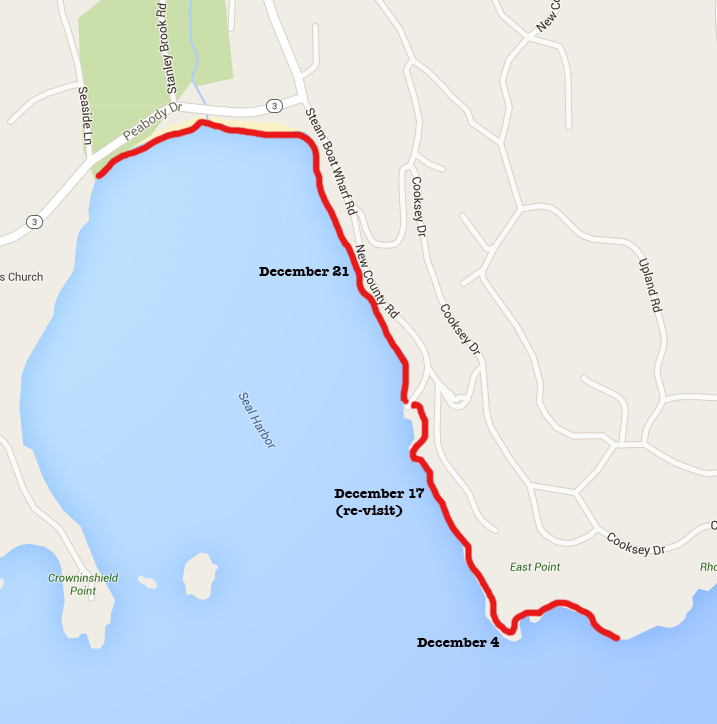
December 17, 7:45- 10:18am. 40 degrees with a stiff wind from the southeast and showers of rain. Cold, raw, and generally miserable weather. Slate-colored/Dark-eyed Junco (Junco hyemalis), 2 Ravens (Corvus corax), 2 Bald Eagles (Haliaeetus leucocephalus), a flock of about 12 Red-breasted Mergansers (Mergus serrator), half a dozen Herring Gulls, and one long-neck bird that could have been a cormorant or loon (too far off to see clearly.)
CW 14 copy

Walker: George Soules, photographer & software engineer, George Soules Photography

web-_DSC2959-Edit

If you remember, I ended the last post with an “oops” because I never made it down to the shore. About a week later my friend George and I went back to fix that. George is a software engineer and photographer. He’s the president of the MDI Photo Club, and he took this photo of me on our walk:
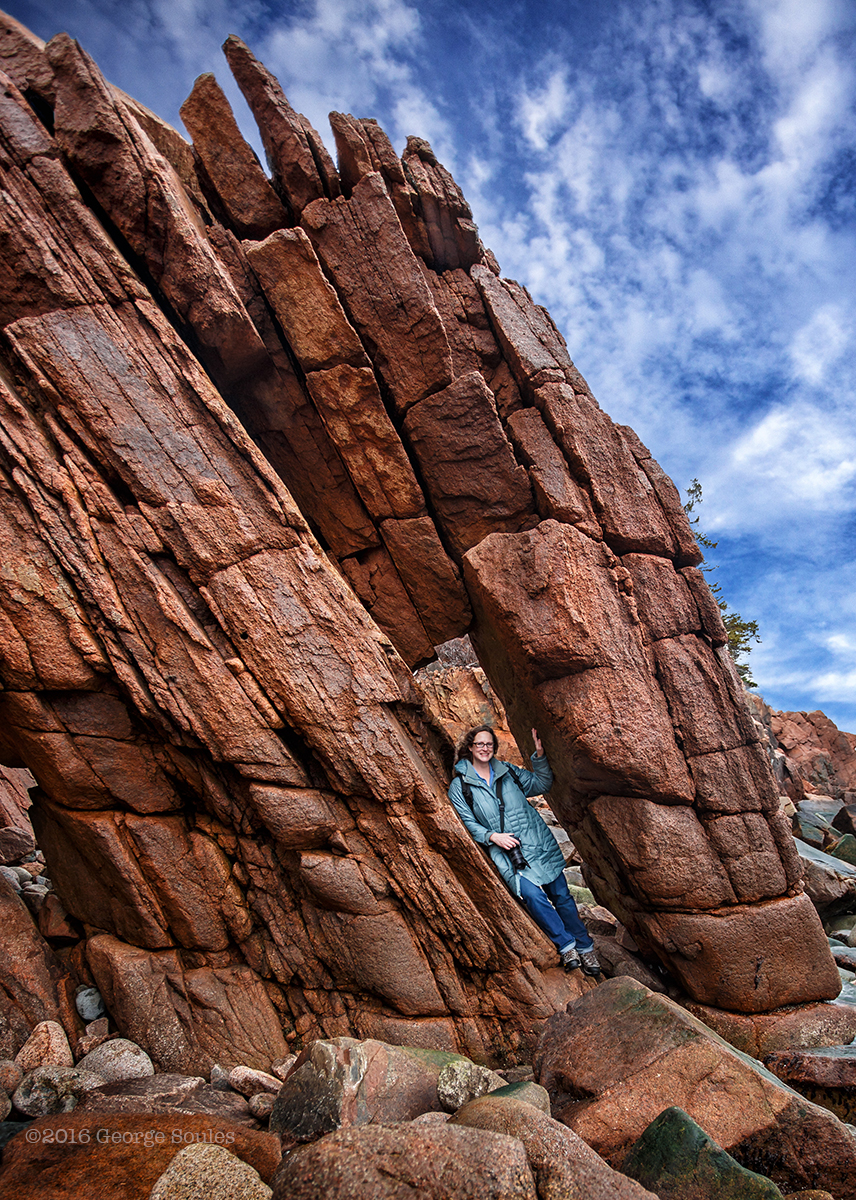
Jennifer Booher

So you can see he’s pretty amazing. For some reason I didn’t record our conversation, but George talked a little bit about his work digitizing the Southwest Harbor library’s archives and asked me a lot of hard questions about the impermanence of digital media and my long-term plans for the Coast Walk records (which are all digital), and it was so interesting that when I sat down to write this post I had to meet up with him to talk about it in depth. I’ll intersperse that conversation with photos from our walk.

web-_DSC2951-Edit

J: So we had talked really briefly about issues around archiving digital media, and you told me a little bit about what you’re doing at Southwest Harbor. You want to start with telling me about that?

G: In the ’80s this guy, Miles Weaver, started cataloging the physical collection [at the Southwest Harbor Public Library.] We had photographs that had come from various sources, but that was [before] scanners and PCs and databases that regular people could use. About 10 years ago … two women, Charlotte Morill and Meredith Hutchins, started scanning [the archives] – people would come in with a shoebox full of photographs and newspaper clippings and letters and surveys and documents and things, so they started digitizing it and then trying to put the pieces together. [They were trying to record the connections between objects as well as the objects.] They started doing research, doing interviews, and basically trying to record information that would soon be lost if they didn’t capture [it, because] some of the knowledge is from people who are up in years, and … they’re not going to be here ten years from now. So they started amassing large amounts of information. … They created a really simple database … but more and more and more stuff kept coming in and they kept seeking out more and more stuff. I’ve created this new database that not only has the features of a typical database … but I’ve added a relationship mechanism [so now] you can go from a photograph – ‘oh, this is a photograph of Eleanor Mayo‘ and you can go from that to her biography and from that to realizing that she was partners with Ruth Moore and go from that to … photos of Ruth Moore and to her biography, … and pretty soon what you realize is that it’s like the web, it’s a network. … Eleanor Mayo’s father … had this construction company on Clark Point Road, 45 Clark Point Road, but that same location was also Chester Clement’s boat building shop and before that it was something else, and today it’s just an empty lot … but it’s there today. History isn’t ‘then,’ it’s a continuum, and the reason I bring all this up is [that] you’re doing something contemporary but everything you’re doing is tied to the past. You know, Don Linahan’s blog [Ed. note: The Memorials of Acadia National Park] is such a great example because he did all this research. … I know him a little, I’ve met him a couple of times, and he wrote that book, Memorials of Acadia. But he’s left [the island]. His blog is still there but who knows, he could lose interest, something could happen to him, … maybe Google says ‘Hey, you haven’t maintained this for two years so we’re going to shut it down’ – that information could just disappear and we’d be going ‘Oh no!’ … He’s a friend of the library, and I wrote to him and said ‘Don, could we somehow take all the stuff off your blog and get it into pdf files? Put it in the library’s digital archive so it’ll be there permanently?’ And he wrote back and said yeah, absolutely. I don’t know how I’m going to do that. I did some experiments, selecting everything in one post and putting it into a pdf. If we don’t preserve it, it could get lost and that would just be a shame. You think about the amount of effort you put into it and the value of the information. So the Coast Walk, the effort’s tremendous and the value’s really high, so that’s why in December I was encouraging you [to think about preserving it]. I understand that doing a book or something like that is a big effort but having it just be on your blog, you’re at risk that it won’t outlast you.

web-_DSC2956-Edit

J: I know, and I do worry about that sometimes. I know that the blog gets backed up, so even if something happened to it it could be re-installed. But in some ways, the whole idea of backups is a theory because backups fail, too. I’ve had that happen.

G: I have this fireproof safe in my house that I put disk drives in, but I’d have to burn my house down to see if it’s really going to work. But Howie told me about this site called archive.org, it’s called the Wayback Machine, I think? And I looked up my Maps Alive website, the very first version of it, and they had snapshots of it – I was like, oh my god that was horrible. So probably if you look in there you’ll find your stuff. [Ed. note: Nope, couldn’t find myself.] But the cover page says they have 890 billion pages recorded in there; it might be in there but if nobody knows about it and you don’t know how to look for it … it’s not accessible. [At the library] we’re trying to create this database that anybody anywhere in the world who has some interest in the island or its people or its history can go there and see what we have and then connect to see what other people have.

web-_DSC2960-Edit

J: I have to say, there is so much that’s online and I am so appreciative of it when I’m doing my research. Like when I was researching Sand Beach I found that whole archive of photographs from the one silent movie? Someplace in California, a silent film archive. And god bless them, they digitized everything. Put it all up there.

G: Yeah well that’s a really good example of how everything’s connected to everything. Because Great Head was given to Mrs. Satterlee by her father, J.P. Morgan, and … one of the people at J.P.Morgan was Charles or George Bowdoin who had La Rochelle built, which is the Seacoast Mission now. And then, you could just go from Sand Beach to that movie to J.P. Morgan.

J: And farther back – J.P.Morgan came to the island because he married Frances Tracy, who, Charles Tracy stayed here in Southwest Harbor in the 1840s … [Ed. note: oops, 1855. The Tracy family were among the very first Rusticators to explore the island.]

G: Is that the Tracy Log Tracy?

J: Exactly. So Charles Tracy brought Frances Tracy [ed. note: his daughter], she brought J.P.Morgan here when she married him, and he brought the entire Morgan [firm], the Morgan Men; one of them was Fabbri. Fabbri was a Morgan Man, and his son built the radio station [on Otter Point.] The Fabbri radio station was the major radio station for transmissions from Europe [during WWI.]  So it’s like from Southwest to Bar Harbor to Otter Point …

G: That research that you’ve done and that you’ve recorded in the Coast Walk, I mean it’s extremely valuable. Some of it overlaps with things that are already out there, some of it covers new things, but it also gets put in a new context… . So what is your plan, how are you going to protect this treasure?

web-_DSC2964-Edit

J: I just don’t know. I mean so much of what I’ve built is web-dependent. I don’t write footnotes, I link them. Because most of the time it’s on the web, which is more useful than a footnote. And in fact, when I’m starting to think about what should be done with this, it would lend itself more naturally to an app than a printed book.

G: I remember you saying that, yeah.

J: Just because it’s so photo-dependent. Even if you took my photos out of it completely, it’s still all the historical photos and maps. I just don’t see how you could make [a book] –  I’ve only done fifteen miles and I think it would already need at least two books! And it’s 120 miles!

G: How long was it supposed to take?

J: Two years. I’m a year and half into into it. Yup.

web-_DSC2967-Edit

G: Well when I moved here three years ago, my goal was to hike all the trails, 120 miles in the first year. At the end of year 3 I’m three-quarters of the way there.

J: Good for you! Real life has a way of getting in the way. And by real life I mean making a living.

G: Yeah, if you could just go full time it would be different.

J: I mean that’s why I made so much progress in those first six months; I was unemployed. So I just kept working.

G: I think that if you could come up with some kind of a framework that would allow you to still do what you’re doing now which is take advantage of the blog format and hyperlinks and stuff but also get the information into some structure that could be preserved. I’m trying to verbalize what I’m thinking. So let me make a side trip and go back to what we’re doing with the library.

web-_DSC2968-Edit

G: So these two women started gathering all this information and they said ‘we’ve got A and B and C, and A’s related to B and B’s related to C,’ and so in the description of A they said ‘for more information about this, see B,’ and in B they said ‘see A’ and ‘see C.’ And that was all in writing. And it’s kind of like if you’ve ever read the Old Testament where it’s this long list of you know, so-and-so begat so-and-so and so-and-so and Sarah was barren and so she was without child and then this happened – it makes sense when I read it but I can’t picture it, but if you write it out as a genealogy then it starts to make sense. And then you can imagine bringing it into a digital form, like Wikipedia, you can look up any of those, you can look up Abraham and just keep following the links and get all the way down to Ishmael and all these people.

web-_DSC2970-Edit

J: So here’s where it really gets crazy is the whole point of the Coast Walk, well no, not the whole point, the Coast Walk has a lot of points, but one of the reasons I started doing it was I felt like the still life photographs are limited. There’s only so much that I can present in that format. And I needed to take it to the next level but I didn’t know what that would look like, physically. But I do know that the more thoroughly I understand a subject the better I can turn it into art. Do you know what I mean? Like if you mildly understand something you can make an infographic, but to really make art out of it – it’s like you can’t tell a joke in a foreign language. You have to really know a language before you can tell a joke. It’s like that with art, I have to really understand something before I can transform it. But the Coast Walk as an art project is very open-ended because I don’t know where it’s going. And it’s not going where I thought it was, because it used to be about the objects and it’s turned into being about the connections. I’m still interested in the objects, but … . Do you know the Frenchman Bay Partners?

G: No

J: It’s a group of people and organizations that are concerned with the environmental well-being of Frenchmans Bay. They have a lot of research projects that are funded by all different entities but all concerned with Frenchmans Bay, so at their annual meeting they present a lot of very interesting topics. I had started coming at this from the marine biology viewpoint, so let’s say looking at the mudflat, I would have been interested in what lives there. Why is it a mudflat, what’s the geology of the area, how did this come to be, and what’s taking advantage of it, what lives there? At the last Frenchmans Bay meeting, someone presented work basically pointing out the link between clam-digging and heroin addiction. [Ed. note: that was Bridie McGreavy of the University of Maine.] [I’m seriously over-simplifying her presentation, but] many clam-diggers are in constant pain because of the work that they do, it literally kills their backs; they need constant painkillers, oxycontin is expensive and doctors won’t prescribe it forever, heroin is easily available and cheap. And so there’s this progression [for some people] from clam-digging to heroin addiction … and [she talked about an ergonomics study that is] trying to break that cycle. So that one talk sent out this whole burst of, I’m thinking of them as gold threads right now, all these little connections, a whole bunch of gold threads going off in a completely different direction, and I’m just kind of reeling from it, going oh my god, how do I even begin – and you know, meeting with George Neptune and talking about the Wabanaki on the island in the past but also in the present, this whole sense of the invisibility of the eastern tribes, and that’s a whole other burst of connections in that direction.

web-_DSC2973-Edit

G: So what you’ve described is exactly the problem that we’ve been trying to solve because the connections grow and ultimately you have to bound it. For what you’re doing, your scope can only be so big and at some point you have to say, ‘well if you’re still interested in this then [go to this link or source, it’s] out of my scope.’ Let’s say this is your scope but your golden threads are still going out [as internet links], then if those [websites] go away you’ve got these dead threads. So that’s the nature of the web, it happens all the time, ‘oh 404 sorry.’ In a database, everything that’s there is there and what’s not there isn’t there. Sounds stupid but all the connections between everything are solid and you don’t have to go from A to B to C to D, you could can go from A to D if there’s also a relationship there. Which you can also do on the web but this is kind of what I was saying about framework, your structure. If you can visualize, if when a new piece of information come in, you can say, ‘oh I know where that goes, that is connected to this, so I’m going to add it and connect it to that.’  Oh and then I know there’s this other thing that’s a picture of this, and I’m going to connect that to that. And instead of saying ‘I’m going to write this down and just add it to the list,’ you just immediately put it into the framework. This was the problem that Charlotte and Meredith had – they just kept having to add stuff to the list and remember that all these connections existed. None of this goes to the solution of how do you do it and how do you preserve it. But maybe if you just started to think about some structure that might be a way to get to the next step. Like the blog, there’s no structure at all… your blog in particular is chronological so it has a sequence but the threads don’t work that way.

J: Although I have to say, the blog is not strictly chronological, it’s geographical. When I find stuff [for places I’ve already written about] I add it in under the Coast Walk that it belongs in.

web-_DSC2981-Edit

G: So we had some discussion 6 months or a year ago about how do you find stuff on your blog? And even this morning I went and I looked and that sidebar, I don’t know what order WordPress is putting things out in the list, it’s not there. Like I was trying to find the walk that you and I went on and there was a Coast Walk 13 part 1, part 2, I couldn’t…

J: You’re actually Coast Walk 14, you’re not in there yet; I’m writing you now.

G: Ok. So somebody coming to your information is going to want to be able to navigate it linearly in geography. And then if they do that then even if you begin in the middle and you visited here in January and you visited again in March they’ll find January and March, hopefully, but if they have to go, the blog posts are chronological and you look at January and you need to know that there is also something written in March; so I don’t know if you put forward links in

J: I do, I link within the blog.

G: So you go back to January and put a link forward to March?

J: Ooh, good point. I don’t. I link backwards, but don’t always link forwards. That’s a good point, I should do that.

G: So that’s a subtle but super important thing [for] the threads, because the threads work both ways.

J: The other thing on the blog is that is does have a really good search function. Like if you’re interested in Compass Harbor, you can search for ‘Compass Harbor’ and it will show you all the blog posts in which I mention Compass Harbor.

web-_DSC2971-Edit

G: So we’ve had this conversation twice now, I’m not meaning to put pressure on you, but

J: What am I going to do about it?

G: Well, what do you want to do about it? Is it important to you? Because let’s say you complete the whole thing and get hit by a bus. Do you want this to be part of your legacy?

J: Oh yeah.

G: So…

J: It all comes back to ‘how do you archive a website?’ Because they’re not designed to be static. The whole nature of it is that it’s fluid and constantly changing so it’s really hard to archive something like that.

G: I don’t know the technical answer to that conversation. Let’s say you archive, back up all of your pages, your WordPress site. You could probably go to your ISP or however you’re hosting WordPress and there’s probably a way to say, compress all this into a zip file that they can save somewhere, and in the future you could bring it all back and all the connections within your site would still be there and the connections off your site might not work, but that’s what I was saying, if something’s outside your scope you have to accept that that link might not work someday. So if that’s super important information maybe you need to bring it in, or at least describe it.

web-_DSC2993-Edit

J: That’s one thing you learn pretty quickly as a blogger is to assess the quality of the pages you’re linking to. Like if I’m linking to information about a bird, let’s say a common seagull, I could link to dozens of different places but I tend to link either to the Cornell bird site or Wikipedia, or there’s one other all-about-birds site. Fairly big, fairly stable, feel like they’re going to be around for a long time. As opposed to somebody’s quirky, small blog, which might have more interesting photographs but might not be around as long.

G: I was having similar conversations with my daughter, Kate, who’s a PhD student. So she does a lot of research and she has to cite her work and I asked her how do you cite seagull articles? And one of the things that you do is not only provide the url but the date – July 13, 2016, that’s when I cited it – because on July 14, at midnight, someone could have gone to Wikipedia and modified the article. … But it’s kind of  weird thing because it’s just ‘this is what was there on the day I looked at it.’ You go there, and who knows?

J: Which makes it less valuable as a reference, because it might not be there, in the form that you saw it.

G: Yeah, so if it was me, if I was doing what you’re doing, … I would think about everything I was posting right now and deciding what information is essential and what information is nice to have. So if the information about the seagulls is interesting but your your blog’s not going to be less without it, then I would say that linking off to Wikipedia is fine. But if, say, it’s about J.P.Morgan and all his connections, I would pick enough of that information and put it in there that you’re telling a complete story. And then you could still link off for further information. The way I would decide what’s what is I would think ‘well what if someday this went into printed form, where there’s no hyperlinks?’ Then wherever there were hyperlinks I would have to eliminate those; nobody wants to read a book that’s got “http://” .
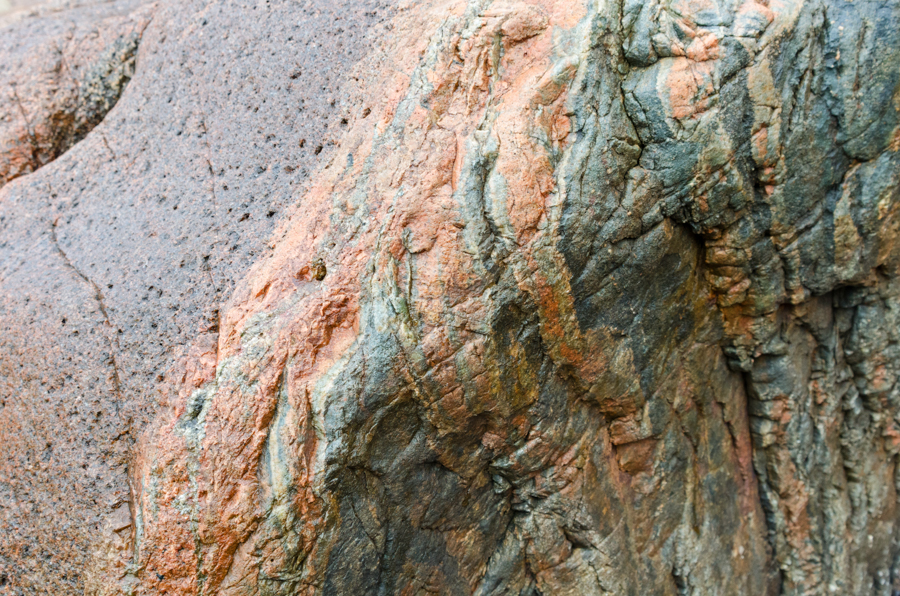
web-_DSC2992-Edit

J: I do tend to use the hyperlinks as footnotes, as citations, and also to direct people to more information than I’m including. Just like you said about the seagulls – there’s more information over there if you want it, but it’s a tangent to what I ‘m talking about here. It’s really all tangents and digressions.

G: I think some are and some aren’t

J: I mean, like this whole conversation. We’re having this conversation because of the Coast Walk. Is it a tangent, is it a digression, or is it integrally part of the Coast Walk?  I don’t know yet!

G: From my perspective, it’s an integral part of it, it’s another dimension. So many things are multi-dimensional, you can look at them from so many different ways. What we’re talking about has nothing to do with the subject itself or the content of your blog, or your timeline or what you’ve done or what you haven’t done, it only addressed those things generically, it could be applied to a thousand situations, but the common theme in all of them is structure and preservation.

web-_DSC2995-Edit

J: Well the other thing is, I think this is integral to the project in the way that talking about the physicality of walking on the shore is. I take photographs of the quality of things I’m walking on, like the seaweed covered rocks, and how hard it is to walk on it, what it feels like to be beside the ocean when it’s ten below zero – this is also part of that, because a big part of the project is what I’m doing on line. Maybe the final art project needs to be a hologram. This big ball of golden threads. Because a huge part of the project is cyberspace.

G: Well, but that’s only because that’s how you’ve chosen to carry it out, there’s nothing about what you’re doing that says that’s how it needs to be.

J: No, but it’s evolved that way, so it is important.

G: But I think it’s a path of least resistance. I think it’s the easiest thing to do. Because you can sit down at any time, immediately after the walk or six months later, and you can create a post and write and write and write and add pictures. If you were doing something more structured, like in a database, then it would be a little harder because you’d have to break what you’re doing into pieces and create items in the database for each piece, and given them titles and identifiers and create the thing that ties them all together. If you were doing a book, you’d say the end result is the book, so I’m going to go from the walk to the book, and you’d have to be thinking about your chapter structure, is each walk a chapter or is a chapter a section, and then there’s, is a chapter a number of walks that are a certain section. But if you think about when you were in school and writing reports, what do they teach you, you have to have an outline, right? “What are you going to talk about, what are your main topics,” and you’d have to break it down so as you did your research you’d know where to plug it in.

web-_DSC2998-Edit

J: I’m not sure that I would call this the path of least resistance though. That’s kind of like saying that flying to Europe is the path of least resistance as opposed to swimming. I mean, for a project like this, I see it more as taking advantage of what technology makes possible. … A lot of the historical images and things that I borrow from other people’s books, if I were doing a book, or when I do a book, I will have that much more paperwork to do, getting permission from everybody. You know, when I did an article for the historical society, and we used all those images, I had to go back and ask permission from everybody and get written permission to reprint those photos. So it’s either ‘path of least resistance’ or the most practical way to approach it.

G: Well, yeah, practical and do-able. Yeah, I agree with what you just said but it’s also, what you said is partly what I was trying to convey, if you chose a more formal end in mind, there would be more structure required, like you would have to have a bibliography, you would have to have citations and permissions, so if you sat down to do the post you’d have to get all this stuff.

web-_DSC2996-Edit

J: But here’s the thing, is that I want everything that I say to be trackable.  I want it to be useable information. Everything that I’ve found, I try to leave a road map. …

G: So if I go to your blog and I say, I want to see all the books that you’ve referenced, there’s probably no bibliography.

J: No

G: And maybe if you’re using a consistent notation for book references, maybe I can do a search for that form.

J: No.

G: So here’s my word of warning and advice. It’s good that you’ve only done fifteen miles, because you’ve only just begun. Charlotte and Meredith worked on this project for 7 or 8 years before I came along and started to look at the structure of it, and now to go back through all that they’ve done and put it together and angle it – it’s oging to be years of work. So think about, if you can look down the road to when you’re done and try to identify some of the things that you think would have to be in place, let’s just say a bibliography, as one example. Some books have 30 page bibliographies, or they go chapter by chapter, this is where I got this information. Think about what it’s going to be at the end to deal with that. So if you think, ok that’s something that I’m going to have to do, well I’m going to start now, maybe just by having a notation that says ‘book reference colon’ so I can do a search and find all of those. Or a separate page on my blog, I don’t link to it, it’s just there, and now every time I cite a book I’ll just add the citation in there. So that’s something that will take several extra minutes every time, but at the end it’ll be done and it will always be there.

J: I think you’re underestimating how many minutes that’s going to take.

G: Well, compared to the weeks that it will take

J: No, you’re absolutely right, I should have a works cited section. OK. Here’s the other thing. This is an unpaid labor of love. So the reason that it’s taken me six months since my last walk is that I’ve been unwilling to rush the research on the blog posts that I’ve been doing. And I’ve been working full time on bringing an income in. So I don’t have 40 hours a week to spend on this. In a good week, I might have 5. And that’s a good week, most weeks I don’t even have that. So I always have to choose, what am I going to do in those 5 hours? Am I going to edit the photos? Am I going to write the narrative? Am I going to research, am I going to write to the next group of people for permission [to cross their land]? That takes an amazing amount of time, getting the permissions. That takes weeks. So sometimes I have to choose what I’m going to spend time on. It was really tempting to just publish our walk,  without sitting down and talking it over again, but I just felt like this was such an important and really interesting conversation, I didn’t want to leave it out.
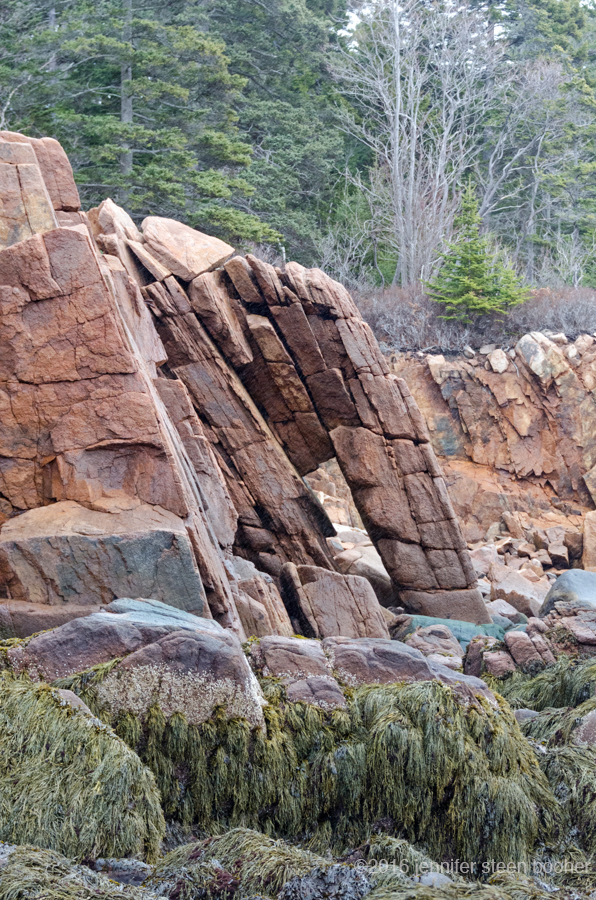
web-_DSC3002-Edit


G: Well, if it gets you to thinking about it, and you start to do one thing, like start the bibliography, you’ll have improved the project and saved yourself time later, and made it more valuable to the next person who comes along … and says, what else did she cite.

J: You’re absolutely right, I should have a bibliography.

G: I’m not trying to make more work for you, but we also talked about … the geographic sequence – there’s another example where if there was a page that said, these are the walks, it would be nice if you could go

J: There is a page of maps that says ‘Coast Walk 1 is this area,’ Coast Walk 2 is this area,’

G: And will it take me to every blog post?

J: No, but I could do that. I can definitely link the maps to the blog posts. [Ed. note: Did it. Check the Schedule/Index tab.]

G: So that’s the other thing we talked about, where you have March linking back to January but January doesn’t link to March. Pay attention to that, and going from the maps to blog posts, there’s two things that, yeah, each of them’s going to add more time, but …  My degree is in information science, so it’s all about what do you do with information, how do you make it accessible to other people? As important, how do you make it easy for you to capture and record the information in the most efficient way? It turns out that if you had all this structure in place then it would, and if you had all the tools in place, it would only take you a minute, ideally. Ideally you would just click on a citation and it would add it to the bibliography. Are you familiar with things like Zotero?

J: Like what?

G: z-o-t-e-r-o

J: No

G: So it’s a plug-in, a Firefox plug-in, my daughter uses it all the time. I guess researchers use it, so she goes, oh this is a wikipedia article about seagulls, she’s on the page, she clicks the Zotero button and it goes out and extracts the author, creates a citation for that page and then just adds it to a list.

J: Oh my god, that’s amazing!!! [Ed. note: downloaded it, tried it, steep learning curve.]

G: So that she doesn’t have to stop and get her mind off of what she was doing.  …

J: That’s fantastic, that’s so much faster. You know what just occurred to me? I need an intern!

G: That’s what I need. What I’m working on now is trying to get interest – traction and credibility so we can go after money, grant money or donors.

J: So in your case what would traction and credibility look like?

G: It would be having people, other organizations on the island, or Maine, or anywhere else, coming to us and saying ‘wow, I saw what you guys are doing, that’s amazing, that’s what we would like to do, and how can we do that, would you help us?

J: And is there a website?

G: It’s not public yet. … When it becomes public I’ll give you a link

J: And can people contact you about it if they’re interested or curious?

G: Oh definitely. The way it works, actually, I’m a software engineer, right, so I acquired this open-source software, Omeka, that did much of what I wanted and then I’ve customized it. The thing that I’ve added is this relationship feature. … I describe what people do as ‘search, filter, and discover.’ So you search for things you already know something about, like I search for ‘hotels in Mount Desert Island.’ And then I get too many results so I filter them down to ‘hotels in Southwest Harbor.’ And then I see one and I go, ‘oh, the Claremont Hotel’ and I click on that. That’s an item on the database, then everything we know that’s directly related to the Claremont Hotel shows up with pictures and titles and part of the description in a ranking order, like most important to least important. So you might see, well first you might see photos of the Claremont Hotel, and then Mr So-and-so who was the manager or built it or something, and then you can go to learn about him, and when you get to his item you see other pictures of him and who he’s related to and other businesses he owned

J: And what his children did and their businesses

G: As long as you keep going and going back

J: I call that the internet rabbit hole

web-_DSC3014-Edit

G: Well, it’s that but instead of it being hyperlinks all through the text like you’d find if you go through Wikipedia, it’s just information that appears at the bottom, so it might say ‘the item is a hotel,’ then ‘images of the hotel,’ and then ‘people’ and then these are people that were somehow related to the Claremont. And then ‘vessels’ – maybe in the picture of the hotel there’s a schooner. So you’re talking about structure, you’re reading a Wikipedia article, and the author has to put in all the hyperlinks, and that’s a lot of work. Here, in this model, there’s a mechanism where we say ‘this item’s related to this item,’ we say what the relationships are, like ‘this is  a photo that depicts this’ or ‘these two things are related.’ So the data entry is really easy, and then the software anazlyzes the relationships, applies rules, decides what to show for what item and what to sequence in what grouping so that you, the person who’s putting in the data, doesn’t have to do that. It’s all automatic.

J: So you know what’s really cool about this, is you are writing software that’s enabling a different take on history.  When I was in college, I was an art history major, and it felt like it was just the beginning [of a change in attitudes toward history] from the ‘great men’ changing art and being individual geniuses, to ‘every art movement came out of a culture’ and [exploring the way] changes in how art looked were driven as much by changes in the technology and changes in the government as it was by individual artists’ personal development.  … There was a point before oil [paints] existed, and people painted in different media and the work looked completely different. But my point was that there’s been a change in my lifetime in the way that history is valued or told, and what I’m seeing now … is a combination of a change in our values and also a change in what’s available. The fact that we can search databases and find receipts from some random hardware store in 1840 makes a whole different class of information available. In addition to [that], we’re now interested in the people who were running hardware stores in the 1840s and not just in the presidents and the war heroes at the time.

G: So, everything that I’ve sought out in terms of trying to find a solution for us is that [with Google or a traditional database, I] somehow stumble across that receipt, and then maybe in the text it might say something about this hardware store, [but in order to find information about that] hardware store, [I have to] copy the page, put that in the search box, get a whole bunch of results, see which one is relevant, and then try to remember why I was even looking for that thing. Whereas if the page just says, ‘this receipt is from, this person made it out, this was the store, and this is where the store was located,’ it’s like, oh yes, that’s what I’m interested in. And then I go to Google Maps or I go to a biography, I can just learn and discover. And why you don’t see that all the time I don’t know. Every time I think I’ve thought of a great idea there’s a thousand other people that have thought of it, but I’m not seeing this anywhere, at least for small organizations.

J: There aren’t a lot of small organizations with someone like you willing to put the time in.

G: And maybe that’s the first time this happens.

J: And you’re building a prototype.

G: I’m hoping I’m building a model that other people will go ‘this would be great.’ … Our library’s not trying to sell anything to anybody, they’re not trying to sell a solution, and I’m not personally trying to convince anybody to do anything a certain way, but if we produce something and other people say, ‘we want that,’ then I can try to help them and for me personally that’s really the goal. So if [an] organization looks at what we have and says, ‘as a board we would like to go in that direction’ that would be great.

web-_DSC3027-Edit

G: Charlotte and Meredith had all this knowledge and Meredith just died. Charlotte’s in her late seventies, maybe 77, 78, and she is well aware of her own mortality. She has said to me repeatedly, her euphemism is ‘if I oops’ then you need to be able to run with this. ‘I’m just telling you all this information so you know, just in case,’ and I told her ‘don’t die because I’ll kill you.’  … We email almost every single day. She had a vision for how this information would get out there but she’s had no idea how it might actually manifest itself, and once I understood what she had, and this whole thing with the golden threads, I really like that term because that’s one people can relate to more easily, and then being able to take my understanding of how you can represent information, now all of a sudden she has this framework to take what’s not only in her head, it’s all documented, but lots and lots of scraps of paper, there really were documents, everything that came along she wrote it down, but now we have a place where we can put it together and clean it up, and the trick is can we do it while she’s still able.

web-_DSC3003-Edit

J: It’s a fantastic project.

G: I can’t wait to get it out there.

J: Do you know when you might go live?

G: I only got this mechanism working this month, so that part’s really new, so for this demo I ‘m trying to take a set of items that are related and clean up the data so that they will demonstrate well. The strategy is to go item by item and say ok, we’ve got everything in there, it’s clean, there’s nothing else to do, and then mark that as public. And then do it little by little. We’d like to have at least a couple thousand items in there before we put it up there. There’s 8500 items in there right now, and there’s at least that many probably that haven’t been catalogued. We need help. Long answer, there’s no date, we hope by 2017 we’ll be making some of it public. … Well has this been helpful at all?

J: oh, it’s been fascinating, are you kidding? It’s a very cool project!

G: I’ll wait another six months and then I’ll push you a little bit.

J: Well some of it I’ll do immediately. I’ll start the bibliography from this point forward. It’ll take me some time to go backward.

G: It might be interesting for you when I’m finally able to devote some time to Don Lenahan’s stuff. His stuff’s just in blog format like yours, there’s no structure to it, and I’m not going to rewrite his articles, I’m thinking I’ll just turn them into pdfs and put them in the database. They will then get connected to everything else as it makes sense.

J: You know what I’m thinking is ‘oh god, please let this go live before I get to southwest harbor!’ Because that’s going to simplify my job so much!

G: Well, at the rate you’re going …

J: Oh ow! I’m hoping five years at this point.

G: For completion?

J: Yeah, but that’s a hope.

G: Not to get to Southwest Harbor.

J: Well, if I get to SWH in 5 years, I’ll be doing well at this point. But I am hoping to finish in 5 years. I was hoping to be done before I turn 50. Not going to happen. I turn 49 in August.

We wrapped up our conversation with a little talk about our families, and I headed home. Before I go, I did want to share this one story from the walk itself. George had been taking a class on geology through the Acadia Senior College, and as you know, I’m trying to learn something about it myself, so we spent a lot of time looking at rocks and trying very earnestly to apply what we knew. We stumbled across this formation, and stared at it for a while trying to figure out what we were looking at. The dark gray stuff, we agreed, was clearly sedimentary. So how did it end up sandwiched between layers of granite?

web-_DSC3022-Edit

After a few minutes, George burst out laughing and said ‘It’s concrete!’

LOL, as they say. LOL.


_________________________________________________

Works Cited (as promised)

Lenahan, Donald. The Memorials of Acadia National Park. (unknown publisher), 2010.

Tracy, Charles. The Tracy Log Book 1855: A Month in Summer (Charles Tracy’s Diary on Mount Desert Island). Acadia Publishing Company, Bar Harbor, Maine, 1997.

Jonathan Silent Film Collection, Chapman University Digital Commons.


__________________________________________________

Addenda 8/28/16

OK, remember ‘Glengariff,’ George Cooksey’s house? It was bought by E.B. Dane in 1909, torn down, and rebuilt much larger.
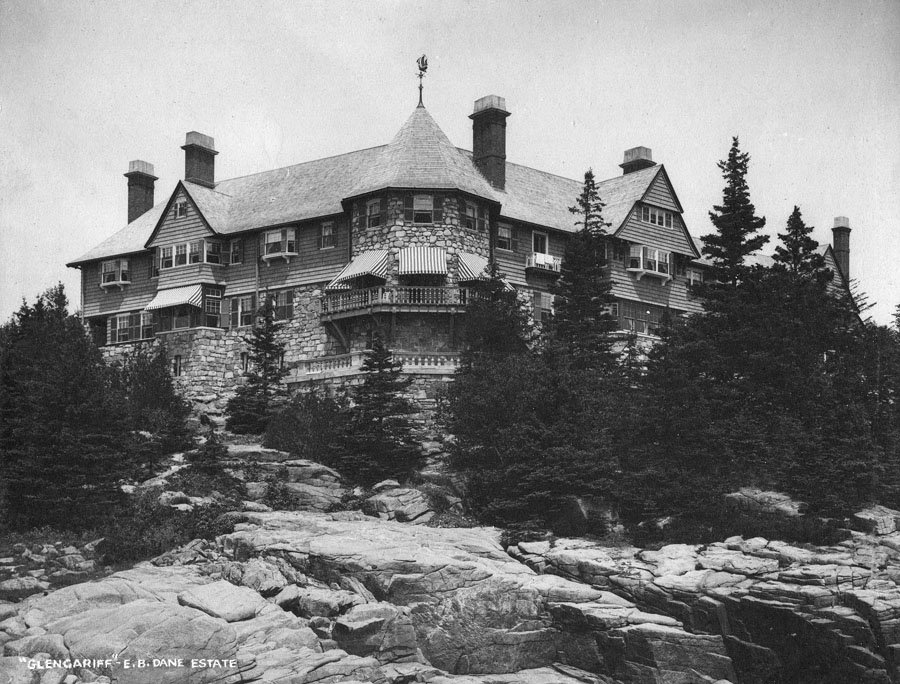
Photo courtesy of the Seal Harbor Library

Photo courtesy of the Seal Harbor Library

Much larger! [More about the house and gardens on the Downeast Dilettante’s blog.] At 244′ long, it dominated the Seal Harbor skyline on the east:

SH Lib Web 563Glengariff

Photo courtesy of the Seal Harbor Library.

The Danes had a similarly scaled yacht (a schooner, really), also 240′ long, called the Cone:

Photo from Vandenbergh and Shettleworth, Revisiting Seal Harbor, 1997.

Photo from Vandenbergh and Shettleworth, Revisiting Seal Harbor, 1997.

The Danes built Wildwood Farm (now the Wildwood Stables) to supply the house with produce and flowers:

The area now occupied by Wildwood Stables was once the Dane farm. Photo courtesy of Acadia National Park Archives

Photo courtesy of Acadia National Park Archives

The area now occupied by Wildwood Stables was once the Dane farm. Photo courtesy of Acadia National Park Archives

Photo courtesy of Acadia National Park Archives

Richard Billing’s, son of the local grocer, told some stories about Wildwood and Glengariff in the 1930s in his memoir, The Village and the Hill: “The E.B.Dane family owned the Wildwood farm and a two story mansion down at Dane’s Point. They may have owned the farm, but the Manson’s [sic] lived in it. They were a great addition to our community. The farmhouse was adequate for their family, which included four children; Charlie, Jennie, Nancy, and John. A greenhouse connected the house to the barn. The greenhouse was full of exotic plants… grown to supply ‘The House.’  The farm also boasted cows, horses, pigs, sheep, goats, and poultry. It was at the Wildwood Farm that I first saw watermelon growing, and squash with the children’s names written on them. Mr. Manson would scratch their names on the young squash, and the scar would result in raised writing when the squash matured. From my home, there was a path directly through the woods to the farm, about half a mile from us …. Often the Mansons would ski to school, or ride on a sleigh driven by their father. Theirs was the only working farm in Seal Harbor.

At the Dane’s big house down on the point, the Liljeholm’s daughter, Elsie, was our hostess. Her father was caretaker of the house, and they lived in the heated downstairs portion of the house in the winter. They would move to the rooms over the garage during the summer, when they would give up their quarters to the summer servants. The great sport at Liljeholms was to venture into the unheated part of the house to play hide and seek. Those of us who knew the house would go immediately to the main dining room, push the catch of a secret panel, and duck through to a hidden room, completely disappearing from view. Another feature of the house was a photographic darkroom in the basement that was built like a circular maze. There was no door, you just kept circling into the center, where there was a completely equipped darkroom … very dark and very spooky, and always very cold.”

According to the Downeast Dilettante, “The Dane estates weathered the great Depression, but by WWII, things were drawing to a close.  The Vanda was requistioned for duty in the war.  …  John D. Rockefeller Jr., in whose view shed Glengariff stood, bought the house for a song in 1946 and had it demolished (His son David later built a house on the property). ”

But Richard Billings gives a different version of the house’s end:

“One day, in the middle of winter, the building caught fire. Those of us who went to help the volunteer firemen were sickened to see most of the house consumed by flame. What was left was ruined by water and smoke. It had to be torn down, and was never rebuilt.”

The only personal information I’ve found about the Danes was a note published in A Church for Seal Harbor. One gathers that Mr. Smyth had been fundraising for the proposed new church, and received this reply, which the church historians found either amusing enough or offensive enough to preserve in their archives:

Bechtle, Isabel K., A Church for Seal Harbor, Northeast Reprographics, Bangor, ME, 2002

from Bechtle, Isabel K., A Church for Seal Harbor, Northeast Reprographics, Bangor, ME, 2002

Remind me never to put anything bitchy into writing, because sure as sure, that will be the one piece of correspondence all future historians latch onto.


_________________________________________________________

WORKS CITED

Bechtle, Isabel K., A Church for Seal Harbor, Northeast Reprographics, Bangor, ME, 2002.

Billings, Richard W., The Village and the Hill: Growing up in Seal Harbor Maine in the 1930′s, Day Mountain Publishing, Augusta, ME, 1995.

Vandenbergh, Lydia and Shettleworth, Jr., Earle, Revisiting Seal Harbor and Acadia National Park, Arcadia Publishing, Charleston, SC, 1997.


Save

Save

Save

Save

Save

Save

Save

Share

Coffee and Conversation at the College of the Atlantic

I was invited to participate in the College of the Atlantic’s “Coffee and Conversation” series, in which I was interviewed by Dru Colbert, professor of art at the college. Friends of Acadia live-streamed the event this morning, and the video is on the Acadia National Park Centennial Facebook page. I haven’t dared watch it (not sure I’d ever be able to bring myself to speak in public if I watched the recordings!) so I hope it’s audible.  It’s about half an hour long: I gave a short introduction to the Coast Walk, followed by questions from Dru and the audience about the project, about collecting, and about art.

If you’d like to listen in, here it is:

Share

Coast Walk 14: East Point to Seal Harbor Town Dock

CW 14 copy

December 4, 9:30am. 33 degrees, light breeze from the south. The morning started out sunny with puffy clouds but by 9:30 it was overcast and the air smelled like snow. There were occasional patches of sunshine as the clouds moved. Red Squirrel, juvenile Common Loon eating a sea star (or maybe a crab); 2 duck-type birds too far off to identify, juvenile Herring Gull.

web-_DSC2389-Edit

Today’s walk was backwards – I started at the Seal Harbor Town Dock and headed south along the shore (again, with permission to access private property.)

web-_DSC2395-Edit

This was a classic Seal Harbor estate, with the most beautiful 19th century stonework and perfectly groomed woodlands, gorgeous even in December.

web-_DSC2399-Edit

web-_DSC2415-Edit

I kept looking over the wall, trying to find a place to reach the shore, but it was just a little too high and a little too slippery to jump. But I did notice this cool calcite crust forming where the calcium carbonate in the mortar has been leaching out. I’m not sure if this qualifies as a baby stalagmite, but it’s the same process at work.

web-_DSC2406-Edit

Some of you know that one of my personas is “landscape architect.” I’m afraid from the moment I saw these stairs:

web-_DSC2417-Edit

my artist/explorer hat came off and the landscape architect hat went on, and I wandered along the most marvelous path that ran through the woods

web-_DSC2449-Edit

and along the cliffs.

web-_DSC2507-Edit

I also spent a lot of time trying to identify the plants I saw, which is exponentially harder in winter. Pretty sure this is a viburnum, but I couldn’t tell you which:

web-_DSC2451-Edit

There were Pitch Pines

web-_DSC2484-Edit

of extraordinary size

web-_DSC2622-Edit

web-_DSC2666-Edit

wild roses (Rosa carolina, which is native to North America, unlike the more common rugosas)

web-_DSC2594-Edit

and this awesome little fungus growing on the roots of a pitch pine. This is the Orange Jelly Fungus (Dacrymyces palmatus) and it only grows on conifers. Apparently there’s a similar fungus that only grows on hardwood.

web-_DSC2616-Edit

I didn’t see a lot of wildlife, except for a few red squirrels,

web-_DSC2467-Edit

but I did find what I think was a chipmunk burrow. I didn’t think chipmunks ate pine nuts (that’s a squirrel thing) but squirrels don’t go underground, so maybe there’s a squirrel in the tree above throwing its food wrappers down on the chipmunk’s front door.

web-_DSC2438-Edit

I also saw a Common Loon. It think it was a juvenile, but it could also have been an adult in its winter plumage. There’s almost always at least one loon on the water whenever I go out, and a couple of times I could swear they’ve followed me. I’d always thought of them as lake birds, but they spend their first couple of years on the ocean.

web-_DSC2536-Edit

web-_DSC2457-Edit

web-_DSC2496-Edit

web-_DSC2498-Edit

This area is called Ringing Point, and I’m a little embarrassed that I’d been wandering along listening to the sound of the buoy for a good forty minutes before that light bulb went off:

web-_DSC2506-Edit

web-_DSC2504-Edit

The pink granite cliffs were cleft into all kinds of cool formations:

web-_DSC2499-Edit

web-_DSC2577-Edit

web-_DSC2525-Edit


web-_DSC2582-Edit

web-_DSC2590-Edit

which continued up into the woods:

web-_DSC2598-Edit

web-_DSC2605-Edit

web-_DSC2575-Edit

web-_DSC2546-Edit

web-_DSC2605-Edit

I spotted a pretty impressive erratic:

web-_DSC2580-Edit


web-_DSC2601-Edit

Looking across the harbor at Crowninshield Point and wondering how long it will be before I explore over there:

web-_DSC2685-Edit


web-_DSC2654-Edit

You may have noticed that I was so bewitched by the woods and the views that I never did climb down to the shore.

web-_DSC2404-Edit

Oops.


Save

Save

Save

Save

Save

Save

Save

Save

Save

Save

Save

Save

Save

Save

Save

Save

Save

Save

Save

Save

Save

Save

Save

Save

Save

Save

Save

Save

Save

Save

Share