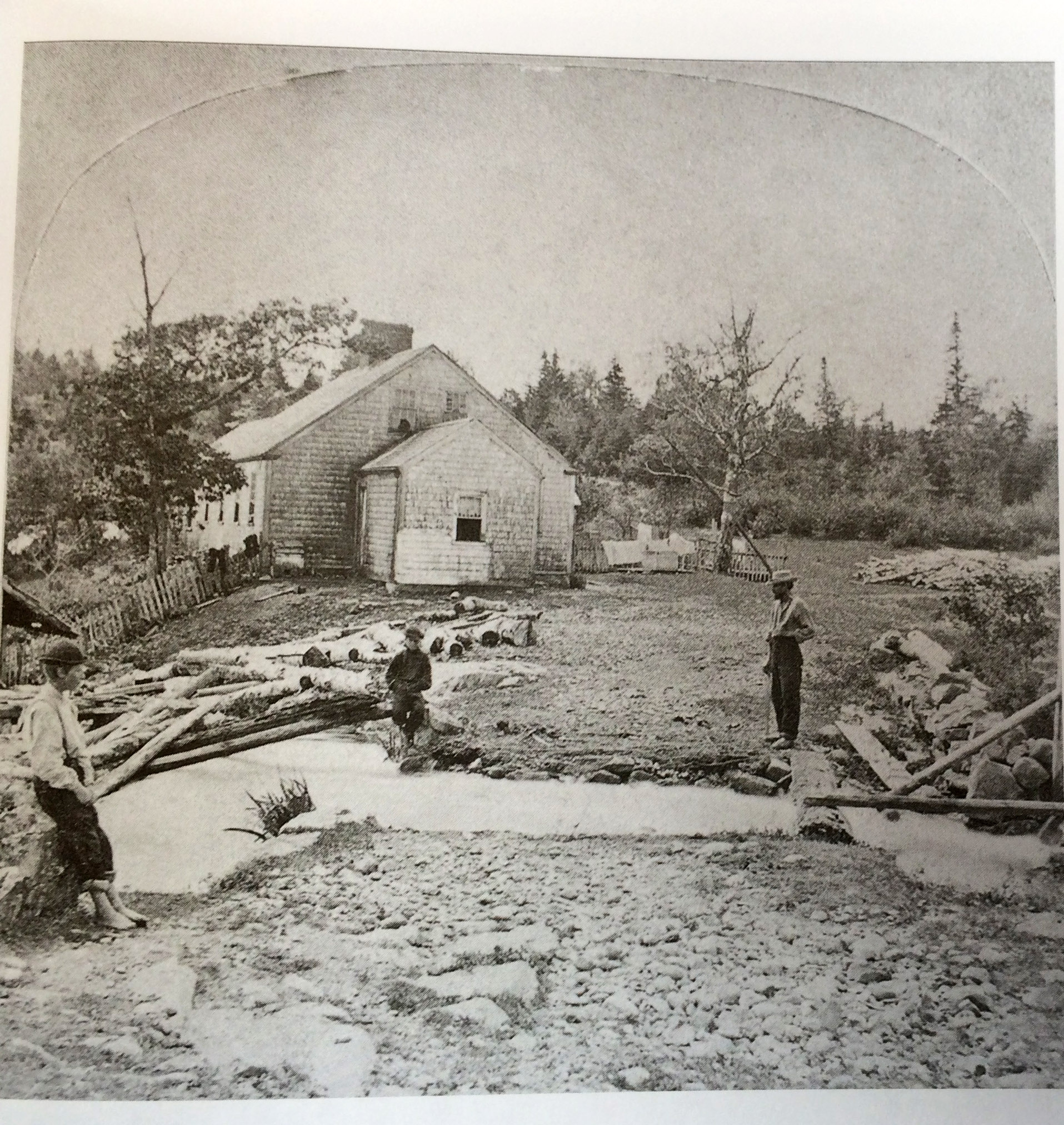
The Coast Walk Project

Blog

Coast Walk 10: Otter Point, part 2

web_DSC8618-Edit

May 15, 2015: 2-4:45pm, forgot to note the temperature, probably low 60s. 2 cormorants, 6 eiders (3 male, 3 female), 2 herring gulls, 1 loon, 2 sea stars, 1 nudibranch (Dendronotus sp?), Northern Lacuna egg cases, a whole mess of sea urchins. And a little cave.

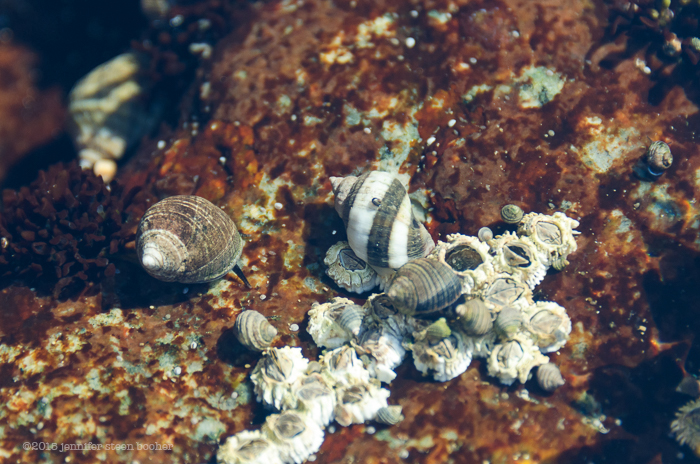
web-CW10mapAnother gorgeous spring day for the Coast Walk! This one was much calmer, with a light breeze rather than the strong winds we ran into last time. My husband, Brian, came with me again. At first the tide pools seemed to have the same creatures we’d been seeing all along – blue mussels, barnacles, periwinkles, and the colorful crustose corallines:

web_DSC8473-Edit

web_DSC8478-Edit

As we got further down the rocks, though, we started seeing deeper-water seaweeds. Many of the pools were full of kelp and Alaria,

web_DSC8497-Edit

and the mix of species got even more colorful:

web_DSC8529-Edit

Then I noticed a tiny white blob on a kelp leaf, which turned out to be a nudibranch! I gather some people call them ‘sea slugs’ but I hang out with a bunch of scuba divers, who call them ‘nudibranchs.’ I’ve been jealous of my diver friends for ages because they get to see these guys.

web_DSC8521-Edit

This one’s on the plain side – other species come in all kinds of vivid colors, with frills and stripes and furbelows all over. I tried to figure out what kind it is but it’s tiny and under water, so a little hard to see details – maybe Aeolidia papillosa? If you could see it from the side, those little white dots stick up, and are called ‘cerata.’ It was so small I couldn’t see them very well, but I think those are the animal’s gills, which in nudibranchs have developed outside the body. ‘Nudibranch’ is one of those scientific names that callously mixes languages: ‘nudi’ means ‘naked’ (in Latin) and ‘brankhia’  means ‘gills’ (in Greek.) Apparently there are 45 species in the Gulf of Maine, and more than 3,000 worldwide. With a name like ‘sea slug’ it sounds harmless, but they are fairly tough carnivores who eat sponges and anemones. Some of them even eat barnacles! Others eat animals with stinging cells, like sea anemones or hydroids, and then somehow re-use those cells in their own defense. All that in one itty-bitty little package.

We also saw a dozen or so sea urchins, all of whom had covered themselves with bits of seaweed or shells. In several cases, they had snagged a very confused live periwinkle. (Sea urchins have little tube feet between the spines that they use to move around or hold on to things.) More about them later…

web_DSC8592-Edit

Then there was this peculiar formation of barnacles:

web_DSC8495-EditSomebody fastened something here not too long ago, but I haven’t been able to find out who or what.  Anybody know?

web_DSC8496-Edit

web_DSC8614-Edit

Then we climbed over a really striking, geometric stone formation, and Brian showed me a small hole hidden under what looked like an ancient rockfall… _DSC8536-web

B: So when I was a kid, back when we first moved here [ed.note, he was about 6], we came to [Otter Point], … and I discovered this … cave, a secret hiding place, and I was so excited. … You can climb down in here and it comes out in the cave down there. I just remember being so absolutely excited at finding this thing, it was like the thing that I discovered that nobody knew about. Of course, I’m sure plenty of people knew about it, but at the time it was my special thing; I remember playing here and insisting that we have my birthday party down here. So we invited my friends down … I don’t even remember what we did  but we all … climbed on the rocks and climbed in the cave and played and imagined that there was buried treasure or imagined that there were pirates, or that this cave was a secret hiding spot. …If you look you can see that the rocks are sort of wedged in the [roof of the] cavern and I can even remember thinking to myself, ‘Wow if that rock fell, that would really be a bad thing!’ So it kind of freaked me out a little bit but in a good way, like rollercoasters … . So, let’s climb through it!

J: OK [kind of doubtfully, not being overly fond of rollercoasters or narrow holes under enormous boulders] Think we can fit?

We kind of slithered down into the hole, which was considerably larger at the bottom:

webIMG_4374

B: if you look up, you’re just like wow, those rocks are just wedged in there, … But I’m sure they’ve been here for a long time. And then, this is the exit, right here.

J: I don’t know that that many people would have found this. I think you’d need to be a little kid to think of going in it, at least from up above. It’s kind of amazing that you were able to find it again.

B: Oh, I knew exactly where it was. I recognized this opening, I just know it. I was waiting for you to say, ‘Oh look, a cave!’

J: Nope, missed it completely. I guess I don’t have my noticing eyes on today.

Yes, that’s right. I was so busy peering into tide pools that I walked right past this:

webIMG_4377


And then we rounded the point and were looking down into Otter Cove at last!

web_DSC8639-Edit


Share

Coast Walk 3 Still Life

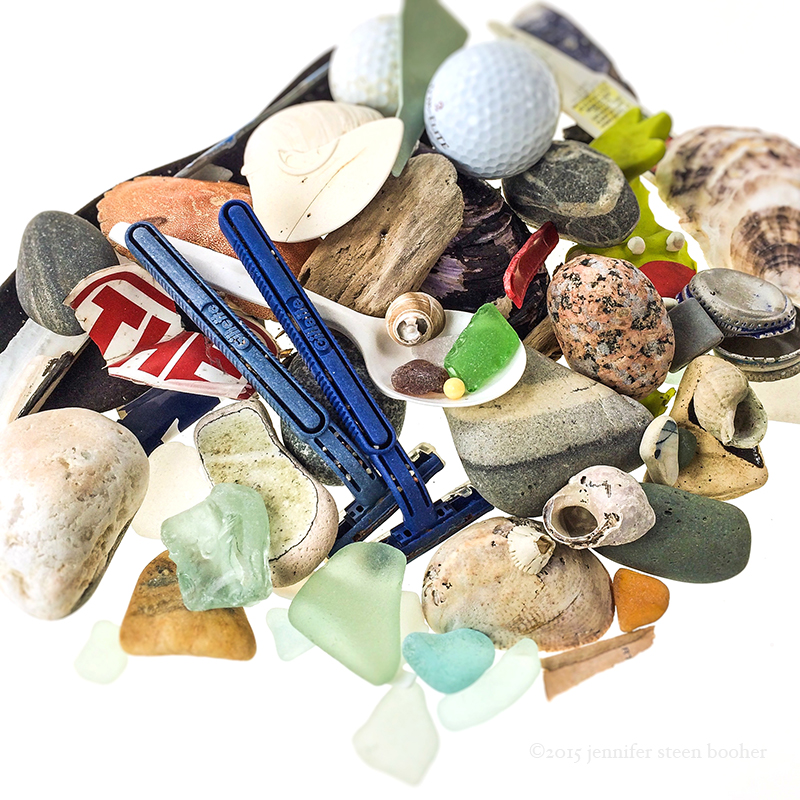
Top to bottom, left to right: fragment of Obama bumper sticker, sea glass, soft shell clam (Mya arenaria), plastic fragment, Northern Rock Barnacle (Semibalanus balanoides), sea glass, beach stone (diorite?), driftwood, beach stones, oyster, granite beach stone, disposable razor, beach china, sea glass, 2 bottle tops, plastic fragment, razor clam (Ensis directus), plastic spoon holding plastic bead, Common Periwinkle (Littorina littorea), driftwood, blue mussel (Mytilus edulis), sea glass, beach stone, remains of plastic chew toy, beach china, sea glass, Rock Crab (Cancer irroratus), disposable razor, Common Periwinkle, sea glass, Dog whelk (Nucella lapillus), sea glass, Obama bumper sticker, sea glass, plastic fork, horse mussel (Modiolus modiolus), Obama bumper sticker, Common Slipper Shell (Crepidula fornicata), plastic plant tag, beach stone, beach stone, piece of a plastic sticker, golf ball, plastic fragment, golf balls.

For your amusement and edification, may I present Coast Walk 3: Cromwell Harbor to Compass Harbor, Bar Harbor, Maine; January 12, 2015. Please forgive the little pun that snuck in there, I couldn’t resist.


Top to bottom, left to right:

Column 1: fragment of Obama bumper sticker, sea glass, soft shell clam (Mya arenaria), plastic fragment, Northern Rock Barnacle (Semibalanus balanoides), sea glass, beach stone (diorite?), driftwood

Column 2: beach stones, oyster, granite beach stone, disposable razor

Column 3: beach china, sea glass, 2 bottle tops, plastic fragment, razor clam (Ensis directus)

Column 4: plastic spoon holding plastic bead, Common Periwinkle (Littorina littorea), driftwood, blue mussel (Mytilus edulis), sea glass

Column 5: beach stone, remains of plastic chew toy, beach china, sea glass, Rock Crab (Cancer irroratus)

Column 6: disposable razor, Common Periwinkle, sea glass, Dog whelk (Nucella lapillus), sea glass, bit of Obama bumper sticker, sea glass, plastic fork

Column 7: horse mussel (Modiolus modiolus), bit of Obama bumper sticker, Common Slipper Shell (Crepidula fornicata), plastic plant tag, beach stone

Column 8: beach stone, piece of a plastic sticker, golf ball, plastic fragment, golf balls.


And now taking shape on the light table, Coast Walk 6:

IMG_4966-web©

Share

Coast Walk 10: Otter Point, part 1

web_DSC8439-Edit

Shadblow (Amelanchier canadensis) in bloom at the Otter Cliffs parking lot.

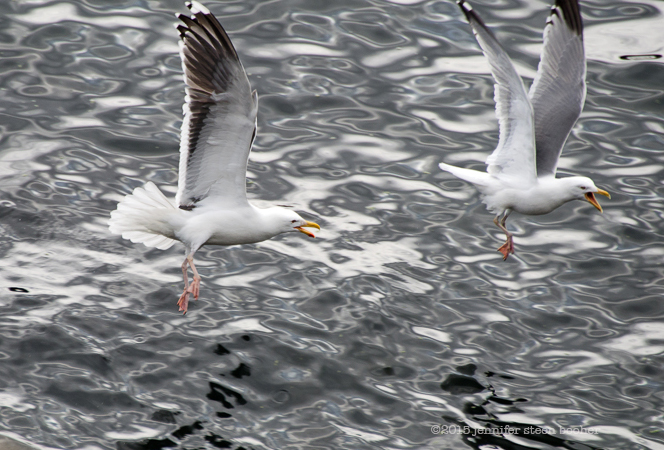
May 13, 2015: 12:30-3:15pm, low tide at 1:08pm, 63ºF, sunny, strong wind and heavy surf. Cold in the wind, warm out of it. 10 eiders (5 male, 5 female), 2 possible laughing gulls, several Herring Gulls, 1 crow, 1 dead salamander, 2 green crabs (1 dead, 1 alive), 1st live sea urchin of the Walk.

web-CW10map

I’m afraid the blog has been falling behind a bit – I’ve reached Hunter’s Beach in real life, but here on the blog we’re still on Otter Point. When I first started working out the logistics of this project, I thought one mile per week sounded reasonable, and based on my previous beachcombing experience, I thought I could go about a mile in roughly two hours. Ha! My usual beachcombing haunts were relatively flat beaches that are good collectors of junk, like Hulls Cove. Now that the ice has melted, I can’t blame my slow pace on winter, and I’ve had to admit that even though I’m getting stronger and faster, scrambling up and down ledges and small cliffs just takes longer.

web_DSC8201-Edit

And when you throw in a good tide pool, some interesting rock formations, and a critter or two, well, the hours just slide by. I’ve kept up the pace of one mile per week by spreading it over the course of several days, but there’s this little matter of earning a living (and raising a family) that’s messing up that plan … I hate to say it, but I’m going to have to slow down. Yes, I know, one mile every two weeks sounds positively lazy, doesn’t it? But going around Otter Point and the east side of Otter Cove took me about 15 hours over the course of 5 days because the tide pools were amazing and I didn’t want to miss anything. Then there were at least 30 hours of editing photos and transcribing audio from interviews, hunting through the Acadia National Park archives, researching critters, searching for old photos, and reading up on the history of Otter Creek  … there were so many amazing things in that one mile it’s going to take three blog posts to cover them all!

web_DSC8550-Edit

So here we are, two weeks ago, heading down the Otter Cliff path with my husband, Brian, on a gorgeous spring day, with a strong wind whipping our hair into our faces and waves crashing against the rocks.

web_DSC8197-Edit

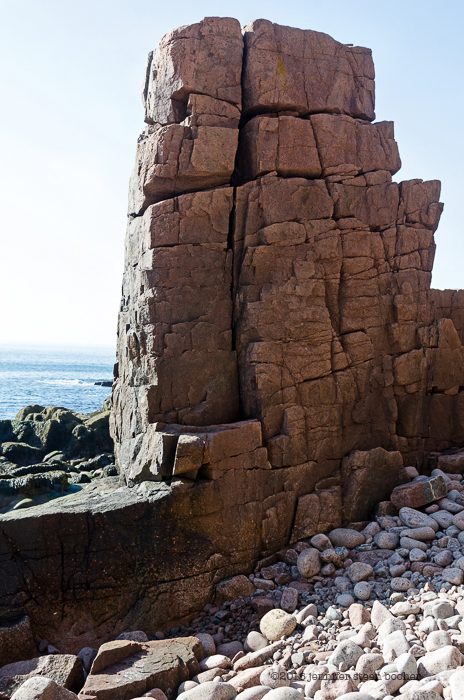
The first thing I noticed was the abrupt shift from the angular but rounded pink granite we’ve been walking on since Sand Beach

web_DSC8392-Edit

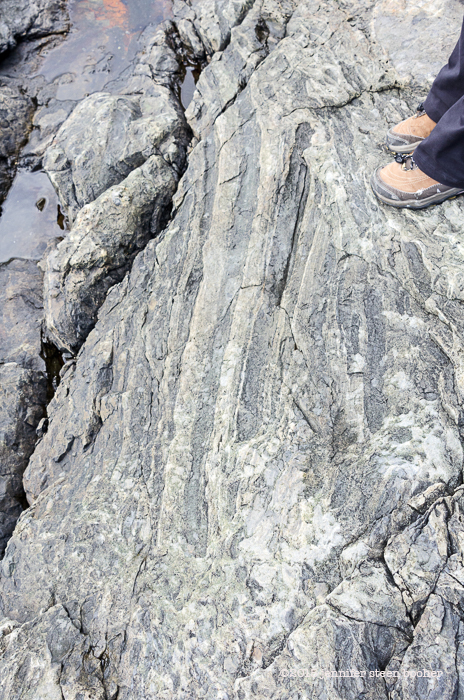
to the mixed up, sharply broken formations of the shatter zone.

web_DSC8194-Edit

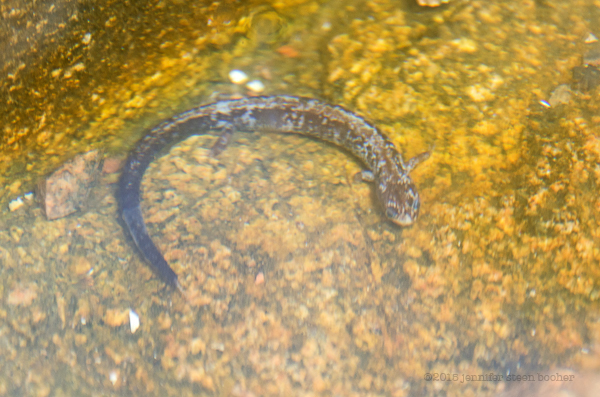
Then I found a dead salamander in a rock pool up near the top of the cliffs and forgot all about geology because I was too busy looking in every pool to see if there were any live ones. (I’ve been hoping for salamanders ever since Rich told me he’d found their eggs in pools here at Otter Point.) Nope, no salamanders.

web_DSC8219-Edit

As we climbed a little further down we found a dozen or so ladybugs scattered across the rocks:

web_DSC8223-Edit

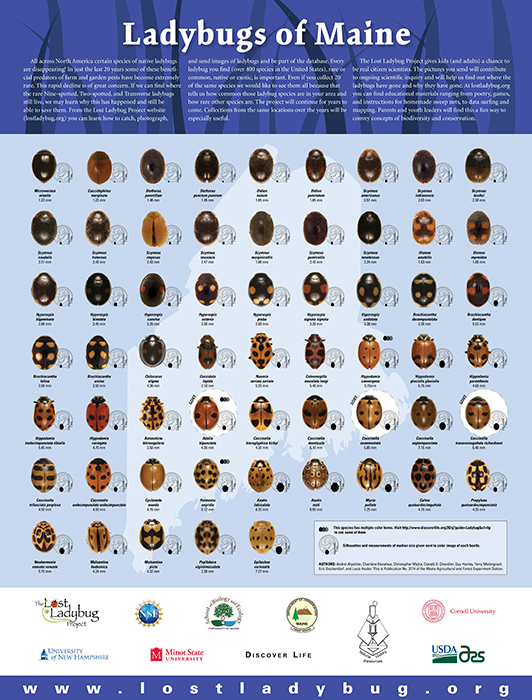
And this is typical of why writing the blog takes so long: at the the time, I just thought, ‘Huh, that’s odd,’ but back home editing the photos I got curious about why ladybugs would be crawling around on granite in the spray zone. They eat aphids, right? And there are no aphids on seaweed. Or rocks. A Google search for “Maine ladybug” brought me to The Lost Ladybug Project and this poster of all the ladybugs found in Maine:

Who knew there were so many species! The LLP is documenting ladybug populations in North America, trying to figure out why native ladybug populations have decreased while imported ladybugs have spread rapidly. “This is happening very quickly and we don’t know how, or why… We’re asking you to join us in finding out where all the ladybugs have gone so we can try to prevent more native species from becoming so rare.” I’m fascinated by other people’s obsessions and a big fan of citizen science, so down the internet rabbit hole I went, trying to ID my bugs so I could add my photos and info to their database, because they asked so nicely.

I was really hoping we had found some Coccinella novemnotata, the Nine-spotted Ladybug (the LLP organizers’ enthusiasm must be infectious because I’ve never thought twice about ladybugs before other than to sweep their dead bodies off my windowsills) but after spending half an hour staring at photos on the Lost Ladybug site, with excursions to Wikipedia, I’m pretty sure our bugs were Coccinella septempunctata, the Seven-spotted Ladybug, which is the most common ladybug in Europe. The species was introduced in the US back in the 70s as a biological control for agricultural pests like aphids. If you remember my rant about Latin names, you might guess that ‘sept’ mean ‘seven’ and ‘punctacta’ means ‘spotted’ (as in ‘punctuation’ and ‘puncture.’)

A few other interesting things turned up: this particular species was the first to be named ‘ladybug’ and all the others were named by association; ladybugs were named for the Virgin Mary (as in “Our Lady); and the seven spots symbolize “her seven joys and seven sorrows,” which is a Catholic thing so I had to look it up. If you are curious, the joys are listed here and the sorrows here. It’s a particularly strange association since ladybugs are not only carnivores (they eat aphids), they can be cannibals, too.

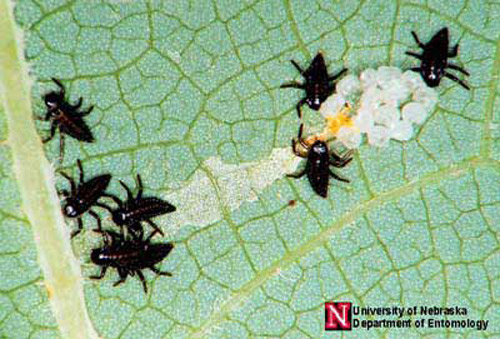
I also discovered that ladybugs have a couple of larval forms, which shouldn’t have surprised me, but it did:

Ladybird May 2008-1.jpg

“Ladybird May 2008-1” by Alvesgaspar – Licensed under CC BY-SA 3.0 via Wikimedia Commons.

Oh, and when ladybugs are threatened they bleed from the knees (apparently it tastes and smells bad to predators.) I still don’t know what they were doing wandering around on the shore, although I did read that they like to overwinter in a south-facing spot with tussocks of grass and sheltered by boulders, so maybe they were just waking up from a long winter’s nap.

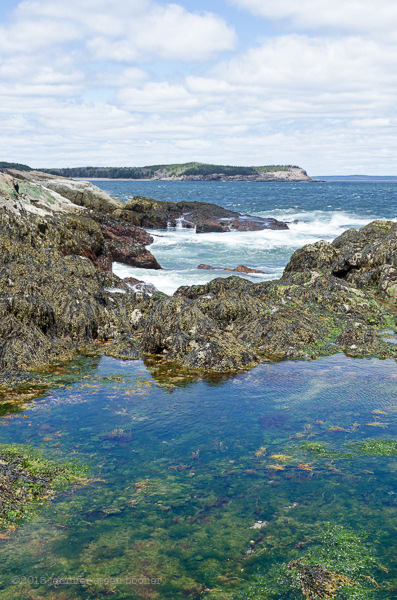
So, after the ladybugs, we reached sea level, and the tide pools got more and more crowded with seaweeds.

web_DSC8243-Edit

The sun was right overhead, and the glare made it difficult to see under the water and just about impossible to photograph. You can probably tell the photos look a little flat today – that’s the overhead lighting.

web_DSC8273-Edit

The topography alternated between ledges stretching out into the sea

web_DSC8340-Edit

and bouldery areas completely carpeted with rockweed.

web_DSC8371-Edit

There were even a couple of stretches of our old friend, the Bar Harbor Formation.

web_DSC8407-Edit

web_DSC8420-EditWe saw the first live sea urchins of the Walk, but I couldn’t get a decent photo of them. They were too far down and the glare was too bright. On our way back up the cliff we spotted something moving in this tide pool:

web_DSC8421-EditSeveral somethings, really. They were black, fish-shaped, a couple of inches long, and moved very fast. We climbed back down to get a better look but the somethings promptly hid. We waited patiently for about ten minutes, but they were stubborn and we went home without seeing them.

web©-CW3stillLife

In other news, the pile of things I found back on Coast Walk 3 is on the light table, and the next still life is starting to take shape.


Share

Coast Walk 9: Sand Beach to Otter Cliffs

web-_DSC7868-Edit

May 6, 2015: 6-11:30am, forgot to note temperature, probably in the low 60s when we started, might have been 70ºF by the end of the walk. 1 Red Squirrel, 2 Herring Gulls, 1 Purple Sandpiper, flock of 10 Guillemots, 1 Cormorant being harassed by a Herring Gull, 5 birds flew by overhead that might have been Canada Geese.

CW8map

Walkers:

Kelley Sanborn, Director of Special Services, Mount Desert Island Regional School System

Lilea Simis, owner, Town Hill Marketweb-_DSC7965-Edit

web-_DSC8038-Edit

Kelley and I met at the Great Head parking lot at 6am on a bright, sunny morning. (Lilea had to get her kids off to school and planned to join us later.) It was about 45 minutes after sunrise, and the day still felt all new and shiny. We struck out along the path, talking about the long winter and how beautiful the day had turned out. Certain people may have started singing, “Oh what a beautiful morning” because we’ve known each other for twenty years and it no longer matters if certain people can carry a tune or not.

web-_DSC7857-Edit

Even though we’ve moved into new geologic territory, hiking over Cadillac Mountain granite now, the shoreline continued the pattern I’d seen all along of headlands and coves. Along this mile or so between Sand Beach and Otter Cliffs, the headlands tended to be weathered and rounded, while the coves were filled with enormous round cobbles.

web-_DSC7861-Edit

Kelley has had some trouble with her knee, which has to be intensely frustrating for such an active woman (her snowshoes got me through the winter!), so when I went scrambling down the rocks to check out tide pools, she mostly followed along the trail at the top of the cliff. (That’s why she’s so far away in the photo up top.)

web-_DSC7864-Edit

web-_DSC7881-Edit

from "A Souvenir of Bar Harbor - Mount Desert Maine," W.H. Sherman, 1893. Photo courtesy of the Jesup Memorial Library

from “A Souvenir of Bar Harbor – Mount Desert Maine,” W.H. Sherman, 1893. Photo courtesy of the Jesup Memorial Library

web-_DSC7883-Edit

There were a few spots where it was possible to get down to sea level, but the stones were covered with a slippery algae I don’t remember seeing before. It was dark green, and Kelley called it “Elvis velvet,” because it looked like the background of one of those paintings of Elvis on black velvet:

web-_DSC7980-Edit

I haven’t identified it yet. It was lovely, but inconvenient. You can see it glowing bright green in some of the photos:

web-_DSC7885-Edit

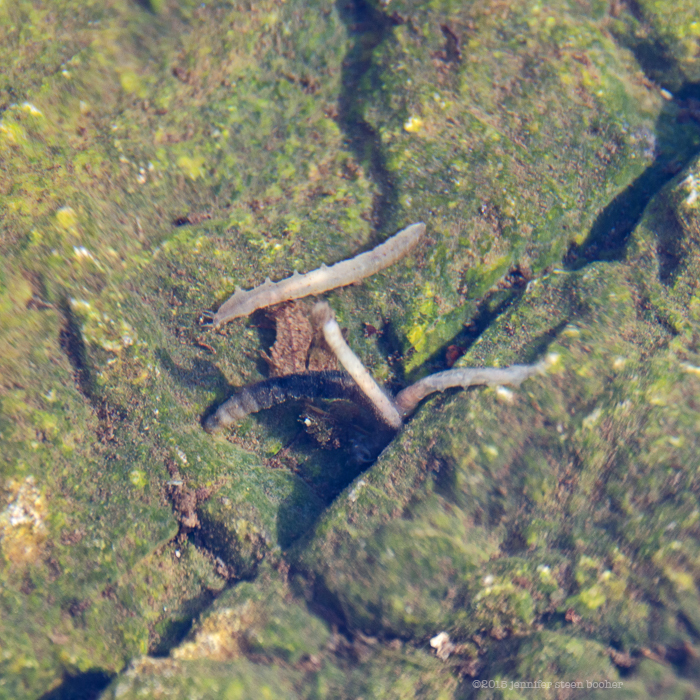
I did eventually find a safe spot to climb down. In one of the pools near the top of the descent (not a tide pool, too high up, probably runoff) I found a dozen or so things that looked like caterpillars. I assume they are some kind of terrestrial larvae that were washed into the pool by the last rain storm. At least one was still alive, I couldn’t tell about the others.

web-_DSC7892-Edit

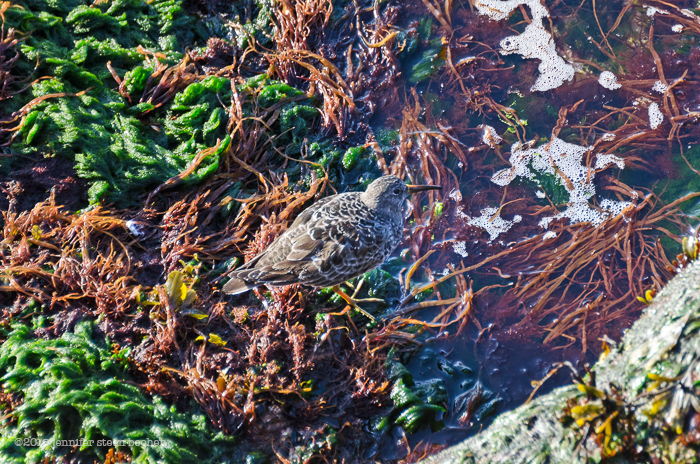
Looking over the edge of a cliff, Kelley spotted this cutie, which I think is a Purple Sandpiper, hunting for breakfast.

web-_DSC7936-Edit

web-_DSC7970-Edit

The discovery of the day was a long, narrow tide pool full of tiny anemones.

web-_DSC7942-Edit

They were about the size of a quarter, and almost translucent.

web-_DSC7947-Edit

web-_DSC7958-Edit

Ever since Schooner Head I’ve been finding wildly striped Dog Whelks. I had no idea their shells could be so varied.

web-_DSC7950-Edit

The lowest tide pools had forests of seaweeds:

web-_DSC7982-Edit

Then there was this amazing cobble beach. I’m not sure you can actually call it a cobble beach, it was more of a boulder beach. Those stones are all big enough for both my feet to stand on, and the cliff face must have been forty feet high.

web-_DSC7987-Edit

Of course I had to go exploring in this forest of sea stacks!

web-_DSC8009-Edit

web-_DSC8017-Edit

web-_DSC8018-Edit

The size of the boulders made it difficult to walk – your foot only connects with a small part of the curve, so every step is wobbly.

web-_DSC8014-Edit

By the time I crossed the cove it was 8:30am, and suddenly we were at Thunder Hole.

web-_DSC8040-Edit

The observation platform and walkways at Thunder Hole are being rebuilt, and the Park Service really really really doesn’t want you walking around down there.web-_DSC8042-Edit

Lilea found us just before Thunder Hole, so we all sat on a broad rock ledge in the spring sunshine, eating apples and granola bars, catching our breath. While the three of us are taking that break, I’m going to tell you about a part of the walk that happened a few days earlier, but belongs here at Thunder Hole.

Photo courtesy of the Jesup Memorial Library

Postcard of Thunder Hole. Photo courtesy of the Jesup Memorial Library

May 3, 2015:  64ºF at 4:30, but by 5:30 had dropped to 52ºF, and the wind got much stronger.

George Neptune, Museum Educator, Abbe Museum, Bar Harbor, Maine, and member of the Passamaquoddy tribe.

_DSC7788-web©

You may remember George from the very first Coast Walk on New Years Day. We had planned long ago to meet here at Thunder Hole for the story of Koluscap and the Whale, and he did tell me that story, but we went on to have a long, fascinating talk, touching on Passamaquoddy spiritual beliefs, the struggle to get Maine schools to stop using “Indians” as mascots, and his dreams for the future. He even brought out his drum and sang the most beautiful song.

And my iPhone recording vanished. It was working, I checked it as we talked to make sure, but somewhere between pressing the stop button at the end of our talk, and opening the program to view the video, it vanished. And I cannot get it back. So I’ve tried to recreate as much of the conversation as I can, although it’s all in my own words now, not George’s, and I know I’ve forgotten so many important details, I could just cry.

So.

The story of Koluscap and the whale is part of a much longer story about the epic fight between Pukcinsqehs, a witch, and Koluscap, a kind of demi-god and cultural hero of the Wabanaki tribes. We’ll hear the full story when we reach Somes Sound, where some of it takes place. It is an important episode as it describes the first treaty ever made in the Dawnland, and establishes the importance of the pipe as a symbol of friendship. (Slight digression here, apparently smoking a pipe together is comparable to the European concept of breaking bread together.)

At this point in the story, Pukcinsqehs (sounds like pook-sin-squash) has kidnapped Koluscap’s relatives, Grandmother Woodchuck and his younger brother Pine Marten. He chased her a long distance, but she stole his canoe and set out across the sea with her captives. Koluscap couldn’t follow so he sang the whales’ song and Putep (sounds like “boo-dep”) came to him. He asked her to carry him across the water, but she was worried about running aground and asked him to promise that she would be safe. Koluscap promised, and asked her to promise to keep him safe on the journey, which she did. So he climbed on her back and they set out after Pukcinsqehs.

As they got closer to the other shore, the clams on the bottom began to sing to Whale that she was getting too close and would run aground. Koluscap did not understand the clams’ song, and Whale told him what they were saying and asked if it were true. Koluscap lied and said they were still a long way from shore, so Whale continued swimming. Soon the clams sang to Whale again, warning her that she was too close and would be beached very soon. Again she asked Koluscap and again he told her to keep swimming. Soon poor Whale did run aground, and Koluscap jumped off her back onto the beach. Whale was very upset that he had lied to her, and reproached him for breaking the agreement. Koluscap said, “I promised you would be safe,” and placing the butt end of his spear against her forehead, he pushed her off the beach and into deep water. Then Koluscap gave Whale his pipe to celebrate their treaty and their friendship, and she swam off, with the pipe smoke rising above her.

George chose to tell this story at Thunder Hole because the Passamaquoddy name for this spot is based on the words for ‘blowing water into the air,’ which are also the basis for the whale’s name, Putep. He also pointed out a naturally-formed face in the rock, which fits in with the very end of Koluscap’s saga, in which he left to go to a place behind the sun, where he is making weapons for a battle at the end of the world, but before he left, he set images of himself in the rocks throughout the Dawnland.

_DSC7783-web©

Somehow we moved from the face in the rock to the idea of the cleft in the rock as an opening to the underworld. I had to stop George and ask what the underworld is. I don’t like to assume I understand a concept just because I know what the word means. My idea of “underworld” is basically Greco-Roman, but for George, the underworld is not hell, or death, or anything particularly negative. See the seven sides on his drum? One for each direction: east, west, north, south, above, middle (here on earth) and below. Above and below are both spiritual (and this is where I really miss my recording of our conversation!), with above being more ethereal and below more closely tied to earthly things.  Things that happen in both places get played out here in the middle, on earth. More to the point, a place like Thunder Hole, a deep cleft in the earth at the edge of the ocean, is a possible point of communication between the realms. As George described it, joining the elements is powerful, and a ceremony here would most likely involve fire, to include all of them. We also discussed his concept of time, which is not linear, but more like a spiral, with distant ancestors still considered family, and part of the current “we.” I’m reluctant to try to paraphrase all this, as I’m in danger of getting it badly wrong. I was raised in the Jewish tradition when I was little, and the Protestant tradition when I was older, and I think in the end religion comes down to stories and belief. Stories are very powerful, and it’s important to get them right.

We talked about the situation in Skowhegan, where George was planning to go the next day for a school board hearing about changing the school mascot, currently the Skowhegan Indians. Skowhegan is apparently the last town in Maine to use that name for their sports team. I admitted my ignorance, and said that for me, personally, if a group of people found the use of their name or image offensive, that would be enough for me to stop using it, but I didn’t quite understand why it was offensive in this case. I grew up in Massachusetts, and there were teams named for the Minutemen, or the Patriots, who used the image of a person as their logo. How was this different, I asked? George pointed out that those were specific groups, well identified in historic or military terms, while “Indians” lumps together entire nations of people who have widely differing customs and histories and beliefs into one dismissive and off-handed term.

Yeah, I can get that.


[As of May 10, the school committee had voted to keep the name.]

In my favorite part of our conversation, George told me about his dreams for the future. He’d like to have a gallery with working studios filled with Wabanaki artists and artisans. Bar Harbor would become an art destination like Santa Fe, where authentic work is appreciated and native symbols are woven into murals and decoration throughout the town (but not misused.) He mentioned the Wabanaki double curve as an example, and once again I had to stop him and admit ignorance: “What’s a double curve?” In answer, George showed me the tattoo on his neck:

_DSC7791-webBy this time the wind had picked up and the temperature had dropped almost ten degrees. My fingers were turning numb, so we headed back to our cars.

It rarely fails – in the course of every single coast walk I learn something that boggles my mind. I generally think I’m pretty smart and well-educated and widely read. I know the whole point of this walk is to learn stuff and become a better artist, but four months in and the biggest lesson I’m learning is the depth of my own ignorance. There is a gaseous form of granite, mice dig tunnels in deep snow, we live on a prehistoric volcano, deer get hurt and I can’t help them, the colonization of the Americas is still happening and I’m part of it, I can climb a steep rock face with my bare hands, and some sea anemones reproduce by splitting in half. What kind of art can I possibly make that would adequately communicate the intricate life of a barnacle let alone the pain the Passamaquoddy feel at having the name of a nation without the actual rights of self governance? I have to hold myself open and accept all the data, even the painful and uncomfortable stuff that I don’t know how to address, in the belief that somehow, when it all gets shaken up together, something big, and powerful, and beautiful will come back out.

Back to the sunny day with friends. (And if that gives you mental whiplash, yes, me too.)

web-_DSC8086-Edit

I tottered across one more cobble beach, but decided that three hours of scrambling was all my legs could handle, so I climbed back up to the path and we strolled out to Otter Cliffs.

web-_DSC8074-Edit

web-_DSC8105-Edit

So why is it called “Otter Cliffs?” I’ve come across two stories. One is that they were named for the Sea Mink (Neovison macrodon), which was hunted to extinction by 1870, before it was even cataloged by naturalists. The species was described through skeletons, a taxidermied specimen, and anecdotal evidence. The mink was a coastal dweller, ranged from Casco Bay north to Newfoundland, and was the largest of all the minks. It apparently lived on seabirds, seabird eggs, marine invertebrates, and insects.

The other possibility is that Otter Creek was named for river otters found there, that the town of Otter Creek was named for the stream, and that Otter Cove and Otter Point were named by extension. I’ve found several references that call Otter Point the Otter-Creek Point (see below). In that case, the animal in question is probably Lontra canadensis, the North American River Otter:

River otters can be found in both freshwater and coastal marine areas. They are found throughout the entire US, except where pollution or habitat loss have driven them away. River otters apparently eat fish, turtles, crayfish, and frogs. I’ve never seen one, but the Acadia National Park website lists them as a common species here. Maybe someday!

Screen Shot 2015-05-10 at 10.06.43 AM

detail of “Path Map of the Eastern part of MDI,” 1911. Courtesy of the Library of Congress.

“After [passing through the Gorge], the road turns up along the Peak of Otter; runs high along the ridgy east wall of Otter Cove, with charming views of the cove and its settlement of farms; and finally stops at a little house. A fee is paid at the farmhouse at the end of the road; and leaving the carriage, the holiday rambler walks along a pleasant path, through a short stretch of evergreen woodland, and emerges on the vast cliffs, at whose foot, [nearly] a hundred feet below, the sea roars and whitens ceaselessly. The trend of the shoreline is visible as far as the yellow Newport Sand [Sand Beach] and the high promontory of Great Head. Otter-Creek Point is over a mile long, between the sea and Otter Cove, and rises to a height of 188 feet, covered with woods, and fronted on either side by noble cliffs. … A mile inland rises the Peak of Otter, a wild foot-hill of Newport [Champlain] Mountain. This region received its name from the otters that once abounded here, but have long since passed away. … Beyond Otter’s Nest, the summer-residence of Lieut. Aulick Palmer, of Washington, a road runs on to the end of Otter-Creek Point. Unless it is nominated in the bond, the buckboard drivers oftentimes decline to drive out over this noble road. On the western side of the point is a notable cavern, near which the natives have dug a deep pit, in the search for Capt. Kidd’s buried treasures. …Otter Cove makes in for half a mile, between high wooded shores; and has on one side a quarry of … red granite. In ancient times the head of the cove was occupied with beaver-dams.” [“The Journey to Otter Point,” M.F. Sweetser, 1888, reprinted in Discovering Old Bar Harbor and Acadia National Park, Ruth Ann Hill, 1993.]

Screen Shot 2015-05-10 at 10.11.03 AM

detail of “Map of Mount Desert Island,” George N. Colby, 1887. Courtesy of the Library of Congress.

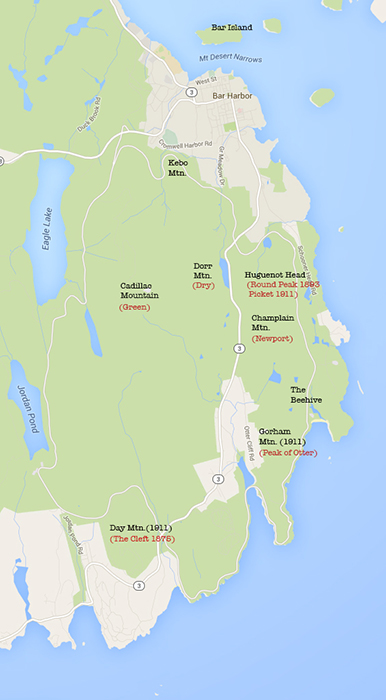
Notice that in the 1887 map, “Peak of Otter” refers to what we now call Gorham Mountain, while on the 1911 map it is the lump of land on Otter Point. Maps from 1890 and 1893 agree with the 1887 map, but there are two 1911 maps that move “Peak of Otter” to the point and call the larger mountain “Gorham.” Mountains moving: I don’t really know what to make of that.

web-_DSC8091-Edit

Looking back from Otter Cliffs into what I now know is called Newport Cove, named for the mountain behind the Beehive at left, which is now Champlain, but was once Newport. Newport Mountain and Cove were named for Christopher Newport, an English sea captain who was commander of the expedition that settled Jamestown (in the course of which he almost executed Captain John Smith, which would have been a tragedy for Disney) and who inadvertently colonized Bermuda. The Beehive and Kebo seem to be the only mountains in this area that were not renamed in the last century: they show up with their contemporary names on an 1875 map, the oldest one I have that labels the mountains.

OldMtnNames-edit2

The current names are in black. The old names are in red. After I made the map, I realized that ‘Dry Mountain’ was first changed to ‘Flying Squadron,’ although it doesn’t show up with that name on any of my maps, and was changed to ‘Dorr’ after Dorr’s death in 1944.

I got curious and looked into the name changes very briefly. It looks like most of them were changed in 1918 when George Dorr, in his role as Monument Custodian for the Hancock County Trustees of Public Reservations, made a formal proposal to the National Park Service. Others changes were proposed in 1919 when the Sieur de Monts National Monument became Lafayette National Park, although they didn’t gain approval until 1929. Dorr’s reasoning seems to have been that the old names were boring, and he wanted names with historical associations, which seems a bit high-handed to me. There’s a good, short, article in the Woodlawn Museum’s newsletter that summarizes some of the controversies around the name changes. My favorite quote: “Privately, Ellsworth District Court Judge John A. Peters advanced the popular misconception that if Green Mountain could be renamed Cadillac then logically Dorr “ought to call another one ‘Buick’ and certainly a peak near Seal Harbor ought to be called ‘Ford.’”

My brain feels utterly stuffed at the moment, but when it clears I’ll do some more research and give you a ‘bonus post’ on the mountain names.

More next week as we head around Otter Point into Otter Cove and up to Otter Creek.

Share

Coast Walk 8: Sand Beach

web-MermaidwithSword

May 3, 2015: 5:30-6:30pm, about 53ºF, sunny and very windy. Cold in the shadows – my fingers got numb! Low tide at 5:30. Not much wildlife: 3 or 4 Herring Gulls.

IMG_4168-web©

The Merriam-Webster dictionary defines ‘sand’ as, “a loose granular material that results from the disintegration of rocks, [and] consists of particles smaller than gravel but coarser than silt.” The first thing every kid learns on the 6th grade field trip to Sand Beach is that there’s not a lot of ‘sand’ there. Maybe half the stuff on Sand Beach that looks like sand is actually finely crushed shells. If you look at it closely, even without a microscope, you can see bits of mussel shells and clam shells and sea urchin spines. Now, mussel and clam shells are not flat, they are curved, right? So each of those teeny fragments is slightly cupped. This gives swimming at Sand Beach its most irritating quality – other than the brazen gulls who will literally swoop from behind and snatch a sandwich right out of your hand – once you get wet, the concave bits of sand suction on to you like they’ve been glued on, and you have to scrape and rinse and scrape and rinse to get the stuff off.

web_DSC7844-Edit

There’s a distinct difference between the rocks at the eastern and western ends of the beach. The area we’ve been traveling through since leaving town has been shatter zone, with a mixture of different stones and periods, and Great Head itself had a lot of areas where the older rock was isolated in chunks within the newer granite. Like this:

web_DSC7523-Edit

At the other end of the beach, the western end, the older rock is replaced by ledges of Cadillac Mountain granite that run all the way to Otter Cliffs. According to my map (Bedrock Geology of Mount Desert Island, Gilman & Chapman, 1988) we’ll see a fringe of shatter zone at the tip of Otter Cliffs.

web_DSC7712-Edit

Great Head and Sand Beach were donated to Acadia National Park in 1949 by the Satterlee family, who acquired the property in 1910. Marie Yarborough, the curator of the Park’s archives, was very kind and dug out some old photos of the estate for us. Thank you, Marie! I’m going to go look through some of their holdings next week, and look forward to seeing what kind of treasures they have.

Photo courtesy of Acadia National Park Archives

The Satterlee estate before the fire. I think we are standing on the Beehive, and Sand Beach would be just out of the photo at lower right. Photo courtesy of Acadia National Park Archives.

Photo courtesy of Acadia National Park Archives

Photo courtesy of Acadia National Park Archives

Photo courtesy of Acadia National Park Archives

Photo courtesy of Acadia National Park Archives. The notes are mine.

Photo courtesy of Acadia National Park Archives

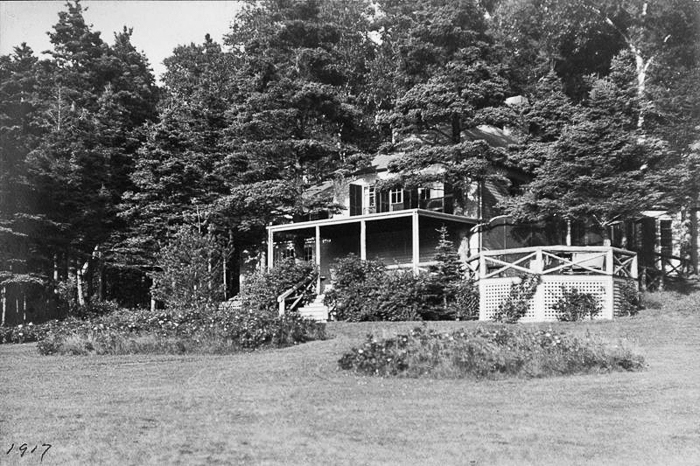
Satterlee house ca. 1917. Photo courtesy of Acadia National Park Archives

Library of Congress, Prints & Photographs Division, [reproduction number, e.g., LC-J7-1234]

Garden designed by Beatrix Jones Farrand circa 1921. Library of Congress, Prints & Photographs Division, [reproduction number, e.g., LC-J7-1234]

“Nearly a century ago, the grounds behind Sand Beach were part of a grand 110-acre estate called “Great Head,” owned by Louisa Morgan Satterlee, the daughter of financier J. P. Morgan, who was one of the owners of the ill-fated Titanic. The estate, which was managed in season by a staff of ten household servants and five gardeners, was a wedding gift from Mrs. Satterlee’s father.

In 1921, Mrs. Satterlee hired the renowned garden designer Beatrix Farrand to transform the landscape. The magnificent grounds, which included beds for annuals and perennials, and even a bridge, in a forested setting, remained in bloom until part of it was destroyed by the Great Fire of 1947 … .

Given to Acadia National Park in 1949, most of the estate’s buildings were removed shortly thereafter. Nature took its course, and the once spectacular gardens returned to woods and meadows. …

The path that now runs from the Great Head parking lot to the east end of Sand Beach was once the driveway for the Satterlee’s main house. The estate included the gardens, barns, greenhouses, servants’ quarters, guest houses, a water tower, and boathouse and tennis courts. An oddly out-of-place concrete foundation here, or stone retaining wall there, are all that remain.” (from “Great Head’s Long-Lost Eden,” Earl Brechlin, The Ellsworth American, July 26, 2012)

photo from Discovering Old Bar Harbor and Acadia National Park

photo from Discovering Old Bar Harbor and Acadia National Park, Ruth Ann Hill, 1993.


In July of 1911, a schooner called the Tay was driven onto Sand Beach by a storm and wrecked. I’ve been told that the most severe winter storms will sometimes uncover her timbers for a little while, but have never seen them myself.

“Lumber schooners like the Tay typically carried deckload piled as high as possible, leaving just enough room for the booms to swing over. It was not unusual for the helmsman to have a hard time seeing forward. Since the entire cargo was buoyant, lumber carriers could, and did, load until the decks were awash. The remains of the Tay lie under Sand Beach, far up on the shore near the stairs.” (p.122, Discovering Old Bar Harbor and Acadia National Park, Hill, 1993.) The photo below is not the Tay, but a similarly loaded schooner.

IMG_4076-ed2

Photo courtesy of the Jesup Memorial Library, Bar Harbor

IMG_4057-ed2

Wreckage of the Tay, photographed ca.1950. Photo courtesy of the Jesup Memorial Library.

IMG_4058-ed2

Wreckage of the Tay, photographed ca.1950. Photo courtesy of the Jesup Memorial Library.

I found two accounts of the disaster, one in the local paper and the other in the New York Times. There are some interesting differences in the accounts.

“In the great storm of wind and rain which was almost terrifying in the heart of town last Friday night, and has proven to have been most fearful at sea, the two-masted schooner Tay, Capt. I.W. Scott, of St. John, N.B. bound from St. John to Boston with lumber, went ashore on the Sand Beach at Great Head, … at 12:15 o’clock Friday night and was a total loss. One man was lost, J.B. Whelpley, the cook, of St. John, N.B., who is survived by a wife and three children. … The crew numbered six besides the captain.

The Tay was doing well, according to Captain Scott, and was bowling along in the face of a heavy southwest gale, when the schooner sprung a leak. At this time he was keeping her off shore and when the leak was discovered he squared away and intended to make the harbor here.

The mainsheet parted and then he lost his main boom. Capt. Scott attempted to stand off shore under head sails, but he was too far in and was swept inside the breakers. The Tay struck hard and was dismasted fore and aft at the first shock and began to go to pieces rapidly. The deck load of shingles was carried away but her cargo of plank below deck is safe on the beach.” [“Schooner Wrecked,” Bar Harbor Times, 1911, reprinted in Discovering Old Bar Harbor and Acadia National Park.]

NYTimesTayWreckThe Satterlees built a boathouse on Sand Beach – I’m not clear if it was built from the wreckage or just named for the schooner:

Photo courtesy of Acadia National Park Archives

Photo courtesy of Acadia National Park Archives

And then I was poking around in the Jesup Library’s vertical file (a four-drawer filing cabinet filled with randomly amazing articles, photos, and documents) looking for photos of Great Head before the Satterlees, and I found this:

IMG_4089-fullarticle

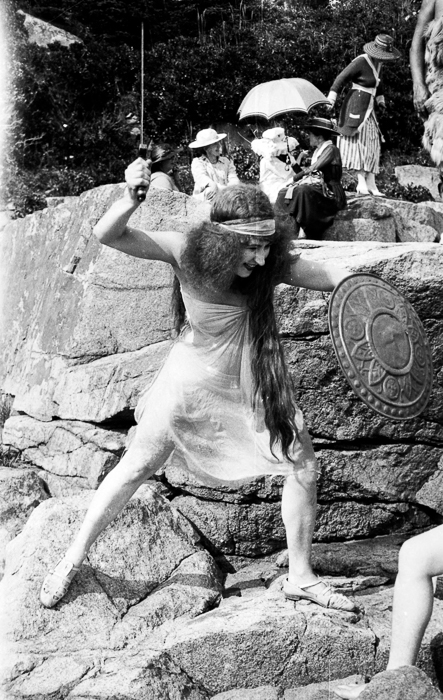
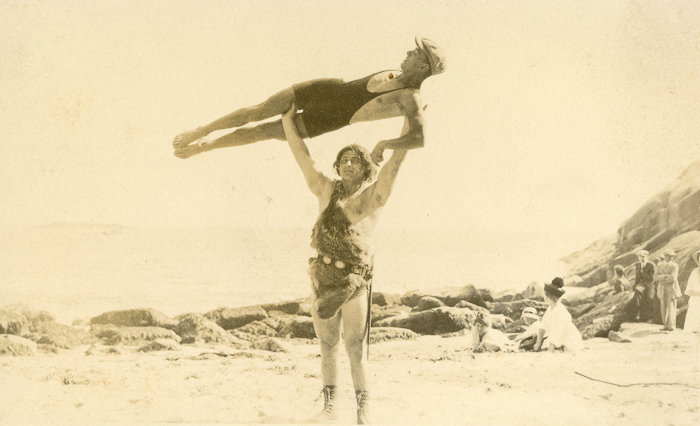
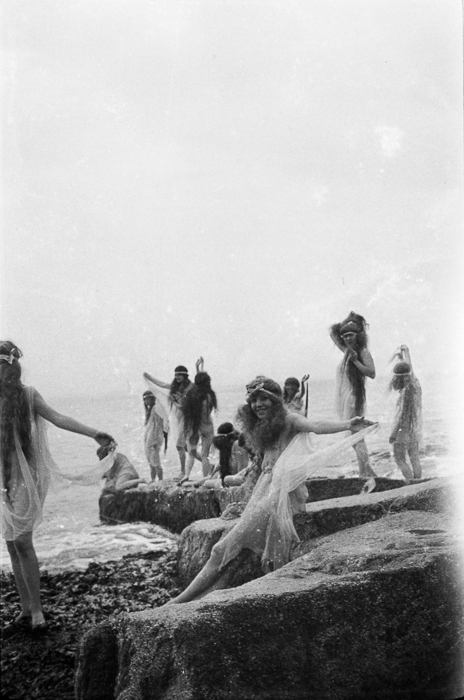
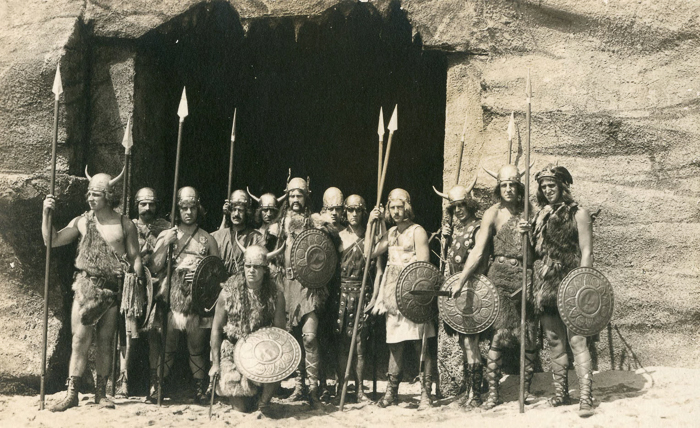
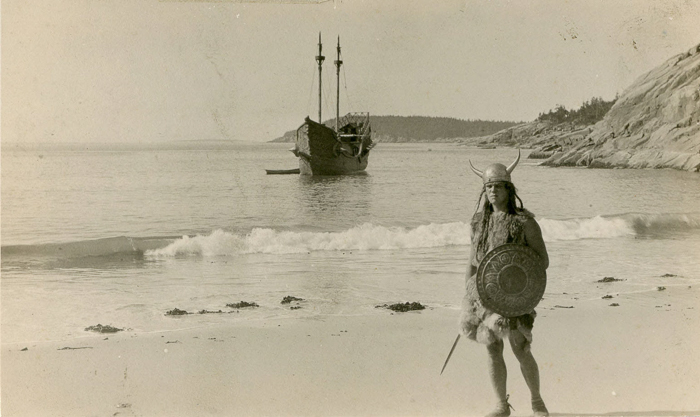
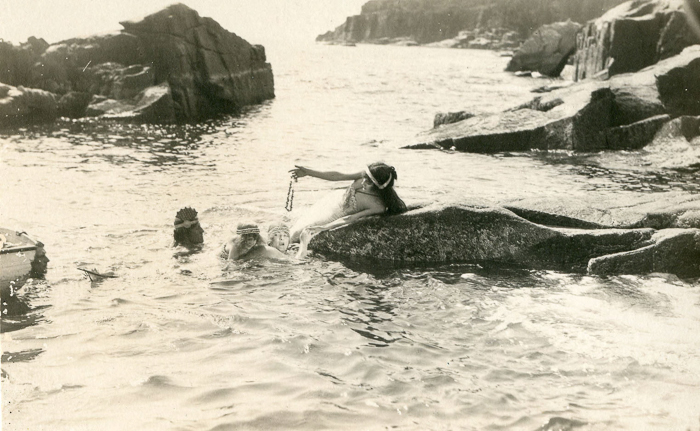
In the summer of 1917, the Fox Film Company filmed scenes from the production Queen of the Sea, starring Annette Kellerman, on Sand Beach and Great Head. “The director, John Adolphi, was enchanted by Bar Harbor’s scenic beauty – until fog, clouds, and rain, interrupting the daily work schedule, somewhat dampened his enthusiasm. … Some actors suffered severe sunburn…; barnacle-scratched players needed medical attention; and sea sickness overcame those in small boats. … Ebb and flood tides, over which even omnipotent Hollywood could not prevail, delayed shooting scenes of costumed mermaids and seals disporting on the rocks. A set called “the cavern of despair” was swept away three times by high tides before it could properly photographed. … Ernest Lorillard, the tobacco tycoon, invited the entire cast to a clambake at Sand Beach, where he himself undertook the bake, piling hundreds of clams on top of a huge mass of steaming seaweed. Herbert Saterlee [sic], appointing himself keeper of the fire, steadily hauled loads of driftwood to replenish the cookout. … Another favorite diversion was holding “rock parties” to view the film-making. These were sumptuous lunches carried by car in large hampers and spread out on the rocks along the Ocean Drive.” (“When Hollywood Came to Bar Harbor,” Gladys O’Neil, Downeast Magazine, Sept. 1981.)

web-poster

I needed to know more, obviously, and Debbie Dyer over at the Bar Harbor Historical Society was out sick, so I obsessively googled the movie name, the star’s name, 1917, Bar Harbor … anything I could think of. And I found the mother lode. Just in case you were wondering whether or not everything in the universe is in fact online, I found a digital archive of silent movie stills: The Jonathan Silent Film Collection, which is part of the Chapman University Digital Commons. A search for “Queen of the Sea” gave me 101 stills from the movie, copyright-free. We just don’t have space for all of them here, but there were some real beauties of the cast goofing off between takes. I have not been able to find out whether a print of the movie still exists.

web-Annette

Annette Kellerman as Queen Merilla. It took me a minute or two to realize that’s her hair she’s holding out, not a scarf. There was a piece that got added to the bottom of the costume over their feet to finish off the tail while they were filming.

“Merilla, the queen of the sea, learns that if she saves four lives, she will be endowed with a mortal body and an immortal soul. The kindly queen saves her first lives by rescuing three drowning sailors whose ship the Sirens (the daughters of the wicked King Boreas of the Storms) have been instructed to destroy. Furious, King Boreas confines Merilla in a cave, but she is freed by Prince Hero, a human being with whom she falls in love. Determined to have his revenge, Boreas wrecks Hero’s ship and locks up the prince’s fiancée, Princess Leandra, in the Tower of Knives and Swords. Following several thrilling adventures, Merilla rescues Leandra, who, in her gratitude, releases the prince from his promise so that he may marry his beloved sea queen.”  (synopsis from AFI)

web-ColdMermaids

A couple of “sirens” freezing their a—s off in between takes.

web-VikingPile

web-strongman

I’m pretty sure the guys in the black bathing suits are the lifeguards. You’ll see them hovering in a lot of the shots.

web-prepwork

Preparing the beach for filming.

web-mermaidCrowd

web-director

Check out all the spectators perched on the rocks.

web-filming

web-spectators

They must have been filming in one of the little boulder beaches off the Ocean Path – spectators on the rocks and in the boats, too, I think.

web-Sirens

Warmer looking sirens. The wind must have dropped.

web-Viking_Attack

I haven’t figured out yet what the Vikings have to do with the plot.

web-PrinceHero

Prince Hero in front of the Beehive. If this was shot in July or August, and he’s standing at the edge of the marsh, you bet your leather booties he’s being bitten by mosquitoes.

web-vikings

That’s the ‘cavern of despair’ mentioned in the article. It was over at the western edge of the beach, just down from the stairs.

web-VikingAndShip

web-OnBoat

web-LittleGirl

This is my absolute favorite photo of all. I’m pretty sure this is Virginia Higgins, a Bar Harbor girl who played the youngest mermaid. She looks so uncomfortable and completely fed up! And the look on the woman’s face behind her? Oh, and don’t miss the baby hanging out at bottom right.

web-mermaidsinwater

There’s little Virginia Higgins again in the middle, and she does not look happy. Neither does the mermaid she’s clinging to. And doesn’t poor Merilla look like she’s trying really hard to avoid reclining on any barnacles?


web-poster2

Annette Kellerman was quite a character – a daring stuntwoman, long distance swimmer, and movie star who pioneered the one-piece bathing suit as an alternative to bathing dresses (on the grounds that no one could actually swim in a thigh-length skirt). Intrigued? Read this article.

Apparently there were several movies filmed on Sand Beach between 1917 and 1921, but I wasn’t able to find photos of any of them. The movies themselves appear to have been lost. However I did find one much more recent movie that filmed a scene here:

still from Cider House Rules, with Charlize Theron, Tobey Maguire (photo from IMDb)


Share

Coast Walk 8: Great Head

web_DSC7366-Edit

So many interesting discoveries this past week, I’m not even sure where to begin. Life cycle of barnacles, photos of the old estate, hiking adventures, a movie filmed here in 1917, a wrecked schooner, sudden change in the geology: birds, banter, and Beatrix Farrand … I had to break Sand Beach out into its own post!

CW8map

April 28: 1:15-3:30pm, drizzling, grey, overcast, 51ºF.  It started to rain about an hour into the hike. 2 Black-backed Gulls, 12 Common Eiders (6 male, 6 female), flock of 7 Black Scoters flew by, 1 loon, 1 Thick-billed Murre (Rich saw it, I didn’t.)

Walker: Rich MacDonald, ornithologist and naturalist; Natural History Center, Bar Harbor

web_DSC7368-Edit2

Rich and I started out from the Great Head parking lot around 1:15 on a cool, overcast day. It started to drizzle when we reached the beach. The rain never got heavy enough to discourage us, although I did have to wipe my glasses off a lot. Climbing down to the beach, we found an old refuse pile beginning to poke out of the bank, and wondered if it were from the old estate:web_DSC7356-Edit

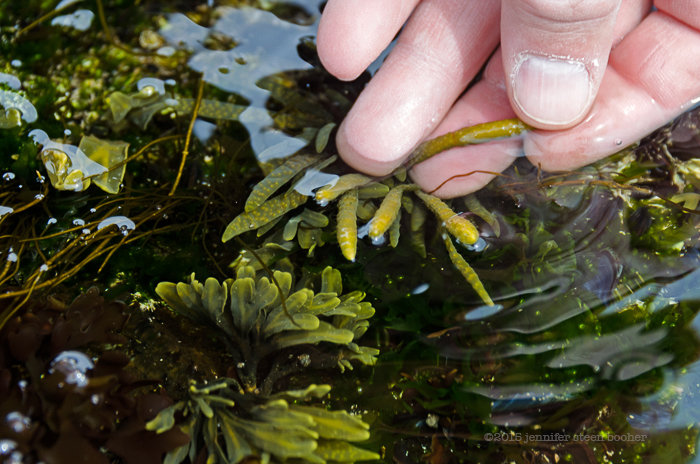
As we started hiking we found some great tidepools, and Rich took a moment to try to help me identify the seaweeds in them. He pointed out the gametphores or conceptacles on shoots of young Rockweed. I find the young seaweeds hard to figure out, they look so different from their older forms.
web_DSC7364-Edit

J: Is that a Fucus?

R: Yeah, this is Fucus vesiculosus. And this is a different kind of Rockweed. People call this and this Rockweed, but there are five “Rockweeds” on the coast of Maine.

J: [Ascophyllum] I can usually recognize, but seaweeds tend to bewilder me.

R: When I was in college I went to the State University of New York in Plattsburgh, New York, and I got this notion that I wanted to be the next Jacques Cousteau, but you can’t really do that in Plattsburgh, so I went for a year to Long Island University in Southampton, New York. It was a great school, … but I was so gung-ho … taking ichthyology (study of fish) and phycology (study of algae) and going into the lab classes out into the field, and my classmates were like, eeew. There were a lot of city people who didn’t want to get dirty, and I [said], ‘I’ll get right in there,’ wading out chest-deep into pools to get stuff, and it was great. I found out what science really was there, and I found out that I liked it even more.

J: Messy, dirty science?

R: I always thought Jacques Cousteau was a scientist, but he was a Hollywood scientist…

web_DSC7358-Edit

J: I feel like I’m becoming a scientist backwards. I always thought that if you wanted to be a scientist, you picked a field and studied it, but I’m finding an interesting creature and studying that, and it’s leading me into different fields. Backwards.

R: I think that I would have been a really good naturalist back in the 1700s

J: Wouldn’t that have been fun?

R: I know! You didn’t specialize in anything, you knew something about everything. I like that kind of generalist knowledge.

J: You wrote papers and drank brandy and all your friends applauded you.

R: That’s right. And the only real downside to that it was almost exclusively men.

J: Well yeah.

R: That’s one thing about it that I didn’t like.

J: What, being a man?

R: No, no, being a gentleman scientist among only gentlemen.

J: Yeah. There were a few women.

R: There were, but you know,

J: They didn’t get any credit.

web_DSC7360-Edit

R: So where are you from originally?

J: Massachusetts. I was born in Brooklyn, New York, and I grew up in Southbridge, Massachusetts. How about you?

Rich: Born in Niagara Falls, New York, and grew up in Lewiston, New York, which is the next town north, … and then vacationed in a lot of different places but including the Adirondacks, and so I wanted to go live in the Adirondacks. Swore I would never leave New York state. And then I met Natalie [his wife].

J: I thought I was going to be a city girl. I grew up in a tiny, broke, mill town, where all the mills had closed, and I was like, ‘I am so out of here.’ And then my husband and I were living in San Francisco, loving it, but I wanted to go back to school for landscape architecture, and we struck a deal that he would leave the computer geek’s dream job at ZiffDavis Labs, if we moved to Maine afterwards. And I was kind of like, Maine? Are you sure you don’t mean New York City? But we never regretted it.

R: I wish I had brought my aquascope. You put it in the water and you can look under the water … It’s like snorkeling except you don’t have to get down into the water, you can just sit here, and I just love the fact that we don’t see any bare rock here. Every inch is covered by something.

web_DSC7391-Edit

J: Now are these baby barnacles all over? Baby something.

R: All the little specks down there? … Probably barnacle spat.

J: Can’t really see them all that well. A lot of things become clearer when I look at the photos on my big screen when I get home. Look at the way the coralline is wrapped around the, what is that, a barnacle? Kind of funky.

R: There are a couple of really good, simple, little field guides we sell. One, the authors include Susan White, who’s a former Maine SeaGrant program colleague of Natalie’s. It’s something like Life in the Intertidal Zone. And it’s a fairly small book,… and then there’s Life on the Intertidal Rocks. The Finder’s Guide series, it’s a little index-card-sized, fits in your back pocket nicely… The Life on the Intertidal Rocks is great for identifying stuff, sitting here and looking, and the Susan White one goes into a little more detail, a little more narrative. Not a lot.

J: One of the best ones I’ve found is kind of odd, I found it online, it’s a teachers’ guide to the Gulf of Maine. I can’t remember who put it out, one of the state agencies. [Ed.note: it’s the Department of Marine Resources.] It’s just line drawings, but it’s awesome. Like yesterday, I got a tweet. I don’t really Twitter, I’m on there because it’s my Dad’s social media of choice, but somebody tweeted me with a photograph of this thing. It looked like a [bright pink] sea cucumber with a tail attached. I think it was a rat-tailed sea cucumber, and the only place I could find references to that was in this teacher’s guide. [I haven’t been able to find that tweet again, if I do, I’ll link it here.]

webCW8birds

Top to bottom: Common Loon, Common Eiders (male and female), Black-backed Gulls

J: [pointing to two birds on a rock] Black-backs?

R: Yes, Great Black-backed gulls. Both of their backs looking a little less black at this angle so I wanted to check the legs. If the legs were yellow, they would’ve been Lesser Black-backed gulls. [writing in his notebook] So what I’m doing, …I have these four-letter codes that are standard codes that are used [by birders], … American Crow, Great Black-backed gull, two, and a black-capped chickadee I heard earlier, there are some ducks out there – probably eider. No, they’re red-necked grebes. They breed in the pretty far north, up in Canada, they come here for the winter. … The great black backed gull is the largest gull in the world.

web_DSC7377-Edit

J: Really? It’s hard to get a sense of the scale when they’re that far away.

R: They’re a big bird, they’ve got a four-and-a-half foot wingspan.

J: I think I saw one of them harassing an eagle last Saturday.

R: That would make sense. …  There’s a common loon out there.

J: It’s funny, I’ve seen loons on almost every single walk. Or, one loon on every single walk. I started to wonder, is it following me? Is it the same loon every time?

R: It’s interesting about the loons because people come up here (there’s another loon down there, over by the gulls) people come up to Maine in the summer and they expect to see loons in the lakes, which they do, and they’ll see loons on the ocean and they’ll say, “Rich, I saw a loon on the ocean! But they don’t go to the ocean, do they?” Well, as a matter of fact, we think of them from the lakes I think because they’re so vocal when they’re on their territory, and they make beautiful and ethereal sounds … but loons…, the ones that are born this summer, when they fledge they’ll leave the pond by late September and they’ll go to the ocean and they’ll stay in the ocean for four years.

J: Seriously?

R: Yep. They won’t leave the ocean for four years, until they’re old enough to breed. It takes them four years to reach maturity. [Then] they will fly and look for ponds where there’s room for them, because loons are very territorial on their ponds. There’s a certain size; Eagle Lake and Long Pond are big enough for maybe two pairs of loons in each of those, but Lower Hadlock Pond, Upper Hadlock Pond, one pair each, because they’re voracious fish eaters so they’ve got to have enough food. I see loons every single day I go to the ocean.

web_DSC7388-Edit

R: So have you found anything really interesting, unusual, exciting so far?

J: There’s a cave down by High Seas, I couldn’t get to it, I have to go back this summer because I think you need to wade to get into it, but I’m dying to get in there.

R: Well that’ll be neat.

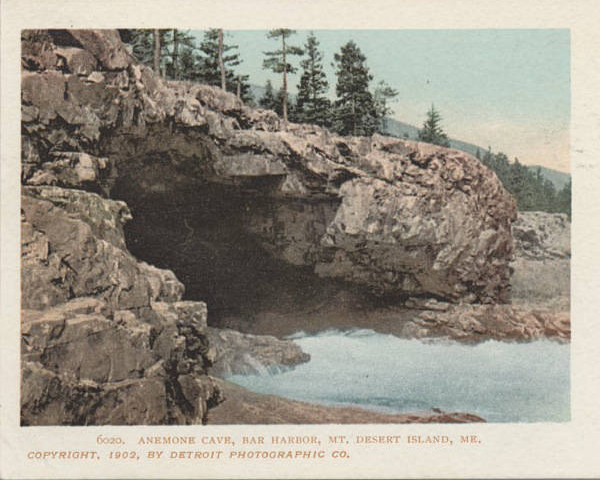
J: And of course Anemone Cave. I hadn’t been there in something like 20 years, and it’s still amazing.

R: There was a time that Anemone Cave had cliff swallows nesting there, but it got well-known and a popular place  people would go and look for critters. They scared away all the swallows.

J: I actually found a guide from 1880-something, and Anemone Cave was already threatened back then. The people who owned Schooner Head were already imposing rules on it, trying to stop people from taking the anemones, so it’s kind of amazing that there’s anything left there.

R: It looks like it goes in cycles, … the literature and the guidebooks say, ‘Check this out,’ and everybody does and then it gets threatened and they take it out of the next generation of books, and then it goes in the next generation after that.

J: Well it’s all over the internet. I wasn’t sure I should even put it in the blog, but seriously, if you do a search for Anemone Cave, there are directions and GPS coordinates, and it kind of doesn’t matter whether the park puts it on their maps or not.

R: Yeah, the internet really changes the way people access information.

web_DSC7393-Edit

We found part of a lobster shell in a tidepool. I find lobster shells all the time, but usually they’ve been cooked. Look at all the blue around the edges of the plates – beautiful colors. We tried to figure out what might have killed it, but our CSI-Acadia episode was pretty short. As Rich pointed out, it would have been a big one, certainly market-sized. The edges of the shell had been nibbled, possibly by crabs after the lobster was dead. I put it in a plastic grocery bag and took it home for a still life, but forgot that I had it, and my bag smelled horrible when I opened it up again for the next walk. Pee-yew! That one won’t be in any still life.

web_DSC7395-EditWe found large clumps of what we think was deer hair floating in several tide pools in one area, but no sign of an injured animal nearby.

web_DSC7397-Edit

R: A pool like that one we just walked by is high enough up that it’s going to be fresh water, although there might be some salt in it from the spray, and I was looking to see if I could find any spotted salamander eggs there. I didn’t see any. It might be just salty enough to make them not go to it. But over in the Otter Cliffs area there are some pools where they do lay eggs.

J: Wow, it never occurred to me to look for them out here. I walked right past that pool thinking it [was] just rainwater. That’ll teach me! Got to look at everything.

R: Yeah, absolutely, you just never know. It’s like when I’m doing birding programs, I always tell them to look at every bird, every gull, every duck, because sometimes it’ll be that unusual one,

J: the one you weren’t expecting.

web_DSC7405-Edit

J: I didn’t see any urchins or sea stars in Anemone Cave

R: Well this time of year that makes sense. Between the snow and ice and the cold water they’re probably deeper right now

J: That’s a relief. Last time I was there, years ago, it was just crawling with them.

Photo courtesy of Acadia National Park Archives

The tea house in its prime. Photo courtesy of Acadia National Park Archives.

R: I love going to the … tea house, the ruins up there at the point. For me it’s special because I was doing research on the birds of MDI from a historical standpoint [Rich has written or contributed to several resources on the birds of MDI] and I found some old bird research journals from the 20s and 30s and they were doing bird banding out there.

J: At the tea house?

R: It was bunch of well-to-do, probably 50, 60 year old women, and I can just imagine them sitting around drinking tea and saying, “Minerva, darling, I think there’s a bird in the net.”

J: The whole amateur naturalist thing again. It’s what I would do if I were rich.

R: I’m Rich, but I still have to work for a living.

J: Oh I get it. Sorry, I’m slow. You’re Rich, I’m Slow.

R: Nice to meet you, Slow.

More about the tea house:

"The Stone Tower on Great Head", Gladys O'Neil, from "The Rusticator's Journal"

“The Stone Tower on Great Head”, Gladys O’Neil, from The Rusticator’s Journal

Note: We’ll talk more about the Satterlee estate in the Sand Beach post, because the rest of the estate was down there. Only the tea house was on Great Head itself, as you can just barely see in this photo:

Photo courtesy of Acadia National Park Archives

Photo courtesy of Acadia National Park Archives

J: OK, I can no longer see through my glasses [because of the rain.]

web_DSC7412-Edit

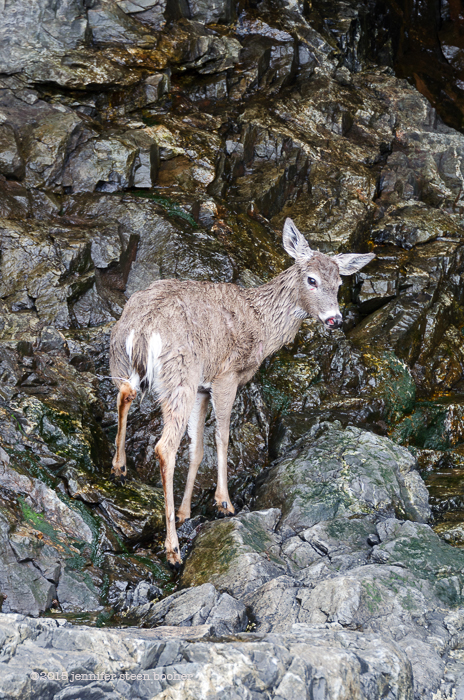
The cave in the center distance is where Nicole and I saw the wounded deer last week.

J: Cormorant. Flying down below.

R: Is it a Great or a Double Crested? [Looking through binoculars] Double Crested. More orange at the base of the bill. If it was a Great it would show white there.

J: I just see silhouettes [no binoculars.] There’s something else out there, in a straight line from the black and white buoy.

R: There’s one next to that orange buoy. I see one I believe is a murre, which is a cousin to a puffin. By that black and white buoy over there is a common loon.

web_DSC7414-Edit

An inconvenient cleft drove us up to the top of the cliff here, and by the time we reached the top I was pretty darn tired and decided it was more sensible to continue on the path than to scramble down the rocks on the other side, especially since it was raining.

J: This is the point when I start to realize how out of shape I am. Or maybe it’s just how close to 50 I am.

R: It’s ok, I’ve crested 50 and it doesn’t look so bad.

J: And you’re still doing this, so that’s good.

R: When I was a kid, I was asthmatic and I was in the hospital a lot, on average about two and a half months a year. And then I got to be a teenager and got tired of all the medicines I was on, and I discovered girls. They didn’t discover me, but I discovered them! I said, ‘ok, I’ve got to do something about this.’ And it was just intuitive to me that the more physically fit I was the less problems I should have with my asthma. But physical exercise triggers my asthma. So there’s a really difficult balance, and I didn’t get very good at that balance until I was well into my 20s. But I started to lose a little bit of weight and started to get a little bit into shape and I did outgrow it a little bit. I still have to take medicine twice a day, but I just said, ‘you know, I have a life that I want to live, and I’m not going to let my asthma be a handicap.’ Sometimes I still mess up and I’ll have asthma problems but generally I just go live my life. I love hiking, skiing, biking, kayaking, and canoeing, and I’ve run the MDI Marathon three times.

J: Seriously? Holy cow.

R: The last time I ran the marathon was in 2010, I think. I’ve got some heroes/role models, people I’ve known over the years. Jim Goodwin, passed away a few years ago at a hundred and two, and he was still splitting his own firewood and Clarence Petty, these are all Adirondack guys I’ve known over the years, Clarence Petty died at a hundred and four. At 92 he said, ‘You know, I’m starting to get old,’ and stopped being a flight instructor. There’s a few of these guys out there who are just amazing people, and I don’t know if I’m going to be amazing like that, but I want to at least stack the odds in my favor to live the life I want.

web_DSC7416-Edit

[We saw several eider ducks.]

J: Now are those the males?

R: The white ones are males and the brown ones are females.

J: Look at them all! I was surprised by how few eiders I saw this winter.

R: The eider population is going down pretty considerably. There’s a lot of factors but one of the big ones is our bald eagles have been so successful returning, and they’re preying on the eiders.

web_DSC7418-Edit

J: I’m just admiring the rocks. And the color of the ocean. It’s not blue, it’s not green, it’s not grey. [It never comes across in photos.]

R: This year’s cruise with Garrison [Keillor] [ed.note Rich and Natalie were naturalists aboard the Prairie Home Companion cruise] was in March in the Caribbean, and it’s kind of fun to be down there and the water’s really beautiful in a lot of ways, but I’ll take this water every day. I just love it up here.

J: Like I said, I’ve never regretted moving up here. Little career-challenging, though.

R: Yes. That’s why I started my business, the Natural History Center. I was a field biologist for the Nature Conservancy and before that had worked as a researcher for other institutions. I thought with my resume, no problem getting a job here. But when a job comes up, a job I actually want, there’s a lot of people with similar resumes or better that want the same job. The last two jobs I applied for there were over 300 applicants for each. I was in the final running, but didn’t get it, so I said, ‘Ok, if I’m going to be happy professionally, I’ve got to make my own job. So I started my nature store and do nature tours, I do some contract research. … I think it’s all worked out well in the end. We’re still a startup. … It’s really satisfying to take a family out and have the kids jut get so excited about whatever the critters are that we’re looking at. And it’s even more satisfying when the next year they come back and say, ‘We want to go on another tour with you!” And the kids are all excited to tell me what they’ve learned in the intervening year.

J: That does sound awesome! High job satisfaction.

R: I get these family groups and I can see I’m really hitting home on a few things with [the kids]. I’m a firm believer that we need even more protected lands than we have. We’ve got a good start here on MDI with Acadia, but in the state of Maine, in my opinion, we’re woefully behind, and nationally and internationally, we’re … behind. For the health of the natural world, we need a lot more.
web_DSC7441-Edit

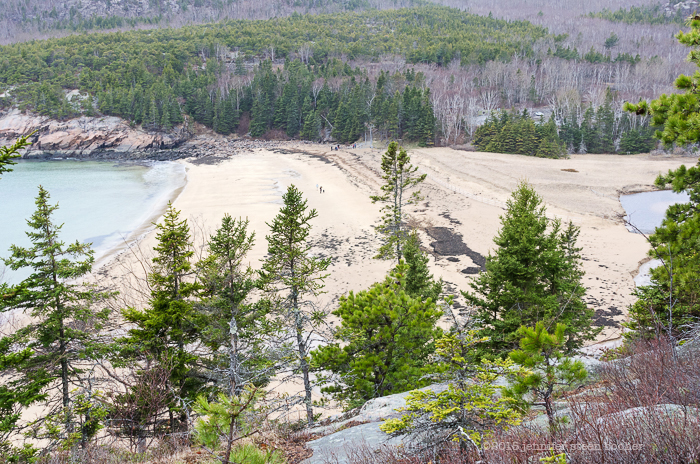
R: This hike, the Great Head trail, is my daughter’s favorite hike. She says it is the best hike in the universe.

J: What does she love about it?

R: I think she likes the length of it. It’s just the right length for her, for her short legs. She likes the diversity of habitat. She likes the fact that a lot of the trees are short, so when we’re looking at birds they’re not eighty feet up in the trees, they’re only 20 feet up. She likes some of the rock scrambling that’s involved, she likes stopping at the … tea house. We always, without exception, stop there and have a chocolate break. She likes the scrubby, pitch pine forest … I love this stuff and she notices that I like it and that also gets her excited. Usually when we do this hike we’re doing it with friends who have kids her age, so she has a lot of very fun memories tied to this. I think it’s a little bit of everything tied up together.

J: We used to use M&Ms. To get our kids up the mountain. We did this one a lot, too, although we usually, when they were little, we’d go up to the tea house and go back down that way. They liked the way the roots formed steps on the path. Tabitha used to called them “Tabby-sized steps.”

R: How old are your kids now?

J: My son is 16, he’ll be 17 next month, and Tabby’s 14. Now I can’t get them out on hikes. At all. Christopher is always sailing. He is a cutthroat competitive sailor. Tabby loves biking, but she doesn’t like hiking anymore.

R: So are your kids going to join you on your walk?

J: My son says when I get down toward the marina he’ll meet me out there. Tabby says there are too many bugs. I might try and do something … in parallel where she’s biking somewhere and we meet up. Natalie and I talked about doing that with kayaks. I just want to include people, I’m not overly dogmatic about how they participate.

R: Right here, this is another reason why my daughter loves this trail more than anything else. [Sits and slides right down a steep, smooth rock.]

web_DSC7442-Edit

R: The scotch pine, the ones with round clusters, like balls of needles, it’s a neat tree. This one’s been chewed by a porcupine!

J: Now how do you know a porcupine [did that]?

R: Take a closer look. You can imagine the teeth peeling this off. If it was fresh without any sap on it we’d actually see some teeth marks. This is very typical porcupine behavior. They’ll chew right down to the inner layer of wood and they’re eating between the bark and the inner layer; they’re eating the cambium. They’ve got to be pretty desperate to be eating scotch pine! The scotch pines, they develop these cones [that have pitch in them] and [naturalists thought they] needed fire, to melt the pitch to release the seed. Back in the 70s some researchers at a site in northern New York realized it just needs extreme heat, but extreme heat is relative. It just needs to be somewhere around 150, 160 degrees Fahrenheit. That’s enough heat to melt the pitch. So where do you get that? When’s the last time we had a fire here? 1947. When’s the next fire? Who knows, but not frequent enough in the history here to have pitch pine growing at the ages we have. So they found that … there’s two ways. One, the cones fall on a rock, and on an extremely hot summer day, with the sun beating down [on] a flat, exposed rock, it can get to about 160 degrees Fahrenheit. Just that millimeter of surface above. But you put your hand an inch above, it’s hot, but it’s 120 degrees. And two inches above, it’s 99 degrees. It quickly cools down. So that’s one of the ways. But in a place like [MDI] we don’t have enough flat rock surfaces to soak up that sun and really get hot. So squirrels eat the cones…, and the resins have natural sugars in them so they eat the resin, and they release the seeds, coming through the gut.

web_DSC7447-Edit

J: So internally it get hot? Inside of a squirrel is 160 degrees?

R: No, but their stomach acid digests the resin.

J: Oh! That is so cool. The complexity of the interactions.
web_DSC7751-Edit

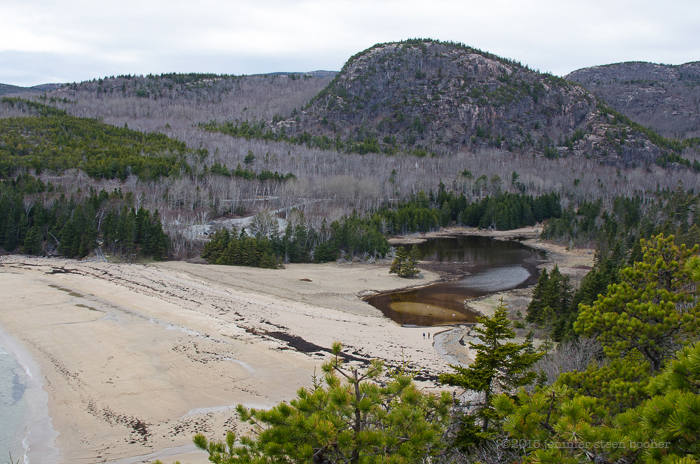
'Sand Beach Mountain, Mount Desert Island,' by Thomas Cole, 1844. From "The Artist's Mount Desert" by John Wilmerding

‘Sand Beach Mountain, Mount Desert Island,’ by Thomas Cole, 1844. From “The Artist’s Mount Desert” by John Wilmerding

R: This wetland over here to our left is a really good wetland for MDI. [Ed.Note: The body of water just right of center in the photo above.]  I find a lot of birds in there during certain periods of the year.

J: That used to be one of the few places my daughter would swim, the stream where it comes out, because it’s warm. It’s the only warm outdoor water here! But she’s moved on now, she and her friends like playing in the waves. Does your daughter like swimming around here?

R: She does. She’ll swim in the stream, she’ll swim in the ocean, if there’s water she’ll swim in it.

J: Mine were like that until they discovered leeches.


And just like that we were back at the parking lot. Thanks for a fascinating walk, Rich; I can’t think of many people who’d be as happy as you about a long scramble over the rocks in the rain!


web_DSC7469-Edit

April 30, 2015: I forgot to note the temperature, but it was cool with a little wind, mostly overcast with occasional bursts of sunshine.

I felt that I had missed too much of Great Head’s shoreline, so I went back a couple of days later, this time starting at Sand Beach and working my way east along the rocks. I’m glad I did! For starters, there were even more birds out today, and they were closer to the shore:

webCW8Birds-Edit2

Clockwise from top left: male Red-breasted Merganser (Mergus serrator), Black Scoters (Melanitta americana), Common Loon (Gavia immer), male Common Eider (Somateria mollissima)

web_DSC7502-Edit

Juvenile Black-backed Gull (Larus marinus) with two mature Herring Gulls (Larus argentatus)

And the tide pools were full of interesting things. You might remember earlier Rich and I were wondering if what we saw in the pools was barnacle spat. The photos I took that day weren’t close enough to tell, but there were some shallower pools today, and yes, clearly the barnacles are settling down:

A metamorph is a barnacle that metamorphosed from cyprid within the last 3-4 days.

So let’s talk about barnacles. They are relatives of crabs and lobsters, and they have several life stages. They begin as an egg, and then hatch into a tiny larva called a nauplius, which has one eye, goes through five moults, and is free-swimming. After those five moults, it becomes a cyprid. See all those tiny things that look like yellowish grains of rice? Those are cyprids. The cyprids’ job is to find a place to settle. They have two little antennules at one end which are not visible to my eyes, anyway, which they use to crawl around and examine hard surfaces. When it finds a suitable spot, a cyprid will glue its forehead to the rock or shell, and begin to form a shell around itself. The little brown ovals scattered over everything in the photo above, and over the mussel in the photo below are cyprids that have glued themselves down and become metamorphs. A metamorph is the stage in-between, maybe 3-4 days after settling, but before the white shell has really gotten going. It’s also called barnacle spat, and it gets all over everything. Worse than cat hair.

web_DSC7609-Edit

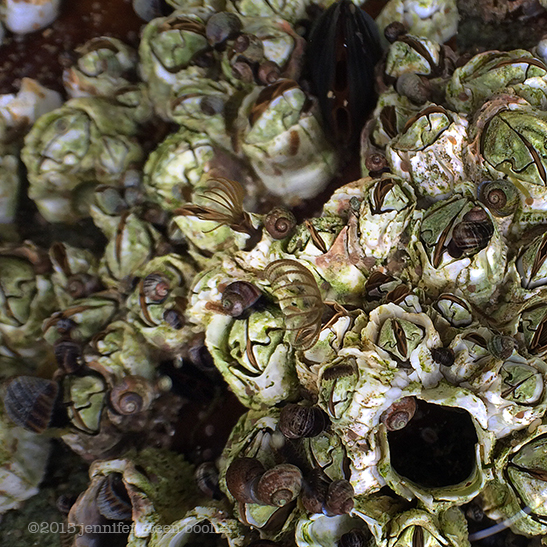
Eventually, the barnacle will extend its feathery legs (called cirri) and begin feeding, sweeping its legs back and forth to filter plankton out of the water, then sort of sucking off its ‘fingers.’ Or toes, really. Like this:
web©-IMG_4117-Edit2

Sea cucumbers feed this way, too. Go watch Diver Ed mimic a sea cucumber feeding, it’s priceless. Back in the photo of the cyprids, did you notice all the itty-bitty baby periwinkles hiding in the empty barnacle shells?

web©-IMG_4148

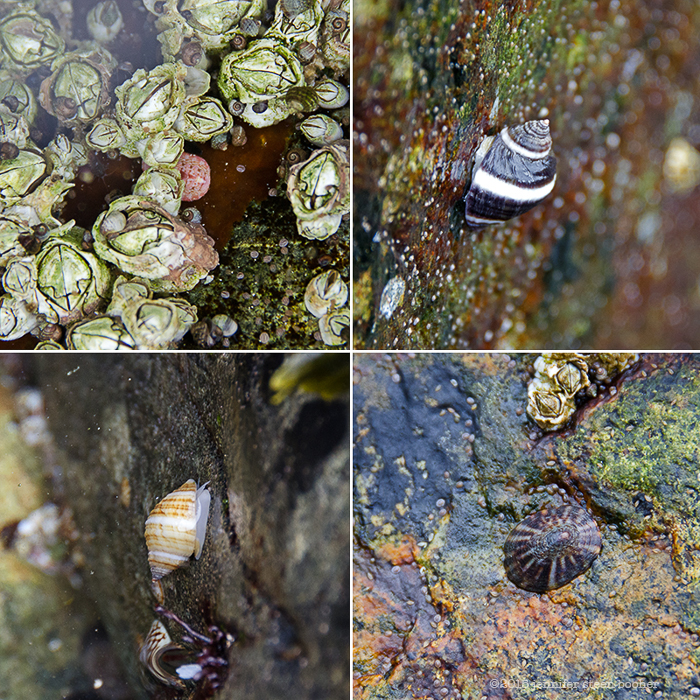
One of the coolest things I came across was almost too tiny to photograph. Top right photo below shows a Red Chiton (Ischnochiton ruber) half-hidden under some barnacles. It was only about a centimeter long, but it’s the first chiton I’ve ever seen in Maine, and I couldn’t believe the hot pink color. A chiton is a mollusk, like the other creatures in this collage, but where whelks and limpets have a single, solid shell, the chiton has eight articulated plates that can flex like the elbows of a suit of armor. Or maybe more like an armadillo shell. The flexibility is important – it lets the chiton move over rough terrain. They’re herbivorous, scraping algae off the rocks with radulae (tooth-like things, sea urchins have them, too.) I think they’re cool because they look like alien fossils. The chiton family is 400 million years old, so they sort of are.
 

webCW8Mollusks

Clockwise from top left: Red Chiton (Ischochiton ruber), Dog Whelk (Nucella lapillus), Tortoise-shell Limpet (Testudinalia testudinalis), another Dog Whelk (also called Dogwinkle)

I’m going to call your attention briefly to the rocks – this is a great example of shatter zone, with bits of the old country rock suspended in the newer stone. IMG_4108-web©Take note, because we’re about to leave the shatter zone for some amazing granite formations on the other side of Sand Beach:

web_DSC7777-Edit

web_DSC7703-Edit

Just wanted to show you a horse mussel and a blue mussel living side by side. I don’t know what smashed the blue mussel, but it seemed to still be alive.

web_DSC7632-Edit

This is as far as I was able to go at the tide line,

web_DSC7669-Edit

so I headed up the cliff:

web_DSC7683-Edit

web_DSC7688-Edit

At the top of the cliff I found myself following a deer trail yet again. How can I tell its a deer trail not a human one? Poop everywhere, clearly deer and not human.

web_DSC7722-Edit

web_DSC7725-Edit

web_DSC7742-Edit

Black-backed Gull chasing a Herring Gull.


I want to leave you with a question I’ve been mulling over. Great Head was private property, and yet it was clearly a popular tourist destination. There are passages like this in many early guidebooks: “Our next ramble is to Great Head … It lies a short mile beyond Schooner Head and is reached by the same road. Approaching the Head, we have a fine view of Newport’s southern end descending to plunge into the sea. [ed.note: Newport Mountain is now called Champlain] High up on the ledges are the nibbling sheep, foraging among the closely cropped grass. Reaching the farmhouse, most persons here leave their carriages; though the road extends some distance farther into the woods. … The left-hand track leads by a gradual ascent directly to the Head. … Arriving at its highest point, a view is had far and wide of the grand old ocean, while landward rise the mountains.

This whole peninsula recently became the property of a Philadelphia family that has a taste for landed trifles. Among their effects, it is said, is an islet in Lake Superior, and a snow-peak in the Swiss Alps. But Great Head need not feel ashamed of itself in any company. …

Visitors are fond of coming to Great Head again and again to spend the whole day in sauntering from point to point, catching each new expression of the cliffs; or book in hand, bestowing themselves under some convenient rock, to keep one eye on the stereotyped page and the other on the changeful deep.” [from Rambles in Mount Desert: With Sketches of Travel on the New-England Coast from Isles of Shoals to Grand Manan, B.F. DeCosta, 1871. (as reprinted in Discovering Old Bar Harbor and Acadia National Park, Ruth Ann Hill, 1993.)]

detail of "Path Map of the Eastern Part of Mount Desert Island," by Bates, Rand, and Jaques, 1911.

detail of “Path Map of the Eastern Part of Mount Desert Island,” by Bates, Rand, and Jaques, 1911. Photo courtesy of the Library of Congress.

I found references like this to Schooner Head as well. They’re both included on trail maps like the one above, from 1911. The map includes a note about private property:

Screen Shot 2015-05-05 at 4.32.02 PM

legend on “Path Map of the Eastern Part of Mount Desert Island,” 1911. Courtesy of the Library of Congress.

How did that work, do you suppose? Did the Hales and the Satterlees and other landowners not mind having dozens of strangers wandering around their estates? Was it just an accepted custom? When did it change? Why?


web_DSC7782-Edit


One last observation that may be of interest to hikers. The pools of rain- and melt-water in the rocks along the hiking trails were teeming with mosquito larvae:

web_DSC7771-Edit

 Better stock up on bug spray this year.


Share

Coast Walk 7: Anemone Cave to Great Head

web-me-climbing2

Notes: April 25, 2015, 37ºF, 9:30-11:45am, a bit of wind, sun and clouds at start but became overcast. Not as much wildlife: one bald eagle getting hassled by a gull, a wounded deer, and a small flock of dark birds too far offshore for me to ID.

CW7-3

Walker: Nicole Ouellette of Breaking Even Communications and Anchorspace, Bar Harbor

_DSC7292-web©

Nicole and I picked up where we had left off a few days earlier, just south of the Schooner Head overlook. We were able to get down to sea level pretty quickly, and the photos above will give you a good idea of what the terrain was like. We made surprisingly good time, especially considering how often we stopped to look into tidepools or admire peculiar rock formations. Look at Nicole mountain-goat-ing it up that narrow ledge!

I use my iPhone to record conversations on these walks, and had the same problem today as last time – the surf and ambient noise drowned out our voices on most of the recording. Grrr. I think that we were too far apart for the microphone to work well, and that’s going to be hard to manage while scrambling over this kind of terrain.

web_DSC7286-Edit

The rock was full of inclusions (iPhone for scale):

web_DSC7294-Edit2

This seems to be typical shatter zone, where the erupting volcano broke apart the older stone. Chunks of it were floating in the magma, either visible as large pieces,

web_DSC7300-Edit

or melted and swirled in:

web_DSC7309-Edit2

web_DSC7313-Edit2

In a lot of places the older stone was softer than the new and has eroded away, leaving empty pockets:

web_DSC7314-Edit2

I did manage to capture this exchange as we came around a corner and saw this boulder:

_DSC7296-web©

A glacial erratic is a large stone that was carried by a glacier from its original location to a new one, often many miles away. They usually stick out because they are a different kind of stone from their new surroundings, like this enormous white granite piece dropped amid shattered Bar Harbor Formation.

J: OMG, erratic!

N: Inclusions!

J: We’re such geeks. Is geology geek a thing?

N: Well, it’s funny, there’s hard rockers and soft rockers.

J: What is a soft rocker?

N: Sediments. Hard rockers are structural geology.

J: So is this igneous, the way it’s flowing like that?

N: Well, it might be metamorphic. Granite would be slow-cooling and lava would be really fast cooling. And then anything that happens to it after makes it metamorphic. So most rocks are metamorphic. Something’s happened to them.

J: Like glaciers?

N: Like glaciers, or getting heated up under the ground, or colliding with another rock. Structural geology was my least favorite class.

J: So what is structural geology?

N: You look at fault lines, [you ask] ‘what happened to this rock.’ What’s nice about geology is you can tell three different stories about something and they could all be equally true. The rock’s not going to be like, “Actually…” So there’s no truth, as long as your story matches the evidence.

J: That sounds like science in general.

N: Yeah. Well I think you go into science because you’re in high school and you’re doing experiments, and they always have some set outcome, so you get to college and you’re doing these things and you don’t know the outcome, or you do six months of research to find out that your data isn’t showing anything. That’s real science, but no one prepares you for that. So you feel this crushing sense of disappointment that you didn’t discover something. Preparation for life, I suppose.

web_DSC7328-Edit2

And then Nicole started interviewing me!

N: Now what was your college degree in? Did you go to school to be an artist?

J: No, I was art history and asian studies.

N: Cool!

J: Yeah, I thought I was going to go into – up until my senior year I thought I was going to be a curator of Asian art someplace.

N: How interesting! Did you have an Asian arts collection, or how did you get into that?

J: I think it’s because my parents – my dad was stationed on Guam during the Vietnam War, and they came back with a whole ton of cool stuff. Our house was furnished in Hong Kong furniture and Japanese woodblock prints.

N: Cool!

J: Yeah, we had little buddhas everyplace. Not because we were buddhist, just because they were cool. And I was just really curious about it, and I got into it more in an academic way in college. But then I spent a year in Japan, my junior year, and I realized that in order to become a serious Japanese art academic, it wasn’t enough that I was getting to be fluent in Japanese, I was going to have to learn Old Japanese, which is like, Chaucer. It’s a whole other language. And I was going to have to be able to read it in penmanship, to be able to decipher signatures and inscriptions. And I was just like, it’s going to take me ten years just to get the language down to the point where I could be that kind of academic, let alone studying the art itself. Ooh, tidepool! Let’s go look at the tidepool!

web_DSC7303-Edit2

So we did. That’s a dog whelk (Nucella lapillus) moving along a patch of seaweed up above.

web_DSC7315-Edit2

As usual, we came to a point where we had to go back up the cliff to continue, and eventually we reached a deep cleft in the cliff. I always have to look into these, because there might be a cave at the end of them. Clearly I’m slightly obsessed with sea caves. It took us a minute to see what was unusual about this cleft:web_DSC7316-Edit2

Can you see the deer? We think she must have fallen down the rocks and gotten stuck down there. Her side was badly scraped, her nose was raw, and she was shaking. (Don’t worry, I’m not showing photos of her injuries.) At first I thought her leg was broken, and she would have to be shot, but then we realized she was just slipping on the wet, algae-covered rocks. We weren’t sure what to do. It was Saturday and the Park business office was closed, so we called the local vet, who suggested calling the police, as they could reach the park rangers. So we did, and while we were waiting to hear back, we worked our way down into the cleft to see if we could help the doe in any way. This of course took us out of cell phone range. (The island has notoriously spotty coverage because we have all these big, solid mountains blocking the signals. If you come here to hike, don’t count on using your cell phone!)web_DSC7323-Edit2

She was clearly not happy about having us down there, and we didn’t want to get too close and possibly freak her out. web_DSC7327-Edit2

I thought maybe if I walked this way, she would move that way and find the path, but she didn’t move. We stared at each other for a while, then I took an apple out of my backpack and left it on the rock for her, and Nicole and I headed back up the cliff. There just wasn’t anything we could do.

web2015-04-25_10.39.04

Pretty soon we came to a cobble beach, and we could see people moving along the trail to Great Head just inside the tree line. We sat on the rocks looking into a tide pool and had some snacks Nicole had brought (I’d left mine for the deer) and then we walked back up the trail to the Schooner Head parking lot, where we finally got phone reception again. Both the ranger dispatch and the police department had left messages. Turns out two rangers were there at the overlook responding to our call. We found them, gave them better directions for finding the wounded deer, and they seemed pretty confident that she’d be alright. One of them pointed out that deer are excellent swimmers, and she could get out at high tide. Given how wounded and shaky she was I’m not so sure, but what I don’t know about animals would fill an encyclopedia. I haven’t heard back from them about how the rescue played out, but if I ever do, I’ll let you know.web_DSC7330-Edit2

In the next episode, Rich MacDonald of the Natural History Center will be walking around Great Head with me!


Share

Coast Walk 7: Anemone Cave

Anemone_Cave_Bar_Harbor

photo courtesy of the Illinois Digital Archives

Notes: April 22, 2015, 7:15-9:30am, low tide at 8:15. 49ºF, sunny.

CW7-2

Walker: Nicole Ouellette of Breaking Even Communications and Anchorspace, Bar Harbor

_DSC7239-web©

Before I say anything else about today’s adventure, I have to give you a couple of warnings.

One: Anemone Cave is not easy to reach, and not easy to leave. You have to scramble down slick, algae-covered rocks and over very sharp barnacles. I got the first injury of the Coast Walk here – sliced the tips of my fingers and the palm of my hand on the barnacles, and I’ll tell you, they don’t look bad but they hurt like hell. You also have to know the tides, as you can’t get in until the tide is way down, and you don’t want to stay once the tide starts coming back up.

Two: Anemone Cave is incredibly fragile. The anemones are in the tidepools, yes, but they are also everywhere else in little pockets in the rock and when their tentacles are not extended they are very hard to see even if you know what you are looking for. Photos below will demonstrate. It is at least as slippery in the cave as it is outside, so finding a place to stand without stepping on any creatures is tricky. I was paranoid the whole time we were there about inadvertently killing one! The Park Service took the cave off all the maps years ago because visitors were causing so much damage, but the cave has been what you might call ‘at risk’ since the 1880s. [“Anemone Cave is a picturesque grotto, forty feet deep, across the cove south of Schooner Head, full of interesting sea-mosses, sea-lettuce, pale-green sponge, … starfishes, and other wonders of the shore…The exquisite sea anemones, once so abundant in its rocky pools, have well-nigh vanished at the hands of visitors; and the owners of the Head now strenuously forbid the removal of the treasures of this loveliest of aquaria.” from ‘Sightseeing at Schooner Head,’ M.F.Sweetser, 1888 (as reprinted in Discovering Old Bar Harbor and Acadia National Park, Ruth Ann Hill, 1993.)] I was last there about twenty years ago, and I remember starfish and sea urchins everywhere – none now.

So, if you can’t balance on one foot for 30 seconds, don’t go. You need to be able to place your feet very carefully. If you can’t comfortably lift your foot to waist level, don’t go. You’ll have a heck of a time getting in and out, and could get badly hurt. Think of how humiliating it would be to have Search and Rescue come and haul you out on a stretcher if you break an ankle! I debated about whether to include it at all, but everybody knows where it is, and it’s all over the internet, so be smart about it. Know your limits, and if you go, tread very very lightly.

OK, enough doom and gloom. On with the show.

web_DSC7199-Edit

Nicole and I headed down to Anemone Cave at 7am on a relatively warm, sunny morning (warm enough to shed our winter coats and hike in fleece tops). There had been a big storm the day before, the surf was still pounding, and we had to wait for the tide to recede a little farther before we could get into the cave safely.  So we hung out on the rocks, watching the waves, enjoying the sun, and chatting. Now, I know Nicole as a specialist in online technology – websites, blogs, social media – but when I told her about this project, I discovered her undergrad degree is in geology. I’ll tell you, when I started walking I was hoping to learn a lot, but I had no idea how much I would learn about my own friends!

J: So how did you end up going from geology major to computer goddess?

N: Oh my god. Well, I’ve always wanted to be a writer. That’s what I really wanted to be. But I got my geology degree because I thought it would be practical, and I wanted to do some sciency stuff, but then I learned that I would have to move to a big city and be an environmental consultant. That’s essentially what I could do with my degree. Or I’d have to go get a masters degree. And I was so burnt out after my bachelor’s degree I was like, well OK, if I’m going to incur some more debt here I’d better be certain, so I took a bunch of jobs, and what I realized was that I could be a writer and it would be a really competitive market, and make no money, or I could just learn a little bit of code, and I could charge $75 an hour, and I could get to write, like, half the time. So that’s kind of what I do now. I do a lot of writing, but I had to be sort of practical about it, nobody was going to be like, oh, Nicole, here’s this trust fund, go live in this house for a year while you write your first novel. I had to figure how to make some money. And then I ended up really liking it. I like that it involves learning new things, working with people. I think I’d get lonely if I was just writing all the time.

J: What kind of writing?

N: I don’t know, you know when you’re a kid and people ask what you want to be? That was my thing. I wanted to write things that people would read. I wanted to travel, and I didn’t have anything super definite. I did buy this book on travel writing, and I thought, I could get paid to travel, that would be awesome. But like I said, once blogging and all that started, writers are pretty cheap, so. But like I said, you add a little bit of code skill to it, and suddenly it pays a little more. I’ve always been pragmatic.

J: No, it makes sense. I finance photography by renting my house in the summers.

N: There you go. You just get creative.

J: It’s funny, I met a whole bunch of artists over the last couple of weeks, and we’re all asking each other, so, what kind of work do you do, what’s your focus, what’s your theory? And then: what do you do to pay the mortgage? Because very few people actually make a living at this, everybody’s got some kind of other income, or a spouse.

N: Hey, do you carry a map?

J: I do, actually. But the nice thing about this whole walk thing is that I can’t get lost as long as I keep the ocean on my left and keep going straight; eventually I will get somewhere.

After 15 minutes or so, the tide had fallen enough that we could get down into the cave. This is the waves foaming into the entrance:

web_DSC7202-Edit


And this is looking out from inside:

web-caveopening

These two are Nicole’s photos; I was so bedazzled by the tidepools I completely forgot to take photos of the cave itself! The shot below gives you a good idea of the size of the cave and the tidepools. That’s me balancing on the edge of a rock there:

web-me-cave2

At first the tide pools seemed to be, not exactly empty – they were fabulous – but empty of anemones. I mean, you can’t call this empty:

web_DSC7221-Edit

The bright pink is a kind of seaweed that grows as a crust on the rock using calcium carbonate in its structure (we’ve talked about it in earlier posts.) I haven’t figured out what the feathery red seaweed is yet, but you can see barnacles, jingle shells, sponges, and horse mussels (close-ups coming right up). The horse mussels were a surprise. I had no idea what they were at first, and I realized I’d never seen one alive before. By the time I find them on the shore the thready-things have been worn off:

_DSC7248-web©

This is Coralline (Corallina officinalis), probably my favorite seaweed because it just seems so improbable. We’ve talked about it before, so sorry if I’m repeating myself. There’s a Tortoiseshell Limpet (Testudinalia testudinalis) at the left of the clump. I’m giving you all the Latin names in case you want to look them up. You’ll get better search results with the official name than with the common name.

web_DSC7251-Edit2

See those tiny, translucent, clam-shaped shells in the background? They seemed to be stuck to the rock the way that a limpet would be, and I could not figure out what they were. Here’s a better view:

web_DSC7264-Edit

They looked a lot like the jingle shells I’ve seen washed up on the beach down south (Anomia simplex) so I did some research and found that jingle shells do live here in the Gulf of Maine. But why have I never found one here in nearly twenty years of beachcombing? Anybody? And just between you and me, “jingle shells” is a term I learned at the shell museum on Sannibel Island (which is an amazing place) – I first knew these as “Grandfather’s Toenails” which is a terribly descriptive name and never ever used by people who want to sell shells. Here’s what the bottom looks like – it’s flatter than the top shell:

web_DSC7231-Edit

And this is a breadcrumb sponge (Halichondria panicea). Between the hot pink coralline and the lime green sponges, the tidepools look like a Lilly Pulitzer fabric.

web_DSC7272-Edit

Finally we found a tidepool that was full of anemones! Here’s the two-minute summary of sea anemone basics: “Sea anemones … [are] invertebrates related to corals and jellyfish. Their bodies consist of a soft, cylindrical stalk topped by an oral disc surrounded with venomous tentacles. At their base, they sport a single adhesive foot, called a basal disc, which they use to attach to underwater surfaces like rocks or shells. Anemones can have anywhere from a dozen to a few hundred tentacles. …  Anemones, like all cnidarians, such as jellies and coral, have only one opening, so food enters and waste exits from the same place. … Anemones are carnivorous, feeding on tiny plankton or fish. Their stinging tentacles are triggered by the slightest touch, firing a harpoon-like filament called a nematocyst into their prey. Once injected with the paralyzing neurotoxin, the prey is guided into the mouth by the tentacles. … Many species of fish, sea stars, snails and even sea turtles have been known to opportunistically feed on anemones.”

web_DSC7269-Edit

These are Dahlia Anemone (Urticina felina), also known as the northern red anemone. They are pretty small – the biggest ones might be three inches across. Fun fact: U. felina reproduces asexually by longitudinal fission (splitting in two). I’d like to see that! It also does the more traditional thing where males and females release sperm and egg into the water.

web_DSC7259-Edit-1

And this is what they look like closed (those lumps are about the size of a quarter):

web_DSC7261-Edit-2

web_DSC7267-Edit

They aren’t much bigger than the periwinkles, are they?

web_DSC7266-Edit

web_DSC7278-Edit

This one is a Silver-spotted Anemone (Aulactinia stella). Fun fact: A. stella can brood offspring from other individuals of the same species.

web_DSC7280-Edit

According to a 2007 National Park Service report, “A census of … 3 species [of anemones], Tealia urticina felina, Bunodactis stella, and Metridium senile in the Anemone Cave was conducted on 23 August 2007 using methods that would be directly comparable to earlier censuses. All three species of anemones have declined from 1999 to 2007: Tealia felina declined by 71, Bunodactis stella declined by 63, and Metridium senile declined by 33. Reasons for this decline could include trampling by tourists, lower salinity levels in the pools during low tides, or runoff from the parking lot above Anemone Cave.” [Note that Tealia urticina felina is now called Urticina felina and that Bunodactis stella is now called Aulactinia stella because science is a moving target.] I didn’t see any Metridium on this visit, but maybe there are some tucked away in a corner. I was really hoping to see some after reading this description: “This makes the anemone look like a turtleneck collar topped off with a wig.”


Eventually we tore ourselves away from the cave and continued southwards a ways. We talked about a lot of things, including geology, but sadly the surf drowned out our voices on most of my recordings. At one point we were looking at a dike like this one:

_DSC7302-web©and she said:

N: Back in the day, this was gaseous [pointing to the white seam], and it would come up and then it cooled out here.

J: So wait, the rock was originally a gas?

N: Yeah, it’s a gas at I don’t know, 600 or 800º celsius, and it came up and filled in these cracks, and we see the lovely gabbro [pointing to the grey stone] and dike [pointing to the white stone].

J: Cool. I didn’t know rocks could be gases.

N: Yeah.

J: OK, mind blown.

N: At a certain temperature everything’s a gas.

(I’m still trying to wrap my mind around the gaseous form of granite.)

According to my geology book (The Geology of Acadia National Park, Carleton A. Chapman, 1970), “You are now in the ancient zone of fragmentation (the shatter-zone.) The ledges along the shore are composed of breccia. Note how the diorite and Bar Harbor Series were thoroughly shattered, impregnated with granitic material, and restored to a consolidated and coherent rock. More recently this mass of breccia was somewhat cracked and jointed by disturbances far less intensive than those which formed the old zone of fragmentation. Note how the ledges tend to be more severely cracked in certain places than in others. This selective fracturing prepared the way for the formation of Anemone Cave. The rock material that originally occupied the space within the cave was more intensely cracked than that now seen forming the cave roof. Frost action and the work of waves were largely responsible for the gradual excavation of this large opening. Notice how extensive, nearly horizontal fractures in the roof have controlled the falling of large slabs and the formation of the broad, flat cave roof.”

We scrambled along the rocks a little farther, and then headed back to the parking lot. I leave you with this last exchange:

J: No anemones up here. I am still so pysched [to have seen them].

N: Yeah, and all that pink cora, corda, …

J: Coralline. Coral, line – it literally means ‘like coral.’ Like ‘serpentine’ means ‘like serpents?’ Coralline, like coral.

[Nicole starts humming ‘Sweet Caroline.’]

J: Exactly. And now I’m going to have that stuck in my head, thanks.

N: Trying to help myself remember.

J: That oughta do it.

N: Now I have to think of other lyrics for it.

J: I don’t know any of the original lyrics except for ‘sweet Caroline.’ Hard to write a parody when you only remember two words.

Has anyone else ever tried to write a song about a marine alga based on a Neil Diamond tune? I think not. Thanks, Nicole!


Next episode: Nicole and I scale cliffs and try to rescue a damsel in distress.


Save

Share

Coast Walk 7: Schooner Head

web_DSC7167-Edit2

Song sparrow (Melospiza melodia) landing on a cobble beach.

April 20: 34 degrees, sunny, 49º by the time I finished. Not warm, but pleasant.
Suddenly I’m surrounded by wildlife: 2 Downy Woodpeckers (Picoides pubescens), 1 Pileated Woodpecker (Dryocopus pileatus), a white-tailed deer, a raccoon, 4 male Common Eider and 3 or 4 females (Somateria mollissima), a flock of 12 Black Guillemots (Cepphus grylle), then a second flock of about 15 (flying, so hard to tell), 2 Black-backed Gulls (Larus marinus), several song sparrows (Melospiza melodia), 1 crow, 1 cormorant, 1 loon.

CW7-1

This past week I’ve trekked from the northern side of Schooner Head to the northern edge of Great Head, and it was fascinating and exhausting, and there was so much to share I had to break up the journey into three posts before it turned into a book. I mean, I hope it will be a book, eventually, but right now it has to be short enough to load! So this is the first post.

web_DSC6875-Edit2

Looking north from Schooner Head: the headland in the distance is Sols Cliff.

As soon as I walked onto Schooner Head, I had left the park and was on private property. I had permission from most of the landowners, but as you can see in the map, not from all. If anyone is reading this who did welcome me, Thank You So Much! The terrain at the shore was steep clefts in the rock, covered in slippery moss-like green algae, and for much of this portion I tucked my camera into my backpack and clung to the stone with both hands while inching along the ledges. It doesn’t look all that high, but it felt like I was climbing Everest. Unfortunately, that meant I didn’t get a lot of photos here.

web_DSC6883-Edit2  web_DSC6857-Edit2

The rocks I was scrambling over were very cool, and I wish I knew more about them. I do know that the middle one is called a dike, and that dark seam is diorite that came up in liquid form through a crack in the older stone, which I think is part of the Bar Harbor Formation:

web©_DSC6839-Edit2

I didn’t spot a lot of wildlife down there, but I did find an unfamiliar snail, which after research I think is a Northern Lacuna (Lacuna vincta.)

web_DSC6867-Edit2

Over the course of the day I spotted a surprising number of birds, given how empty the ocean has felt most days so far. Clockwise from top left; eider duck, loon, black backed gulls, a flock of guillemots, and a downy woodpecker:

Common Eider (Somateria mollissima)

Eventually there was (as usual) a wall of rock straight into the ocean, so I backtracked and scrambled up to the top of the cliff. It stayed high and steep, and I wasn’t able to get back down to the shore within the property I had permission to visit. This is looking down into one of the rock clefts from the cliff top.

web_DSC6923-Edit2Up on top of the cliff, a pileated woodpecker took one look at me and fled. (You’ll see this is a bit of a theme this week.)

web_DSC6888-Edit2

When I reached the property edge, I headed back to the road and visited the next place for which I had permission, on the south side of the Head. There are a few items of interest in the middle section which I didn’t get to scout out, but I can share old photos of them with you. There were cannons placed here during the Civil War Spanish-American War [see note at end of post] and although they are long gone now I’ve heard the foundations are still there.

IMG_3654

Photo courtesy of the Bar Harbor Historical Society

Schooner Head used to be a tourist destination because of the Spouting Horn, a phenomenon somewhat like Thunder Hole: “Schooner Head is a bold headland on the coast, with high rocky cliffs, breasting the surf. In one of these is a long, tunnel-like opening, from whose inner end a cleft opens away into the top of the Head. During rough water the waves rush madly into this passage and dash out at the top, throwing showers of white spray many feet into the air. This is the famous Spouting Horn, which, on the pleasant days usually chosen for this excursion, forbears to spout. Venturesome persons have climbed up through the Horn, at low tide, but it is a perilous and uncomfortable journey.” [excerpted from ‘Sightseeing at Schooner Head,’ M.F.Sweetser, 1888 (as reprinted in Discovering Old Bar Harbor and Acadia National Park, Ruth Ann Hill, 1993.)]

IMG_3656

Photo courtesy of the Bar Harbor Historical Society

“There are various wild legends connected with the white stain on the seaward face of the Head, which bears a singular resemblance to the lower sails of a schooner. One of these tells of a pirate-schooner, one of Capt. Kidd’s, running in to make a harbor and land treasure at Otter Cove, and disabled off this shore by a broadside from a British corvette, after which she was dashed to pieces on the Head. Hence the mariners along the coast, a century or more ago, often fancied they saw, off this point, the ghost of a schooner, with a shadowy helmsman, flitting past in the white moonlight. There is also a tradition that one of His Majesty’s cruisers ran in here, during the War of 1812, and opened up brisk fire upon the cliff, under the impression that its white face, dimly descried through the fog, was the mainsail of a flying Yankee schooner.” [another bit from ‘Sightseeing at Schooner Head’]

There’s also a small cemetery, and according to Cemeteries of Cranberry Isles and the Towns of Mount Desert Island (Thomas F. Vining, 2000. Updates are posted on this page of the MDI Historical Society’s website) it is occupied by Albys, Bauers, Clarks, Lynams, and Vaughans. I couldn’t see it very well even with a telephoto lens:

web_DSC6959-Edit2

The south side of the Head continued the predominantly Red Oak forest we’ve been walking through since High Seas, although I found some White Oak leaves, and there were several stands of Paper Birch and (possibly) Yellow Birch.

IMG_3655

photo courtesy of the Bar Harbor Historical Society

The view toward Schooner Head, about 1895. The Brigham cottage stands in the open. "The small creek that flows into the cove ... powered a small seasonal mill. The summer cottagers got their water through an aqueduct from the Bowl... . The 1947 fire was traveling at maximum speed and intensity when it passed through here. It burned everything in its path, including the cottages on the Head and nearby (except High Seas)." from Lost Bar Harbor.

The view toward Schooner Head, about 1895. The Brigham cottage stands in the open. “The small creek that flows into the cove … powered a small seasonal mill. The summer cottagers got their water through an aqueduct from the Bowl… . The 1947 fire was traveling at maximum speed and intensity when it passed through here. It burned everything in its path, including the cottages on the Head and nearby (except High Seas).” (photo from Discovering Old Bar Harbor and Acadia National Park, Ruth Ann Hill, 1993.)

web©_DSC7285-EditAfter the rugged climbing I’d done on the north side, I was relieved to see the south side was much easier walking:

web_DSC7003-Edit2

It was comparatively flat with only small patches of slippery algae, and honeycombed with the best tidepools! (Please remember this is private property and don’t make the kind people who gave me permission to show this to you regret their generosity.) Why were they the best? Because they were gardens of seaweed. Seriously, I have never seen so many species flourishing so thickly.web_DSC7025-Edit2

I think I’ve mentioned before that seaweeds stump me, and most of these are new to me, but I managed to identify a lot of them. The wide, flat leaves are a Laminaria species, the wide, frilly leaf with a bright central stem is an Alaria species, the squiggly brown ones are Dumontia, and some of the bright green is Sea Lettuce (Ulva lactuca). I don’t know what the other bright greens are. Yet. The yellowish one at bottom right is Knotted Wrack (Ascophyllum nodosum).

web_DSC7022-Edit2

web_DSC7019-Edit2

This bright green stuff is Enteromorpha:

web_DSC6946-Edit2

The brown patches that look like lichen are a crustose seaweed, meaning it’s a plant that grows as a crust on the stone, maybe a Ralfsia,

web_DSC7077-Edit2while this reddish coloring is probably a different one, probably Hildenbrandia:

web_DSC7085-Edit2

So many new species, and I’m only a couple of miles from home! I wonder if it’s because the shorelines I usually beachcomb have a gentler slope, and the ones I’m on now are rock outcrops with a steep drop-off, so I’m seeing species that prefer deeper water or less exposure to the air? Maybe if I’d been able to reach the shore along Sols Cliff I would have seen these sooner?

Now this is something cool that I just learned here – see all the paler dots on the strands of Fucus in the photo below?
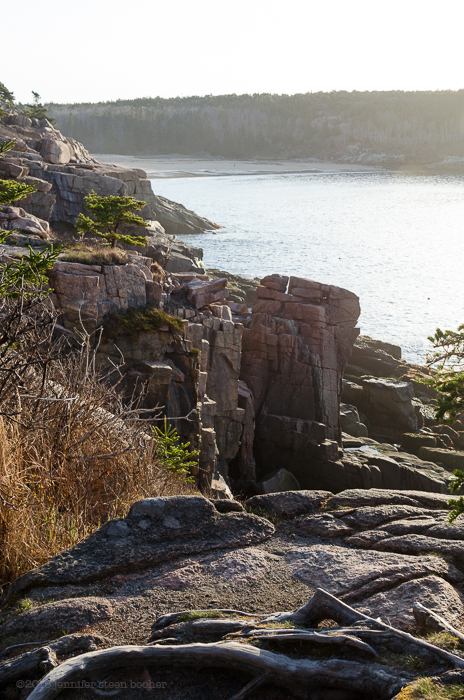
Reproducing seaweed

Those are conceptacles, the reproductive organs of the plant. They release male and female gametes into the water, and the resulting embryos attach themselves to the rock to form new plants.

I was so busy staring into the tidepools and trying to get photos of all the different seaweeds, that I didn’t notice I had company. At some point I looked up, and a raccoon was standing about five feet away with a shocked look on her face. I kid you not, if she could have spoken, she would have said, “Get off my rock!” She took off as soon as I noticed her, and I only got a few fuzzy photos of her fuzzy bottom.

web_DSC6980-Edit2

The ledges with the amazing tidepools eventually sank down into a cobble beach, and I was able to do a little beachcombing there.

web_DSC7120-Edit2

web_DSC7126-Edit2

web_DSC7177-Edit2A little stream empties into the cove, and a small flock of song sparrows was splashing around in it. They took off when they saw me, but several of them came back to the beach and hopped around pecking at things in the seaweed.

web_DSC7147-Edit2

I had left my collecting bag in the car (doh) so I had one hand full of camera and the other hand full of stuff. It looks like a bouquet, doesn’t it?

web_DSC7139-Edit2

To be continued…

____________________________

ADDENDA

April 30, 2015

While poking around in the vertical files of the Jesup Memorial Library I came across an article about the cannon (“Cannon in the Dooryard,” Frank Matter, The Islander Magazine, date unknown) that filled in a lot of the details. It was apparently placed on Schooner Head, in the front lawn of the Hale estate, in June of 1898 following the sinking of the battleship Maine in Havana harbor. Because the country expected to be attacked at any moment, the government scrounged up four old Civil War-era cannons and sent them down east. The other guns were placed on Egg Rock and Turtle Island. The bridge to the island had to be widened and strengthened to bear the weight of the cannon. It was a short war – the armistice was signed by mid-August – but the gun emplacements were not completed until October. They were, obviously, never used.  One can only imagine how irritated the Hales must have been to have construction going on through the entire summer season. According to the article, Mr. Hale refused Washington’s offer to remove the cannon, saying , “it might cause further injury to his roadway and lawn,” and the cannon remained in the Hale family’s front yard until 1943, when it was sold for scrap as part of the war effort. The Hale estate was destroyed in the Fire of 47. I’ve included the full text of the article for your amusement:

"Cannon in the Dooryard," Frank Matter, The Islander Magazine, date unknown.

"Cannon in the Dooryard," Frank Matter, The Islander Magazine, date unknown.

"Cannon in the Dooryard," Frank Matter, The Islander Magazine, date unknown.

May 5, 2015

Found a couple of photos of the Hale estate before the fire:

from "Lost Bar Harbor" by Helfrich and O'Neil

from Lost Bar Harbor by Helfrich and O’Neil. That must be Champlain Mountain in the background.

and after:

The caption reads "His Schooner Head estate in ruins Richard hale pluckily starts a new chapter of his "The Story of Bar Harbor," a scholar's must." From "Mount Desert The Most Beautiful Island in the World" by Sargent Collier and Tom Horgan

The caption reads, “His Schooner Head estate in ruins Richard Hale pluckily starts a new chapter of his ‘The Story of Bar Harbor,’ a scholar’s must.” From “Mount Desert The Most Beautiful Island in the World” by Sargent Collier and Tom Horgan


November 6, 2016

from "Opulence to Ashes: Bar Harbor's Gilded Century" by Lydia Vandenbergh

from “Opulence to Ashes: Bar Harbor’s Gilded Century” by Lydia Vandenbergh

The first European settlers on Schooner Head were William Lynam and Hannah Tracy. Married in Gouldsboro, they moved to MDI in 1831 and started a hundred-acre farm on Schooner Head. [As a side note, can I say how much it irritates me when history books say that male settlers came to the island and brought their wives with them? I don’t think any pioneer farm survived unless it was a joint enterprise, so can we please just start saying ‘they’ instead of ‘he?’]  There were few inns on the island until later in the 19th century, and the earliest tourists often boarded with local families, including the Lynams. Several of the early artists who visited (including Frederic Church, I think) stayed here.

from "Opulence to Ashes: Bar Harbor's Gilded Century" by Lydia Vandenbergh

Outbuildings of the Lynam farm, with a fish oil press in the foreground. Photo from “Opulence to Ashes: Bar Harbor’s Gilded Century” by Lydia Vandenbergh.

from "Opulence to Ashes: Bar Harbor's Gilded Century" by Lydia Vandenbergh

Sawmill on the Lynam farm. Photo from “Opulence to Ashes: Bar Harbor’s Gilded Century” by Lydia Vandenbergh

'Schooner Head and Lynam Farm,' Frederic E. Church, 1850-51. From "The Artist's Mount Desert" by John Wilmerding

‘Schooner Head and Lynam Farm,’ Frederic E. Church, 1850-51. From “The Artist’s Mount Desert” by John Wilmerding

Charles Tracy, a New York lawyer and one of the earliest tourists to MDI, kept a diary of his visit here in 1855. Here are his descriptions of Schooner Head and the Lynam family:

from "The Tracy Log Book 1855" edited by Anne Mazlish

from “The Tracy Log Book 1855” edited by Anne Mazlish

from "The Tracy Log Book 1855" edited by Anne Mazlish

from “The Tracy Log Book 1855” edited by Anne Mazlish

You may already know some of this, but a whole web of connections spreads out from that 1855 visit. Charles Tracy’s daughter Fanny, who traveled with him, later married J.P.Morgan. She brought him to Mount Desert Island for their honeymoon, they built a house here, and most of the senior members of his firm (the ‘Morgan Men’) started summering here and building houses. The Morgans bought Great Head for their daughter, Louisa Satterlee (see Coast Walk 8) – her children donated it to the National Park.  Alessandro Fabbri, whose WWI transatlantic radio station we talked about in Otter Creek, was the son of one of those Morgan Men. So the web goes from brown bread at the Lynam farmhouse to Gilded Age cottages along West Street to submarines in Otter Cove. Crazy, isn’t it, what one tourist started?

________________________________

WORKS CITED

Collier, Sargent and Horgan, Tom, Mount Desert The Most Beautiful Island in the World.

Helfrich and O’Neil, Lost Bar Harbor.

Hill, Ruth Ann, Discovering Old Bar Harbor and Acadia National Park, 1993.

Matter, Frank, “Cannon in the Dooryard,” The Islander Magazine, date unknown.

Mazlish, Anne, ed., The Tracy Log Book 1855: A Month in Summer, Acadia Publishing Co., 1997.

Sweetser, M.F., ‘Sightseeing at Schooner Head,’ 1888 (as reprinted in Discovering Old Bar Harbor and Acadia National Park, Ruth Ann Hill, 1993.)

Vining, Thomas F., Cemeteries of Cranberry Isles and the Towns of Mount Desert Island, 2000. (Updates are posted on this page of the MDI Historical Society’s website)

Vandenbergh, Lydia, Opulence to Ashes: Bar Harbor’s Gilded Century, Downeast Books, 2009.

Wilmerding, John, The Artist’s Mount Desert, Princeton University Press, 1995.

Save

Save

Share

Coast Walk 2 Still Life

_DSC6801-web©

Coast Walk 2: from the Town Beach to Cromwell Harbor; January 6-10, 2015


Remember Coast Walk 2 – wandering along the Shore Path? This is the still life of objects I found along the way. It went a lot faster than the one for the first walk because I didn’t have any gross bones to clean. My favorite bit of this one is the hot pink coralline in the second row. That color! Usually when I find coralline it has bleached white. I’ve no idea why the color lasted so well in this one. Coralline is a marine alga, a seaweed, but it uses calcium carbonate in its structure, so it feels hard and brittle. If you look closely at it, you can see it has articulations every few millimeters that allow it to flex. Also very cool? All the itty-bitty baby mussel shells! None of those are even as big as my pinkie nail. They were so hard to work with, as the least breeze would move them around, but then they would develop some kind of static-electricity bond with the plexiglass of my light box and just stick to it. As my mother used to say, “It’s a good thing you’re cute.”

From left to right, top to bottom:

Hovering above: plastic ring, sea glass

Row 1: young Blue Mussels (Mytilus edulis), Northern Rock Barnacle (Semibalanus balanoides), more mussels

Row 2: granite beach stone, Corallina officinalis, plastic marker cap, driftwood, Dog Whelks (Nucella lapillus)

Row 3: sea glass, fish eggs (dried out now but there’s a photo of them fresh in the CW2 blog post), sea glass, more mussels (not sure if they’re Blue or Horse Mussels), acorn (probably Quercus rubra), beach stone, mussels

Row4: Dog whelk, more mussels, Common Periwinkles (Littorina littorea)

Row 5: Seaweed attached to barnacle, Smooth Periwinkles (Littorina obtusata), sea glass, plastic thingy (I think it’s from a glow stick), beach stone

Row 6: Common Periwinkles, granite beach stone, sea glass, mussels

Row 7: Dog whelks, Horse Mussel (Modiolus modiolus)

Share