The Coast Walk Project

Blog

Coast Walk 6: Schooner Head at Last

web©-_DSC6755-Edit2April 13, 2015:  65ºF, 11:40am-2pm with low tide at 12:30, sunny and warm, not much wind. One loon and two or three crows.

CoastWalk6end

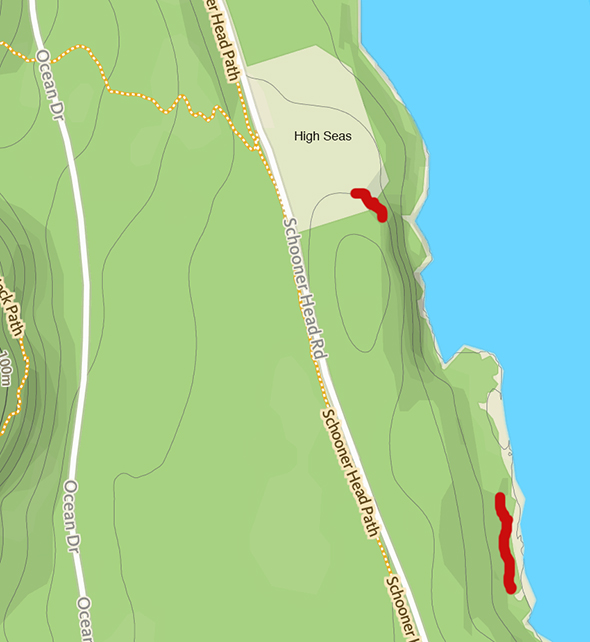
Coast Walk 6: Feb.3 through April 13. That wasn’t so bad – it only took 9 weeks to go about half a mile (not counting trekking in to the shore and back out again.)

The weather changed abruptly this week. And by abruptly I mean it feels like we went from mid-winter to early summer, skipping spring entirely. Last Monday I canceled the Coast Walk because a disgusting mix of snow, sleet, and rain was falling out of the sky and I was pretty sure the shore would still be covered in waterfalls of ice. Today it was 36ºF when I went out at 6am, but by the time low tide rolled around it was sunny and 65º.

web©-_DSC6693-Edit

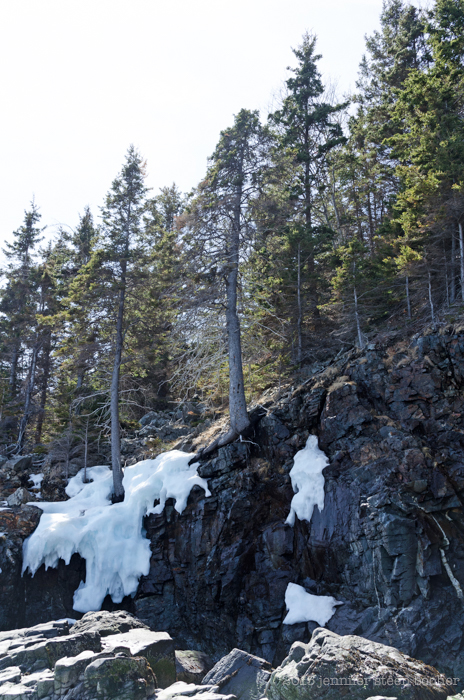
There are still pockets of snow and ice left in the shade.

As soon as I left the house I had to strip off my coat and fleece, which led to the first problem of the new season: where to put all the things I’ve been carrying in my coat pockets! Clearly I will have to buy pants with enormous pockets or get some kind of fanny pack, because it is a royal pain to pull my backpack off every time I want a tissue. And I don’t dare carry my iPhone in my back pocket – the ice may be gone, but the rocks are still covered in slippery green algae. And in barnacles, which turned out to be the second wardrobe-related issue of the day. This was my first day out without gloves, and scrambling over barnacle-encrusted outcroppings with bare hands was quite painful. I managed not to cut myself this time (barnacle scrapes hurt more than paper cuts and they usually get a little infected) but next time I’ll have to bring a pair of fingerless biking gloves. Mine have padded palms which will be very helpful, although I suspect they won’t last long. Wonder how many pairs I’ll need to get through the summer? Ditto for jeans: my poor snow pants are held together with gaffer tape after 3 months of sliding over ice and barnacles.

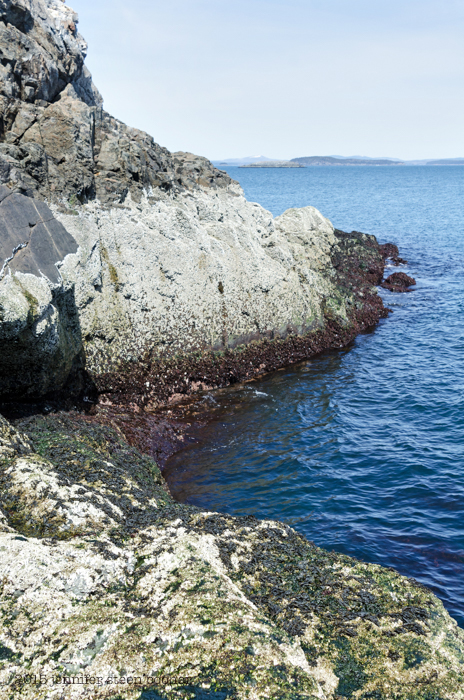
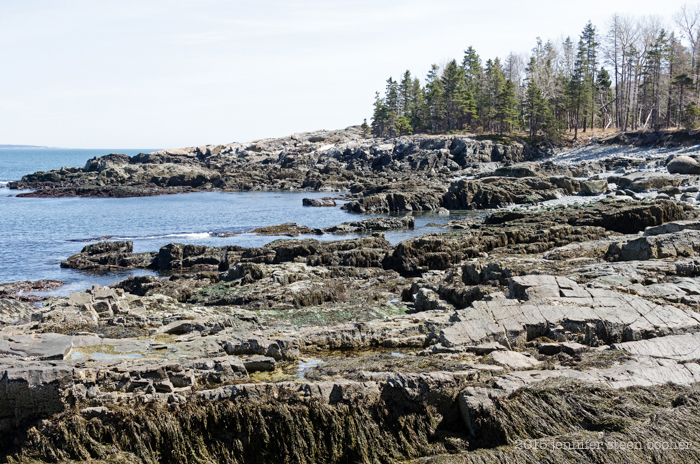
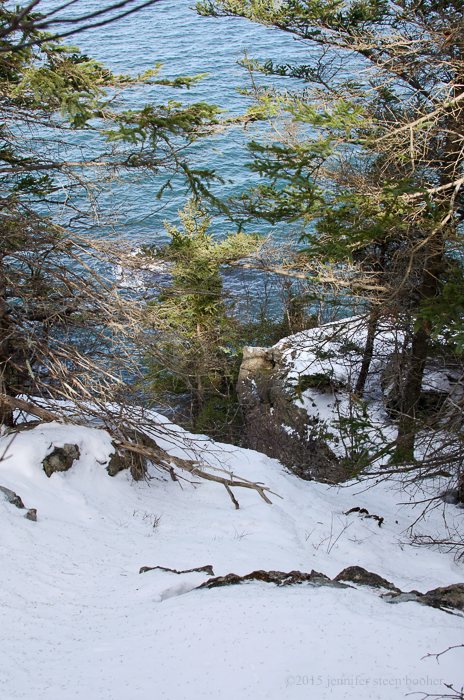
web©-_DSC6676-Edit2I trekked in to the same point that I finished the last post with, just at the northern edge of Schooner Head, but this time I was able to scramble down the low cliff. It was about six or seven feet high, and I jumped the last three feet, thinking that once upon a time when I was ten I used to get a swing going six feet in the air and jump off because it felt like flying. When did a little three-foot jump start to feel scary? Anyway, I headed north to see how much I could reach of the areas I missed while hiking along the top of the cliff.

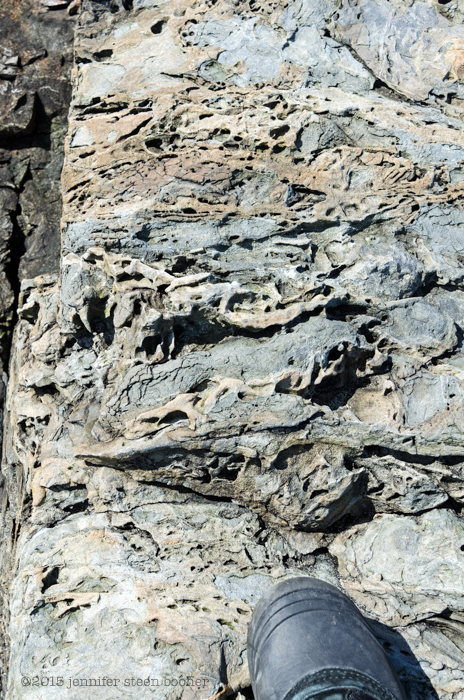
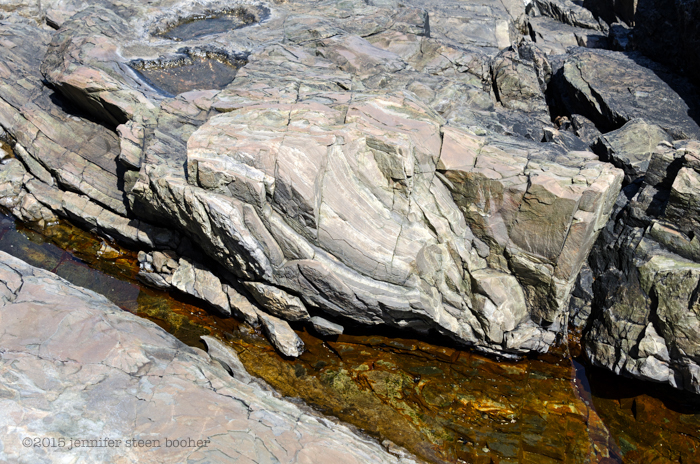
According to my map (The Bedrock Geology of Mount Desert Island), this whole area is part of the shatter zone, which is where the volcano that became Cadillac Mountain pushed through the existing bedrock before the glaciers came, so long ago it makes my brain hurt to imagine it. [My husband proofread this post, and he asked why it’s called the shatter zone. I was like, “Geez, how do you not know that? Oh, right, you didn’t chaperone the 6th grade field trip to Great Head. Twice.” According to the park ranger who led our group (and yes, how amazing is it that our kids go on field trips led by National Park Rangers?) the shatter zone is the very large zone around the perimeter of that ancient volcano where the magma pushed up through the bedrock and shattered it. When we reach Great Head I’ll show you zones where the bedrock floated in the magma until it cooled, and you can see shattered chunks of it embedded in the granite.] There were some really odd bits of rock down there:

web©-_DSC6686-Edit2

web©-_DSC6679-Edit2

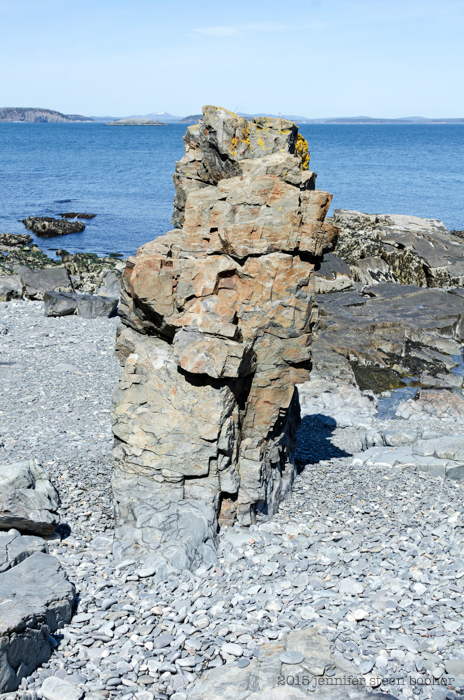
web©-_DSC6793-Edit2That sea stack looks a lot like Bar Harbor Formation stone (which you can see off the Shore Path by the Bar Harbor Inn.)

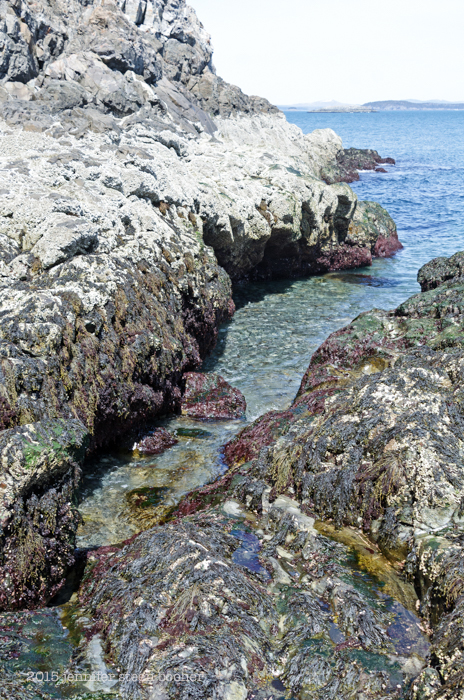
web©-_DSC6700-Edit2Most of the shore was pretty steep, with lots of these little gullies cutting into the stone. It made for a lot of climbing up and slithering down. You can see how thick the barnacles are, too. Definitely adventurous terrain!

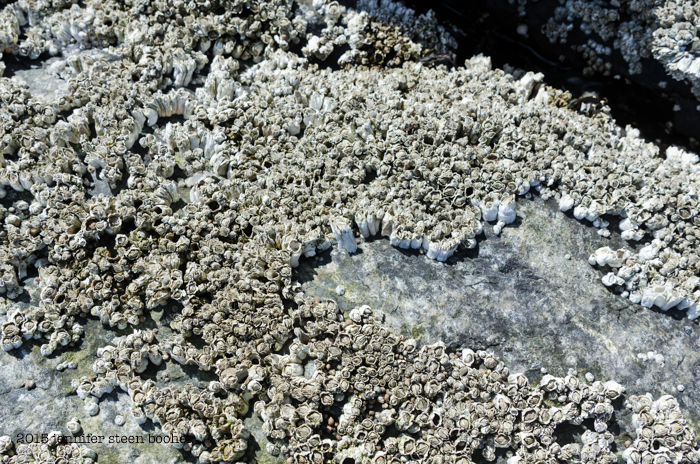
web©-_DSC6730-Edit2The barnacles were not only dense, covering the surfaces completely, they were really tall, probably because they were packed in so tightly. I suspect that bare patch was opened up by ice forming and then getting pulled off by the waves.

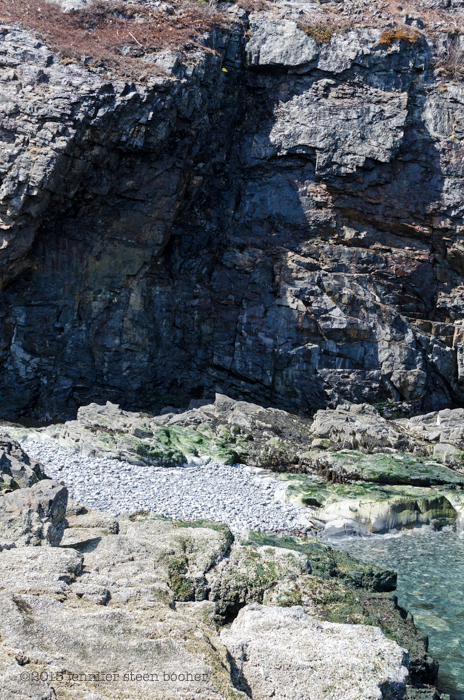
web©-_DSC6675-Edit One of the gullies opened out into a small cobble beach under a massive overhang that was almost a shallow cave. Almost.

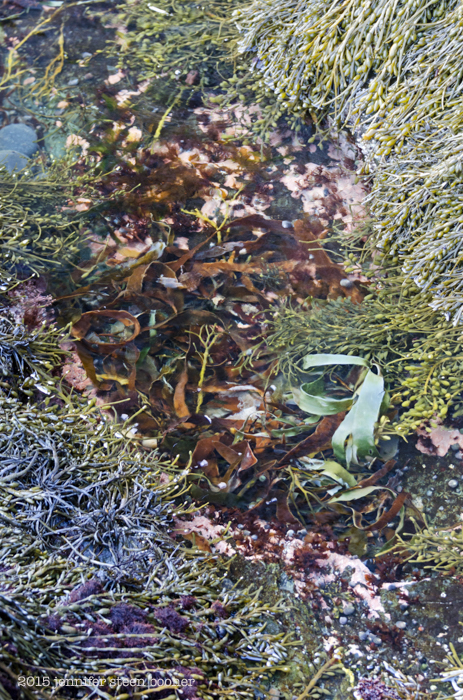
web©-_DSC6746-Edit2It was so nice to see the tidepools without a crust of ice. Seaweed was actually moving around, as were the periwinkles, and I saw the first scud swimming. I couldn’t get a clear photo, sorry; they are tiny and they move so fast, it’s like trying to photograph a toddler on Christmas morning:

web©-_DSC6741-Edit2Isn’t she cute? Scud are crustaceans, related to shrimp, wood lice, and lobsters, kind of in the way I’m related to my great-grandmother’s sister’s children – distant branch of the same family. Scud and shrimp, for example, are both Malacostraca, which is a class of crustaceans, but scud are Amphipods and shrimp are Decapods. The ‘pod’ in the name comes from the Greek word for foot, and amphipods (translates as ‘different feet’) have two different types of legs, while decapods (translates as ‘ten feet’) have, you got it, ten legs. Scud have seven pairs of leg-ish appendages, so you’d think they’d logically be called septapods, but the legs aren’t all the same and then there are two more leg-ish things that are sort of mouth parts, so it was probably too complicated to explain all that in a made-up Greek-based word. Malacostraca also comes from the Greek and translates as ‘soft shell,’ although as Wikipedia points out, they are only soft after moulting. Thank you, Wikipedia.  You’ll have noticed that all the Latin names (aka scientific names) in this paragraph are Greek. They’re called Latin names because the grammatical structure is based on Latin, regardless of what language the name draws from. Scientific names looked pretty uniform when all the people naming things were European, but it makes for some interesting juxtapositions now that science is more inclusive and the base language is, say, Inuit (Tiktaalik roseae, for example.)

P.S. The Latin name for ‘Latin names’ is ‘binomial nomenclature.’

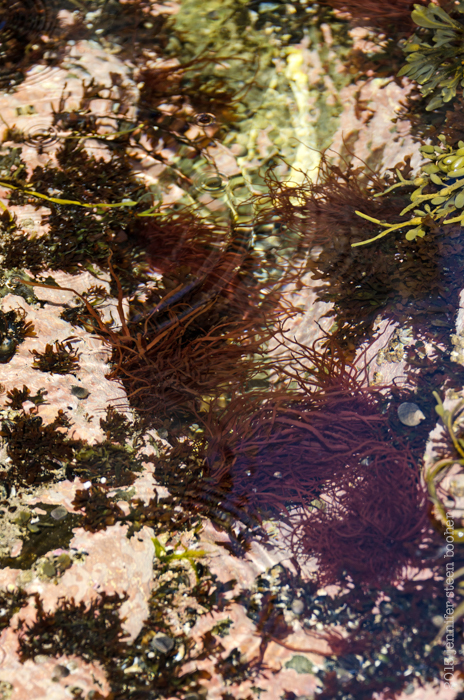
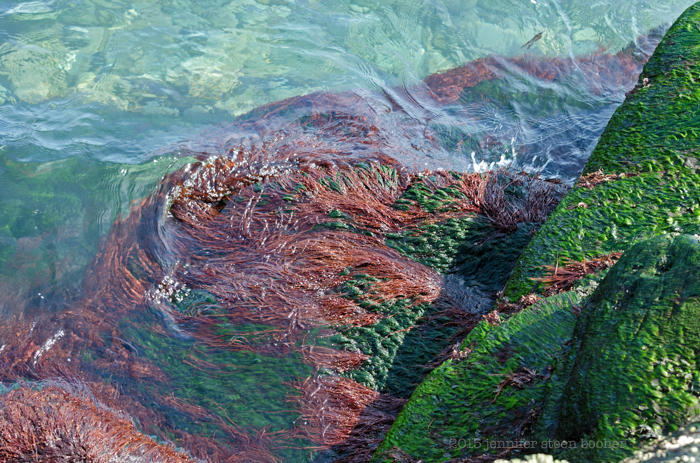
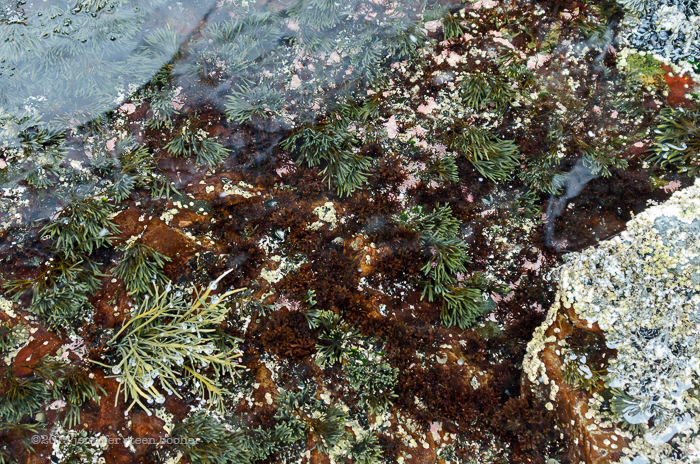
web©-_DSC6709-Edit2That reddish seaweed in the tidepools puzzled me. I’m not great with seaweed identification, but I’m pretty sure I’ve never seen that before. It also blanketed the rocks in a thick red mass down at the low tide line. After doing some research, I think it’s Dumontia contorta (also known as Dumontia incrassata .) It doesn’t seem to have a common name, although all the sources I found say it’s common in the intertidal zone. The bright green mats of seaweed stumped me. It could be Acrosiphonia arcta, or it could be Ulva intestinalis, or it could be something else entirely. I’ll have to look at it more closely next time I run into it. Sometimes it’s hard to know what to pay attention to when I’m out there.

web©-_DSC6716-Edit2Eventually I ran into a part of the shore that said very clearly, “You shall not pass:”

web©-_DSC6713-Edit2so I turned back toward Schooner Head, where the cliff drops down to a very pretty cobble beach.web©-_DSC6763-Edit2

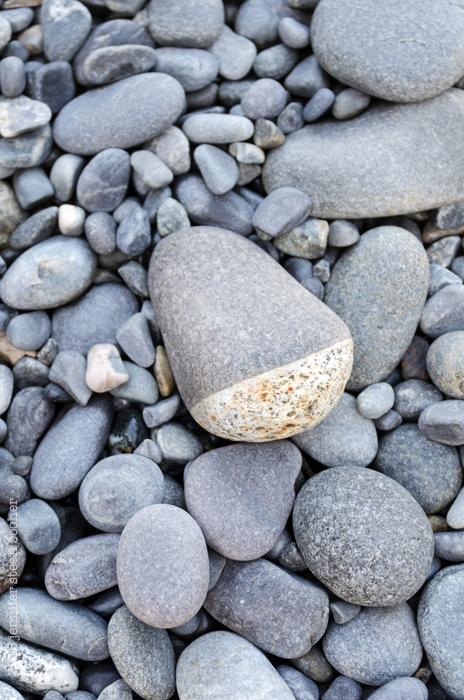
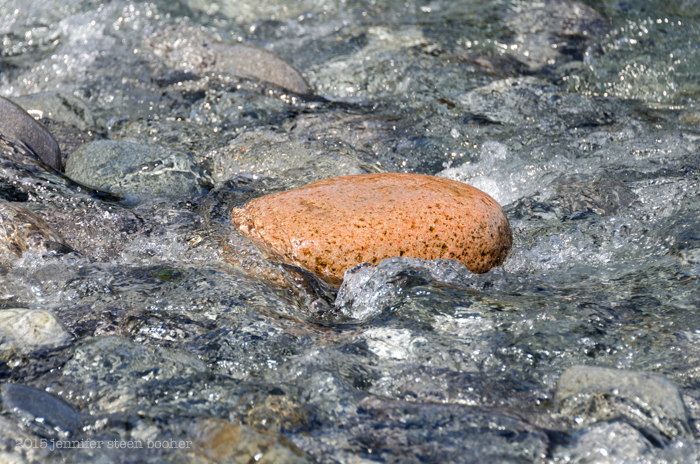
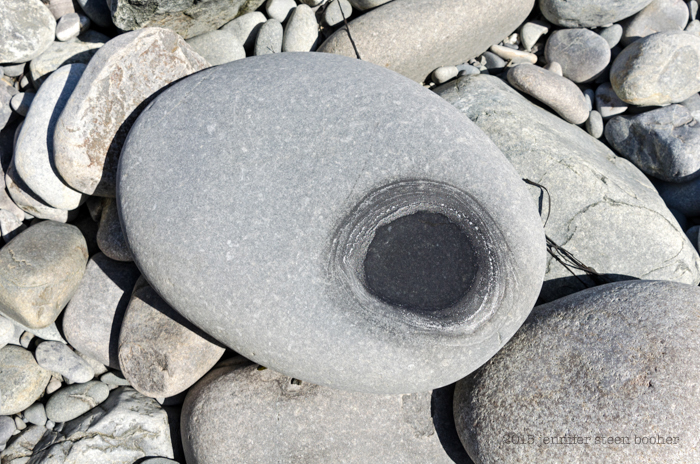
web©-_DSC6760-Edit2This cobble had a shallow depression worn into the top, which had filled with seawater. As the water evaporated, it left rings of salt crystals around the puddle.

web©-_DSC6772-Edit2If you come on a Coast Walk with me, be prepared to squat on a stony beach and watch water evaporate. And maybe afterward we’ll go for a cup of coffee and watch paint dry.

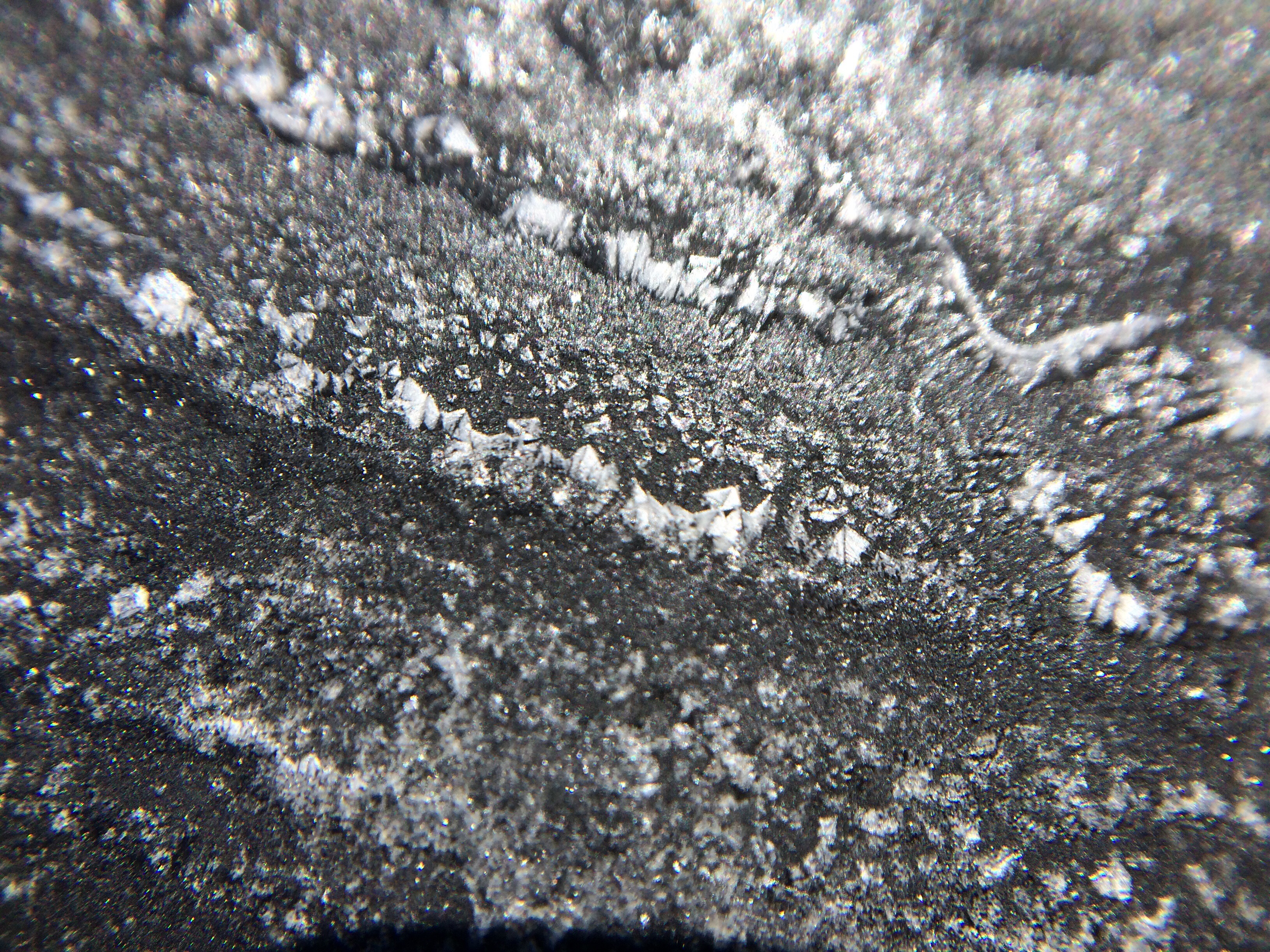
Closeup of the salt rings (taken with a macro lens on my iPhone):

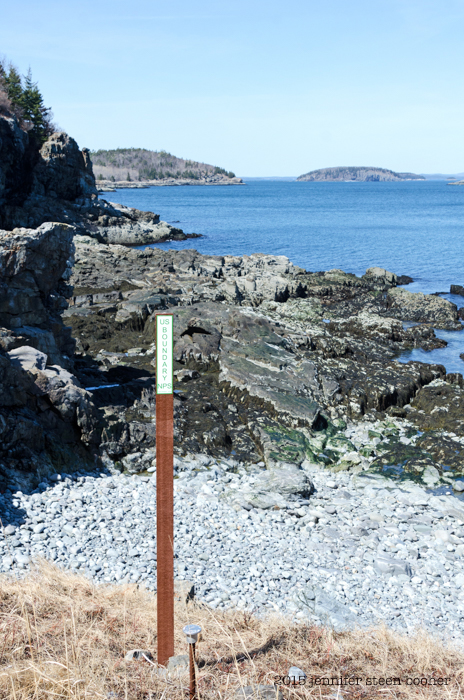
IMG_3837 And with that, I was on Schooner Head, and had passed out of the park boundaries. Thank you Acadia, it’s been wonderful! See you on the other side (of Schooner Head.)

web©-_DSC6799-Edit2

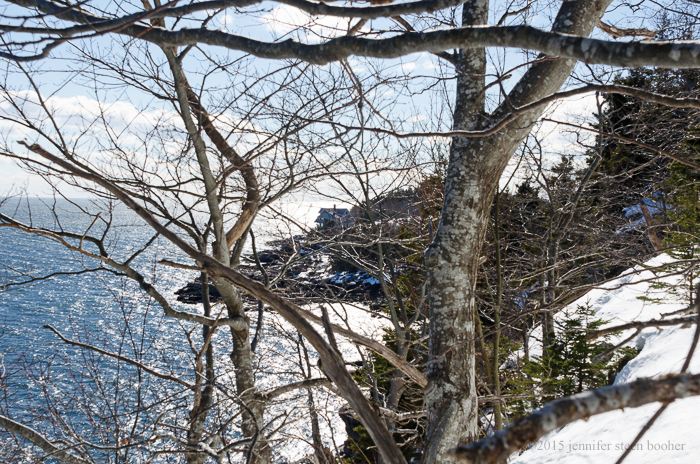
P.S. I had permission from the landowner to be here, don’t worry!

Share

Coast Walk 1 Still Life

_DSC6497-B-web©

Coast Walk 1: January 1, 2015, The Bar to the Town Beach, Bar Harbor, Maine

The first still life of the Coast Walk – why did it take 3 months to pull together? Mostly because of the eider skull in the 2nd row from the left. It looked like this when I found it on New Year’s Day:

web©_DSC4859and it took a long time to clean the smelly parts off without damaging the delicate bones. (This might be a good time to thank my family for accepting the skull-in-a-jar that has been macerating above the sink for most of the winter. Thank you, family.) The spine in the second row from the right came from the same bird. There might have been more of the skeleton buried in the seaweed, but the pile was frozen solid and these were all I could pull free. Also thank you to Jane Disney, one of my walkers that day, who found the moon snail shell while I was listening to George Neptune’s stories about the Wabanaki encampments!


So what are we looking at? From left to right, top to bottom:

1. sea glass, die-cast toy truck, sea glass, Common Periwinkle (Littorina littorea), Razor Clam (Ensis directus)

2. ceramic electrical fixture, granite beach stone, porcelain shard, Common Eider skull (Somateria mollissima), ceramic spark plug, Soft-shelled Clam (Mya arenaria)

3. more periwinkles, Northern Rock Barnacle clump (Semibalanus balanoides), two Dog Whelks (Nucella lapillus), driftwood, more periwinkles

4. seaweed – I’m not so good with marine algae, but I think it’s Rockweed (Fucus distichus), sea glass, Green Crab (Carcinus maenas), sea glass, bird leg bone

5. more sea glass, Common Eider spine, aluminum soda can tab, Blue Mussel (Mytilus edulis), fabric flower, copper doohickey (maybe part of a hose)

6. Moon snail (Lunatia heros), more periwinkles, styrofoam packing peanut, another Blue Mussel, plastic spoon, lobster-claw band, plastic earpiece from sunglasses, sea glass, and an oyster shell (the shape looks like Ostrea edulis, a.k.a. the European flat oyster, which means it was most likely farmed, not wild)

Share

Coast Walk 6: March 2015

web©-_DSC6391-Edit2

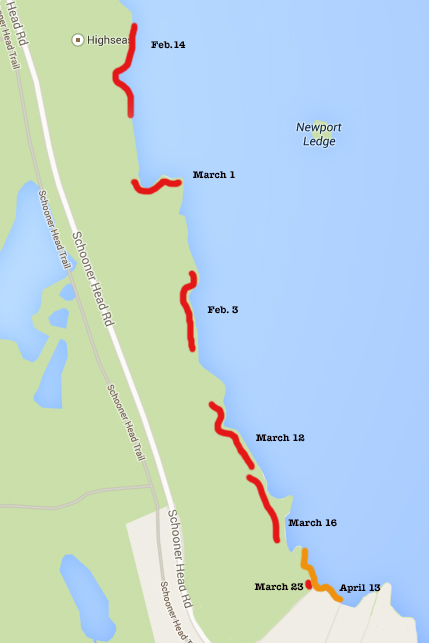
I haven’t posted in ages because this past month or so has been a bit of a struggle and it didn’t seem like I had much to report. The snow just kept getting deeper, and the few spots where I might have been able to climb down from the cliff were waterfalls of ice, so I’ve been trekking along the top of the cliff. It’s frustrating, as I feel I’ve been missing a lot of the shore, and the ground was hidden under a good three feet of snow, so my observations have been limited to trees, snow consistency, and how damn cold it gets when the wind is blowing. I’m getting better at snowshoeing, though. Now I only occasionally fall over because I’ve stepped on my own shoe! So here’s the summary of what happened in March.

CoastWalk6and7

All the segments so far

March 12, 2015: 35ºF, strong wind from southeast-ish but it shifted a lot, so can’t really say a direction. Sunny and comfortable in the sheltered areas, very cold in the wind!  1 crow, 2 black ducks

web©-_DSC6390-Edit2My friend Jane Holland (of the Aysgarth Station B & B) came with me today – I’ve had to stop interviewing people because A) we need our breath for climbing uphill through 2 feet of fresh powder, and B) the snow makes crunchy cornstarch sounds that drown out conversation. All you can hear on the recording is “Crunch, crunch, sniffle, cough, honk (as I blow my nose because the cold wind makes it run like a faucet) , crunch, crunch, cough, poof (as I step on my own snowshoe again and keel over sideways.)”

The terrain here rises up a bit from the Schooner Head Road and then drops down toward the ocean, where it cuts off into a cliff:web©-_DSC6394-EditThere were snowshoe tracks down near the cliff top. It was the first time since I left the Shore Path that I’ve seen someone else’s tracks in front of me, and I was surprisingly put out. Guess I’ve gotten a bit spoiled by all this pristine snow. I did hope it was someone who had read my last post and came to see how beautiful the area is! I’d never explored around here, didn’t even know it was part of the park, and I’ve just been amazed at how lovely it is. The forest has been Red Oak pretty consistently since High Seas, and I can’t believe I never noticed that before. It seems like most of the places on the island that I’m familiar with are either dominated by maples or by spruce. It’s especially noticeable in the winter, because the oak trunks are so smooth and patched with pale gray (they must be relatively young.)

web©-_DSC6399-EditJane spotted a freeze-dried mouse next to a snow-burrow that had been opened up by something searching for food – fox, mink, other predator? Then we started to notice burrows all over the area, each with a few acorn shells outside the entrance. Ski pole included for scale:

web©-_DSC6413-EditYes, that’s something’s scat, but neither of us knew what kind of animal left it. Something trying to dig out the mice, maybe? And here’s the dead mouse. I made the photo small because I know not everyone is fascinated by poop and corpses.

web©-_DSC6410-Edit2The oddest find of the day was a contraption meant for grilling fish that someone had stuck in the branches of a tree. Jane and I debated whether a storm could have lodged it there, but given that we were a good fifty feet above hide tide we thought it doubtful.

web©-_DSC6398-Edit

The cliff edge was fairly thickly wooded by this point and the combination of wading through deep snow and bushwhacking through spruce trees started to wear us out, so we headed back uphill while we still had the energy to enjoy the climb. I had one last glimpse of Schooner Head through the trees, and it finally feels like we are getting close!

web©-_DSC6405-Edit

March 16, 2015: 41ºF, some wind, sunny. A mixed flock of seabirds – about a dozen black ducks, a couple of herring gulls, and a couple that might have been eiders (too far away to tell, even with telephoto lens.)

I went on my own today. There was enough snowfall yesterday to erase our tracks near the road, so it was a bit of guesswork to pick up where we left off. I only saw one burrow this time – the others were probably covered by the fresh snow. The terrain gets very steep here, and I saw on a map that this is (or was) called Cranberry Hill. Can’t remember which map now – I got a little careless with my note-taking, sorry. Heading up from the road it was a Red Oak forest:

web©-_DSC6434-Edit2

but heading down toward the ocean the spruces took over. This was the least fun Walk I’ve had yet, because the terrain was so steep and the trees were so thick that it was very hard to walk in snowshoes. The snow had firmed up since Jane and I went out, so at least I wasn’t sinking into it, but imagine the angle my ankles were at walking across this in snowshoes:

web©-_DSC6443-Edit2

I actually took a snowshoe off  to test the snow because it was so painful to walk that way, but I promptly sank in up to my knee, and had the dickens of a time getting back out! web©-_DSC6444-Edit2

The spruce got really dense along the cliff edge, so I couldn’t see the ocean at all, and pushing through the needly branches with my ankles all twisted from the terrain was No Fun At All. After a bit I started to worry that I was actually going to do some damage to my ankles, and this would be a hell of a place to get stuck, so I headed back up the hill. I got glimpses through the trees of Schooner Head, and it looked like I would be able to reach the shore there, so my plan was to start there on the next Walk and hike backwards to finish this stretch of coast. web©-_DSC6451-Edit

When I reached the top of Cranberry Hill, my bad mood evaporated because the view was stunning:web©-_DSC6472-Edit2

Champlain Mountain covered in snow, with the red oak forest spreading like silver mist through the valley. My god it was gorgeous! I couldn’t capture it in photos. A wider lens (and maybe a better photographer) would have helped.

web©-_DSC6466-Edit2

Looking down from Cranberry Hill: you can see Schooner Head Road at the bottom there, and just barely pick out my car parked on the road. But you can see what I mean about the red oak forest – it fills the whole valley and spreads all the way to the coast.   web©-_DSC6475-Edit2

I couldn’t get down at the point where I came out – the hill is a series of ledges and small cliffs, so I backtracked along the top to the point where I came in:

web©-_DSC6478-Edit2

And boy, was I ever glad to get back to my car after all that!

March 23, 2015:

This is a really short one. I forgot to take notes, drat it, but it was a very cold morning, about 9ºF with a fairly brisk wind, and sunny. My husband, Brian, came with me. You remember him from last month, right? Our plan was to hike in along the park’s border with the northernmost property on Schooner Head, and scramble down to the shore at the house. See, I had received permission from the property owner to walk along their shoreline, but forgot to ask permission to walk in along the driveway – doh! The snow had frozen pretty solid, and our snowshoes didn’t sink in at all. It was a pleasant walk through the usual red oaks:

_DSC6479-web©Took about 15 minutes to reach the shore, but even though it wasn’t much of a drop, maybe six feet or so, it was completely coated in ice. We thought we might have been able to get down at certain points, but our hands were still cold from putting on our snowshoes, and we’d have had to take off our gloves long enough to swap snowshoes for creepers … I decided that reaching the shore with frozen fingers would be kind of pointless. And then there was the question of getting back up a six foot tall ice slide… So we went home. And I was discouraged. I thought I would try going back to the same spot in a week to see if the ice was melting (after all, it was practically April) but the day I planned to go we had a beautiful mix of rain, snow, and sleet. And I was even more discouraged. Which is why it took me two weeks to finally write this blog post: I didn’t think I had anything to show you. Funny, though, as I’ve been editing the photos and writing, I realized I did get to see a lot, even if it wasn’t what I had planned. And now it really is April, and there’s bare ground showing through the snow in town, although it’s still at least a foot deep out in the park. I’ll go back and try again next week. I have to get ’round Schooner Head this month, because several of the property owners who’ve granted me access start renting those houses in May, and don’t want me intruding on their renters. So complicated!

Share

Coast Walk 6: Snowshoes (March 1)


_DSC6351-web3©Notes:  March 1, 2015: 34ºF, no wind, overcast with occasional sun, 3-4:15pm

CW6-March1

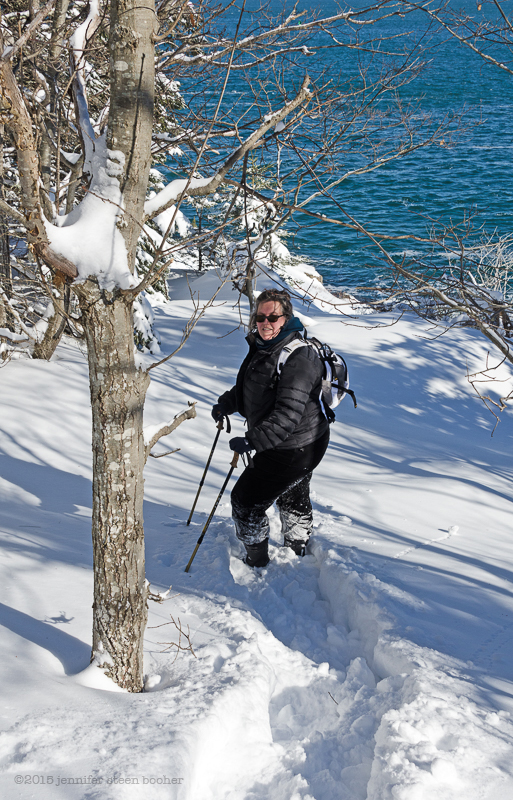
_DSC6311-web©I’m still hiking the area between High Seas and Schooner Head, and hope to finish it in another 2 weeks if conditions stay the same. My husband, Brian, joined me on this section, and we both tried snowshoes for the first time. He wore a vintage pair his parents had inherited, and I had a modern pair on loan from a friend (thanks, Kelley!) We both used our battered old cross-country ski poles for balance. It was a lot of fun, and definitely beats floundering through thigh-deep snow banks. It got a little tricky in the thick woods, though; I had to keep disentangling my feet and my poles from low-hanging spruce branches.

_DSC6387-web©

His and hers snowshoes

Most of the area along Schooner Head Road slopes steeply upward from the road, and there don’t seem to be any trails, so we drove along until it evened out a bit, then strapped on our gear and went off-roading toward the coast through a beautiful grove of young oak trees. There wasn’t much undergrowth, and I’ll bet it’s a gorgeous hiking area in the spring. It would have taken about ten minutes of brisk hiking, except I’m a photographer so everything takes me twice as long. It’s an old family joke that everyone else hikes up the mountain but I do wind sprints because I’m constantly saying, “Wow, look at the lichen on that tree! You go ahead, I’ll catch up.” And then I have to run uphill after everybody.

web-_DSC6309-Edit3

web-_DSC6314-Edit3We were looking for the sloping ravine I’d spotted on the last walk, hoping it might be another way down to the sea cave I’ve been obsessing over. We found it, and in the summer it might be possible to scramble down, but right now the lowest portion is a waterfall of ice. Pretty, but I’m not quite ready to learn ice-climbing, so we kept going out onto the little point you can see on the map.

web-_DSC6316-Edit3

web-_DSC6333-Edit3

Looking back from the point we had a clear view of the cave (the photo at the beginning of this post gives a better idea of how big it is):

_DSC6335-web©

This was about an hour after dead low tide, so I’m not sure I’ll be able to get in without wading, but you know I am going to try! In about two weeks, as we head into the new moon, the tides will be at their lowest point, and I’m going to give that cave another shot. I don’t know what it is, there’s just something about caves that makes me feel like a kid on Christmas morning. Anything could be inside! I’m hoping for anemones and starfish, but I’d settle for pirate treasure.

There’s a narrow passage through the rocks at the end of the point which looks like it would be a good access point to the shore when the ice melts. There were also some fabulously weathered boulders. I thought this one looked like a rabbit (our rabbits have short ears):

web-_DSC6372-Edit

The house in the distance is on Schooner Head, which is beginning to feel like the hill from Through the Looking Glass, the one Alice could never reach:

web-_DSC6361-Edit3

And this is looking back toward Sols Cliff. The mini-island in the center of the photo is just off of High Seas:

web-_DSC6346-Edit

I’m heading over to the Bar Harbor Historical Society this week to research the area; can’t wait to see what cool stuff I can dig up there!


Share

Coast Walk 6: Heading south from High Seas (Feb.14)

web©-_DSC6215-Edit

Notes: February 14, 2015 (yes, Valentine’s Day): 16ºF with a wind chill around 0º, patches of sun with light sprinkling of icy snow that quickly changed to serious snow, wind from southeast-ish. Damn cold.

CW6aThis was one of the most beautiful sections of shore I’ve seen. When I started down the cliff there was a very light sprinkling of snow in the air – the flakes were tiny ice crystals, so it was like walking through a shower of glitter. Gorgeous, and well worth having my cheeks frozen and wind-burnt to see. Here’s how I got down the cliff:web©-_DSC6160-Edit

alternately trudging through snow over my knees and sliding on my bum. I’m going to need new snowpants by spring!

web©-_DSC6164-EditThat headland in the distance is Schooner Head, where Coast Walk 6 is supposed to end. It seems awfully far away. On this walk I didn’t quite reach the point of land in the middle of the photo. It’s hard to see, but the shoreline is cut by several deep gullies that go way back into the cliff, so it’s a longer hike than it looks. Even at low tide, they still have water in them, and I had to wade to get as far as I did.

web©-_DSC6159-Edit

web©-_DSC6154-Edit

There wasn’t much wildlife out; four black ducks or female mallards (I can’t tell them apart), one male mallard, and a couple of eiders. There were squirrel tracks, and prints that could have been either a fox or coyote.

web©-_DSC6180-EditMy big motivator for this hike was the rumor of a sea cave somewhere south of High Seas. I spotted something in the cliff face that looked promising – can you see the enormous dark arch in the middle of the photo below?

web©-_DSC6183-EditHere’s a slightly closer look. I couldn’t quite get to it on this trip – there was another deep gully between us, and the tide had turned.

web©-_DSC6220-EditI was tempted to keep going – it was so close! – but stopped for a reality check: alone at the base of a sixty-foot cliff, snow coming down harder every minute, tide starting to come in, freezing temperatures, two gullies to wade through to reach the only way back up the cliff … I turned back. Not giving up, though! The shore is only passable at dead low tide, so it’ll have to wait for the right day. Meanwhile, it looks like there might be another way down just past the [potential] cave. If it ever stops snowing, I’ll go around the top of the cliff and check that out.

web©-_DSC6208-Edit

web©-_DSC6202-Edit

web©-_DSC6198-Edit

web©-_DSC6211-EditYes, it will be more comfortable to explore in the summer, but I will miss views like this.

web©-_DSC6233-Edit

web©-_DSC6192-Edit

web©-_DSC6248-Edit

web©-_DSC6239-EditWhen you look out into the landscape, everything is monochrome greys and whites, but when you look up close, it’s technicolor.

web©-_DSC6238-Edit

web©-_DSC6226-EditThe hot pink is Coralline, a crustose form of marine alga that uses calcium carbonate in its structure. It looks like stone, or a crusty coral, but it’s a plant.

web©-_DSC6222-Edit

web©-_DSC6196-EditThe Maine version of stars in your eyes:

web©-_DSC6251

Share

Phooey

web©-_DSC6099-Edit Diver Ed, Captain Evil, and I were supposed to explore Anemone Cave today. It was going to be an awesome crossover between the Dive Log that Eddie’s doing this month and the Coast Walk, kind of like when Superman shows up in a Batman comic, but no, it’s still snowing. And there’s a heck of a surge, and it is bitterly cold with a strong north wind (which means there would be big waves breaking on the shore, major ice, and the wind knocking us off balance.) So we bailed. And I’m cranky.

web©-_DSC6108-EditI love winter and I love snow, but I’ve never seen this much accumulation – guess I picked the wrong year! We’re supposed to get another round of light snow on Thursday, and then 8-10″ on Sunday. Given that we’ve already got at least 2 feet on the ground it’s unlikely that I’ll be able to make much progress, so I don’t know when the Coast Walk will be back on track.

web©-_DSC6097-Edit Meanwhile, you should check out Eddie’s project. He’s trying to do 28 shore dives this month – one per day – and is posting these awesome short videos on Facebook. Here’s the latest Dive Log – watch him wade through 5 feet of frozen slush in a drysuit and scuba gear!

I’ll keep trying, of course, and I’ll post those attempts here for your amusement.

Share

Not quite Coast Walk 6 (Feb. 3, 2015)

web©-_DSC6080-Edit

Notes: February 3, 2015: 11am-12:30pm, 7ºF, stiff wind off the bay, sunny and cloudless but bitterly cold. Just after high tide.

map

Walker: Brenda Beckett, PA-C, MDI Hospital and Captain, Acadia Photo Safari

web©-_DSC6043-EditWell, I knew the weather would get the best of me at some point, but I have to admit, this is not how I expected it to win! I thought maybe a freezing rain or gale-force winds would keep me indoors, because we get a lot of both in the winter. Here on the coast, serious snow is rare, and a good winter is one where we get enough to cross-country ski on the carriage roads. Six inches, maybe a foot. This year is a record-breaker: a week of snowstorms left us with a good three feet of snow, with drifts up to six feet deep. My kids have had four snow days in two weeks, and our schools don’t close unless the weather’s bad.

web©-_DSC6035-EditAll of which meant that when Brenda and I set out from High Seas we found the going very slow. The snow was so light and powdery that even with snowshoes Brenda sank in up to her shins with each step; without snowshoes, I frequently went in over my knees. It was pretty obvious that we were not going to be able to do the mile or so of hiking that I had scheduled.

web©-_DSC6052-EditWe had also planned to take this blog into more serious territory than my usual posts: our destination was the spot where her family had scattered her beloved brother-in-law’s ashes over twenty years ago. See, I’ve been asking everyone I know about the ecology of the shoreline, the geology, the animals, the history … and also about how they use it or interact with it now. And Brenda reminded me that one of ways we use it is for rituals. Celebrations, mostly. People get married on the shore, they get engaged, they have birthday parties. But you’ve probably read the Isaak Dinesen (mis)quote, “The cure for everything is salt water: tears, sweat, or the sea.” We bring our sorrows here, too.

web©-_DSC6073-EditWeighing our options, we decided to bag the walk for the moment [I’ll try again next week] and instead drive up the Schooner Head Road a bit and then hike straight in to the memorial spot. We parked by the Atwater Kent Field monument, on the west side of the road:

web©-_DSC6036-EditThe plaque commemorates the donation of 62 acres to Acadia National Park by the Atwater Kent Foundation in 1946. Kent was a famous inventor, and in 1925 his company was the largest maker of radios in the U.S.  I think he had a summer place in Northeast Harbor, and in 1927 he bought the Sonogee estate, which is between Hulls Cove and Bar Harbor. [If all goes well, I should reach Sonogee near the end of 2016.] He died in 1949.

web©-_DSC6089-EditStarting from the memorial, we hiked [relatively] straight toward the coast, passing through an unusual grove of oak trees; either young or stunted by the wind, their multi-trunked shape was more like an apple tree than what I think of as a typical oak:

web©-_DSC6090-EditWe noticed a few rock cairns sticking out of the snow – there may be a path here, somewhere below. The terrain must be pretty rocky, as we found the snow would be maybe a foot deep on top of a ledge, and our next step would plunge three feet into the snow, like this:

web©-_DSC6041-EditFortunately it was a gentle plunge, more like riding a slowly sinking elevator, and we reached the shore without mishap. It probably took us a good twenty minutes to get there, though.

web©-_DSC6085-EditJ: So is this where you guys had the ceremony?

B: I think it was back there to the left, but this was the place where they used to come when they were in college.

J: Were they at COA?

B: No, they went to Orono. He was from Ellsworth, and we’re from Massachusetts, and they met at Orono. And he always used to come out here cause he loved it here. His dad grew up in the same house they lived in in Ellsworth, but his dad’s grandfather, I guess, on his mother’s side, grew up on Great Duck Island. His father was the lighthouse keeper on Great Duck. [That] was Michael’s great-grandfather. So his grandfather grew up out there. He had like 12 siblings or something.

J: At the lighthouse?

B: Yeah, … and then his grandfather, when he was an adult, lived in Northeast Harbor, so a lot of his relatives were from the island [MDI], and Michael was from Ellsworth. So he used to come out here all the time.

J: And he was married to your sister?

B: My sister Julia, yeah. They met in college and they married right after college, and he died when he was 25.

J: That is so sad.

Michael-web

Michael Grindle, about a year before his death.

B: In a plane crash. Yeah, it was very sad. He was the promising child, went to college, he was really smart, he was a chemical engineer. Lived in Virginia. He was working as an engineer, and he was flying for work, he was flying home. And the plane crashed, it was a commuter jet, everyone died. It was terrible. … His parents still live in Ellsworth, in the same house they’ve lived in forever. My sister still keeps in touch with them. I guess he’s been – ’87 he died – so 28 years ago, I think?

J: And so you had the ceremony out here?

B: He had a funeral at a church in Ellsworth, and we came out here with his ashes and had a little thing, just  family and friends. It was in February; he died in February. There wasn’t this much snow, but it was pretty icy, and when my brother was holding the ashes he tossed them over the edge of the cliff and this wind came up and blew them back in our faces.

J: Oh no!

B: So we were all like, ‘There’s Michael!’ We all got a little Michael on us. When [my sister] comes up to visit she’ll come out here still to his spot.

group-old-web

Brenda, Julia, and a friend at Michael’s spot in the early ’90s.

J: She picked a gorgeous place.

B: I want something like this, too, or in the ocean. I don’t want to be buried in the ground, I want to be cremated and have my ashes tossed somewhere in the ocean.

J: Somewhere where it’s nice for people to visit.

B: Yeah. This is a little remote, but they were 25 when he died, so my sister was like, ‘Oh this is fine,’ you know. My parents were like, ‘it’s a little rough getting there.’ But they did it.

J: In February. Wow.

web©-_DSC6056-EditWe were quiet for a bit, thinking, and then turned and went a little further along the coast. I thought it might be wise to head back to the road while we still had enough energy to enjoy the climb, so we floundered back uphill through the trees, laughing at our awkward progress.

web©-_DSC6057-Edit

web©-_DSC6072-Edit

web©-_DSC6079-EditI’ll give this section another try next week – wish me luck!

web©-_DSC6094-Edit

Share

Coast Walk 5: Bear Brook to Highseas

web©-_DSC5988-Edit

Notes: January 26, 2015: about 7ºF, 8:20am-11am, light wind from North, low tide at 9:15am.

Screen Shot 2015-01-29 at 1.57.52 PM

January 26: Bear Brook to High Seas

Walkers:

David Folger, Willowind Therapeutic Riding Center

Matt Drennan, Drennan Woodworking; Historian & Naturalist, EYOS Expeditions

web©-_DSC5973-Edit

This week found me back at the end of Seely Road, crossing the property of a friendly landowner into the Park –
web©-_DSC5960-Edit

Looking north toward the Porcupines. The curved stone wall at left was part of the old Chatwold estate we talked about in Coast Walk 4.

there’s a long stretch of coast to the south of Sols Cliff that I hadn’t realized was part of Acadia National Park until I started mapping the route for this project. There are no trails in this section, so it was slow going, pushing my way through thickets of spruce, over ledges, and through snow drifts.
web©-_DSC5964-EditI got glimpses through the trees of the view out over the Bay, and down to the rocks on the shore about 20 feet below me. Although there was a passable shore exposed by the low tide, the drop was too steep in this area and the ledge too slippery for me to reach it.

web©-_DSC5972-Edit

Sea smoke rising off the bay, with Egg Rock in the distance and Schoodic Head beyond.

Much of the time I followed in the footprints of a lone fox, who was very good at spotting passable areas of ledge but who often trotted underneath spruces that were too thick for me to pass. For most of this part of the “walk” I tucked my camera into a backpack and used both hands to maneuver up ledges or hold tree branches to keep my balance. At least the vigorous exercise kept me from feeling the cold! I learned pretty quickly that Paper Birch trunks are unreliable handholds because you can’t tell at a glance if they’re alive or dead.  More than one broke off in my hand. Striped Maple saplings, on the other hand, are flexible and sturdy. Several times I used the old “sit and slide” method of getting down a ledge – this is a lot of fun when the snow is deep! If you hold a spruce branch while sliding, you can swing in a nice curve, too.

Out of the corner of my eye I spotted something a little too straight to be a natural ledge:

web©-IMG_3260-EditA foundation, I thought? Where there was once a house, there was once a road… And sure enough, there was a large clearing beyond the steps,
web©-IMG_3261-Edit

and beyond that, a nice, broad road trace – probably the driveway for the estate. There were some very pretty stone walls along the drive, too.

web©-IMG_3262-Edit

Later that day I asked Debbie Dyer which estate this might have been – this was Hare Forest:

web©-IMG_3273

Photo from Lost Bar Harbor by Helfrich & O’Neil

The New York Times, Sept.23, 1900. ©The New York Times

The New York Times, Sept.23, 1900. ©The New York Times

The house was built in 1899-1900 and was originally called Ledge Cliff (boring!). The name was later changed to Hare Forest (much better!), and it burned in the Fire of ’47. According to the Registry of Deeds, it was given to the Park in 1999.

detail of "Map of Mount Desert Island" published by Colby & Stuart, 1887. (©Library of Congress, Geography and Map Division)

Hare Forest is in the area labeled “No.60/Bingham Est.” (Detail of “Map of Mount Desert Island” published by Colby & Stuart, 1887. ©Library of Congress, Geography and Map Division)

I was strolling along the old road, savoring the easy walk and wondering how I’d know when I’d reached the overlook where I was supposed to meet Matt and Dave, when I heard them talking off in the trees. In the early ’80s, while they were students at the College of the Atlantic, the two of them had worked on an ambitious survey of seabirds nesting on coastal islands, sailing out in an old ketch to investigate bird colonies. I had asked them to come along and give us a picture of how the bird populations have changed over the years. We hollered back and forth until we met up, and wandered back down the road to the clearing, where we stood and looked out toward the Thrumcap.

_DSC5970-web©

David: There’s not a tree left, is there?

Matt: In the early – what, late 70s, early 80s, that thing had a forest on it.

Jenn: It’s so hard to picture

M: On the north half, anyway. It seemed like a forest.

D: It wasn’t barren!

J: So are the cormorants still nesting out there?

M: Yes, there’s cormorants nesting on the south side, mostly on the spine that comes down [that way.]

D: When was your last count? Did you count? Guess?

M: I haven’t counted. They’re down, I would guess. I’ve come down here and there’s a ledge down below those trees that eagles have in the past used as a dining table. … They’ve had cormorant and gull carcasses. I think that they’re still there but they’ve been getting hammered so much by the eagles; you don’t see the immediate decline because the gulls and cormorants are relatively long lived, but I don’t think they’re producing.

D: Not enough to replace themselves.

M: Certainly not enough. So there will be a decline.

J: Because of the eagles?

M: Well, the eagles are a part of it, there’s lot’s of parts of it.

D: So well said.

M: I think that the state has a website that you can track the eagle nests through since the late ’60s when they started monitoring, and the explosion from here downeast is astonishing. I mean when we were in college eagles weren’t even on our radar, as far as these seabirds were concerned. And now they are definitely a factor.

web©-_DSC5980-Edit

A young eagle flew by way, way overhead.

J: So what are the other things affecting the cormorant population?

D: You look at – if herring is down,

M: Fish, water temperature,

J: So the warmer water, less food…

M: Or over-fishing, it’s hard to say.

D: Just different food sources. What else would you say? Shags, they go up and down. Before it was gulls were the major predator [of] the shags, then humans. Humans messing them up by landing on islands and letting gulls come and take advantage while the adults were off the nests. But that’s probably not so much anymore.

M: No, I don’t think so. In our collective memory there were definitely – in Blue Hill, on the other side of the island – there were expeditions to go set the shags back.

D: The salmon farms?

M: No, before that, just in general.

D: I bet here, too, when we had herring weirs up and down the coast? I know the fishermen hated those things. Shoot em on sight. But when we were out on Egg Rock, that was ’83 or so, we had over 600 pairs out on this island [the Thrumcap], it was an extraordinary number of cormorants relative to even the coast. We never had colonies of that size. Why they exploded like that, no idea.

J: When did the herring weirs stop?

D: I don’t remember seeing many herring weirs.

M: There were herring weirs in the Narraguagus but not very many.

D: Not many, and you had that one herring cannery over there in Winter Harbor

M: And Sorrento had one too

D: And there was one in Southwest. But when I came, first showed up in ’76, that cannery was just closing. It was so cool though; old, dilapidated, seagulls flying everywhere.

J: That’s the one they’ve turned into condos now?

D: Condos, yeah, and the Dysarts Marine or marina, or whatever you want to call that. But that was a classic Maine sardine factory. The fishermen definitely did not like cormorants when there were herring around.

M: But now all the herring, they don’t come inshore anymore. The fishery is out by the Rock.

D: But it was interesting why that 600 pairs started to nest out there. That’s 600 birds plus, finding food somewhere.

J: What was it before that? Before it exploded.

D: There were a few there. There were gulls there, eiders there. That’s about it that I know. And there were trees there! And then all of a sudden the cormorants showed up and started nesting in the trees and all that guano; that’s when those trees died, when the cormorants moved on [to the island.]

J: It’s so hard to imagine it with trees on it.

D: It’s so hard for me to imagine it without trees. I have to look at my slides because I know I have pictures of that. It had a dozen, twenty trees, probably. By virtue of size they must have been 30, 40 year old trees, I would guess.

M: Yeah

D: The other outrageous thing you’ve gotta think of – all the Porcupines, they had no trees on them.

J: Really!?

D: Back when the Bucksport mill [was open], that was St. Regis, they used to cut wood like crazy and tow ’em down to Bucksport for pulp. And that was in the 40s, I believe.

M: Yeah, Richard Higgins told me that before the war, him and his dad used to drive across the ice from Hulls Cove and cut wood on the islands by Sorrento and drive it back across the ice.

D: Driving wood across the ice

M: On a truck, yeah.

D: No thank you!

J: Guess it froze a little thicker?

D: I have a hard enough time crossing Hamilton Pond!

M: I don’t know, maybe that’s apocryphal, but,

D: Right. It just seems like with tides – it just seems so sketchy.

M: Well, sea ice is a lot more elastic than fresh. You can go on inches ’cause it bends rather than breaks, but driving a truck loaded with wood says to me that the weather pattern was very different, and it was wicked cold and no wind for long periods of time. Like the jet stream was different, or I don’t know, that it couldn’t have blown like hell regularly out of the north, or that ice would’ve come out of the top of the bay. And it also must have been, this would’ve been a nice warm day for three months. [ed.note. It was 7ºF.]

D: Its hard to imagine.

M: Yeah, it is.

web©-_DSC5989-Edit

We walked back along the road, trying to spot old trees that had survived the fire and noticing a fair number of non-native shrubs that had probably been part of the estate. My twig-identification skills have seriously deteriorated: I’ll have to go explore in the spring when they leaf out. If I can find the point where the old drive reaches the Schooner Head Road, it should be an pleasant, easy hike. Wonder if there’s anywhere to park? The guys had binoculars with them and had been scanning the sea. I had my telephoto lens, but it wasn’t showing me anything but waves and sea smoke.

J: Are you guys seeing anything other than herring gulls?

D: There’s a black-backed gull that just flew away. Which is another thing. The numbers have just dropped dramatically around here. This Christmas count, I only found one black-backed gull all day long. That makes two. but there used to be,

M: When we were scalloping in ’88-ish,

D: 30 percent of the birds behind the boat were probably black-backed gulls.

J: I saw a flock of maybe about 10 of them over at Seal Harbor a few months ago, but that was the first time I’d ever seen them.

D: They’re definitely larger and more aggressive, but they were I think more dependent on the dragger fishing fleet that doesn’t exist here [anymore.] We don’t have dumps, open landfills, so what they’re finding for food I think has just decreased dramatically. Gull populations seem to be way down, too.

M: Plummeted.

J: Even the herring gull?

D: Herring gulls. Compared to what we had when Matt and I started all this stuff.

M: Egg Rock … seems in recent years to have been a stronghold, one of the few, for gulls. I mean, I’ve counted 600 some pair out there in the past five years. … But other islands, Fisherman [Island], down by Jonesport, this side of Jonesport, … the count in the early ’90s was 650 pair, and I went out there with Glenn and Scott six years ago, it’s big, it’s as big as Great Duck, it’s 300 acres or something, and marched and marched and marched around, … and there were like ten gull nests.

J: Which island is this?

M: Fisherman. It’s down almost to Great Wass. And all the gull nests were at the base of the few spruce trees, hiding from the eagles is my assumption, but ‘all of them’ was ten, or twenty, down from 600, eight, ten years before. And three or four young eagles flying around the place.

D: Its pretty representative of what’s probably happening up and down the whole coast area, from Penobscot Bay east, at least. But you know, then, if you [go back] to the ’20s, seagulls don’t like to nest where human occupation is, they just don’t like it. And we used to use these islands a lot more, year round, and probably the seagull population numbers were way down, then, too, because they [were] just inappropriate places to nest, or just not good nesting sites, except for something like that [pointing to the Thrumcap] where a human really wouldn’t want to [go.] But the Duck islands, they were all occupied, Fisherman was probably occupied with fishermen,

M: Seasonal uses

D: Yeah, any sizable island that you could put a house on usually had residents.

M: Meaning cats and dogs and rats

J: Egg-eaters

M: Stuff that would yeah, knock the birds down.

J: So the population went down as the islands were settled, and then as they were abandoned it came back up into the ’70s and now its crashing again ’cause of the eagles? And other stuff?

M: Yeah, the eagles, but its also [that] there used to be 10 working fish draggers in that town and now there’s one,

D: There used to be a Southwest Harbor dump … good year round food sources. So many combinations.

J: And there must have been a dump on the Bar Harbor waterfront, too.

D: Yeah, … the old coal dock and the Walsh [property], all that used to be a dump, right?

M: And that’s another thing, is there’s no ducks.

J: Like, eiders? Or what kind of ducks?

M: Eiders, yeah, eiders mostly, I can’t remember any time when we used to come here birdwatching in the ’80s where … we couldn’t see a few hundred, unless it was blowing out of the east and they went and hid somewhere, and

D: Not more than ten years ago we could look out at Duck Island and see a thousand eiders rafted out there this time of year. And we’re hard-pressed. Even my old eyes.

M: No, it’s not your old eyes, you could see with your naked eye a raft that size.

D: Yeah, it’d be like a floating Sargasso Sea out there.

J: We used to see them off of the Ocean Path, off Sand Beach there.

M: Yeah. We’d come down here every day when we were in college, and look at ducks.

J: It’s pretty empty today.

web©-_DSC5996-Edit

J: So are the birds out on the outer islands, or are there just fewer of them than there used to be?

M: It’s hard to say. There’s fewer gulls, it seems like. Do you remember numbers from [the count on] Great Duck?

D: Numbers of gulls out there? There weren’t that many. Really.

M: And there’s still not that many.

D: Yeah but that’s the human use. But Little Duck is the real

M: Little Duck is

D: the better island to look at.

M: ‘Cause there was never anybody living there. And I for sure have pictures of hundreds of cormorants and gulls on the western shore, and I go by there regularly these days.

D: Nothing.

M: Yeah. There is not a single gull on that island.

D: There any eiders? Probably very few.

M: I doubt it. John Anderson’s students who study eiders these days, on Great Duck, say there’s twenty. Thirty. [ed.note. Anderson is a professor of Natural History at the College of the Atlantic.]

J: Twenty or thirty – ducks or nests?

M: Ducks. Just looking at them from the water.

D: One of the things Matt and I found out on our own is that humans, biological researchers, have a major impact on all these birds that they study.

J: Really? Just hanging out there and counting them?

D: Yeah, being out there and disturbing them, and you get up and you make a bird move, there’s all kinds of elements.

M: What I’ve seen in recent years on Great Gott when I’ve been doing construction work out there and there’s lots of eagles coming by, and the eagles throw the gulls into absolute frenzy of panic. If you walk outdoors, if you happen to be in the house, and an eagle goes by, you walk outside, the eagle says, whoa, human, veers off, and I think what John’s been seeing is a steady migration of gulls from the north end to the south end.

D: Oh, towards the lighthouse where the people are.

M: Cause the Barofskys aren’t there that much

D: To shoo the seagulls away. Hah! ‘Cause back in the day the seagulls were so wary of humans around they did not like to come down and sit on their eggs.

J: So now they’re preferring the humans to the eagles?

M: Yeah, the lesser of two evils.

J: Poor gulls.

M: And, out at Mount Desert Rock, …when Greg Stone and Harriet and them used to go out there in May, with a dog, there were two [or three] gull nests out there; and now, nobody goes out there unless it’s construction workers, til late June, early July, so the gulls are already committed, and there’s a hundred and fifty gull nests out there now. It’s a gull colony.

web©-_DSC6003-Edit

Black ducks objecting either to our presence or to the eagle who flew by earlier.

By this time the land had dipped down to sea level and we had climbed out onto the shore. The snow just above the tide line was a highway for small creatures:

web©-_DSC5994-Edit

After a bit of scrambling and sliding, we rounded a corner and saw Highseas in the distance. Highseas was designed by Fred Savage, built in 1911, and given to the Jackson Laboratory in 1951. It is now a conference center and dormitory for students in the Lab’s summer program. There’s a very detailed history of the house on the Jackson Lab’s website. The most interesting bits are that the first owner designed the Precipice Trail, the second owner kept 24 Sealyham terriers, and that during the Fire of ’47, the gardener saved the mansion by keeping hoses running on the main house while his own home burned.

web©-_DSC5999-Edit

My car was parked at the base of that white tower (with permission), so that was the end of the day’s hike. (After a steep climb up the septic field.)

Next week Ken Cline and I may be going hunting for a sea cave he found while kayaking, although the tides are against us all week, and Brenda Beckett will be hiking the cliffs with me.

______________________

February 25, 2015

This is where the 24 Sealyhams lived:

_DSC6255-web2©


Share

Coast Walk 4: Compass Harbor to Bear Brook

_DSC5837-web©

Contributors: Hilda Roderick, Paul Richardson

CW4map

The red lines show the portions of the coast where I walked, with permission from the property owners (more about that below.)


Notes:

January 17: 12-12:30pm, about 10ºF, some wind, bright sun but bitterly cold

January 18: 2:30- 4:30pm, low 40s, overcast with light to moderate rain.

January 19: 2:30-3:40pm, 46ºF, sunny with passing clouds.


I started Coast Walk 4 on Sunday the 18th, right on schedule, but this was another week where low tide and sunset were inconveniently close together, and a late afternoon rain shower meant that by 4:15pm the light was too uncertain to be wandering around cliff tops. In short, I only made it part way around Sols Cliff, and had to go back the following day. Fortunately it was 46ºF and sunny on Monday, making that by far the most pleasant walk yet.

web1-IMG_3241You might have noticed that the map for this walk is a little spotty. This is the first walk that has been entirely on private property with no common area of shoreline, so it required an awful lot of research and communication. I have to remember in the future to leave myself a LOT more time for this step! It took days, and there were a lot of people I just couldn’t reach in time. First I went through the town tax maps to see who the owners were, then I asked my friends and family to see who might be able to introduce me. If I’d had more time, I would have written letters to the remaining people. The yellow highlighted properties are ones whose owners or property managers gave me permission to walk there, and most of the others I was unable to contact. Only two people refused outright, which was encouraging.

Many shoreland property owners have to deal a lot of trespassers, and often those trespassers are destructive or invasive of the owners’ privacy. I can sympathize. I live on Ledgelawn Avenue, which gets a lot of foot traffic, and you would not believe the things people throw in my front garden. Smokers will sit on the stone wall, then stub their cigarettes out in the garden; people have even come up onto the front porch after dark and hung out on our swing. So while I’m disappointed when property owners refuse, I completely understand why.

As you can imagine, figuring out where a property line is in real life is tricky. Only one property owner in the whole area had the courtesy to post their line with ‘No Trespassing’ signs and surveyor’s tape every few feet. For all the others, I did my best to work it out from the house and driveway locations, and when in doubt, I cut it short.

_DSC5729-webThe walk began on Sunday around 2:30: I walked out to Dorr’s Point in a light rain, passing the the ruins of George Dorr’s estate, Old Farm, which gave its name to Old Farm Road.*

from "Lost Bar Harbor" by Helfrich and O'Neil

The house at Old Farm, from “Lost Bar Harbor” by Helfrich and O’Neil

from "Opulence to Ashes: Bar Harbor's Gilded Century" by Lydia Vandenbergh

from “Opulence to Ashes: Bar Harbor’s Gilded Century” by Lydia Vandenbergh

Picking my way down the icy rocks to the small cove southeast of the point, I was very grateful for my brand-new ice creepers.

_DSC5738-web©This is one of my favorite beaches on the island: the rocks are perfectly rounded and seem to have an infinite variety of patterns, the cliffs are striking, and the waves break so dramatically on the ledges. I wish I could find a name for it, but it seems to be unnamed.

_DSC5777-web©

_DSC5902-web©

_DSC5773-web©

_DSC5855-web©Wildlife was scarce that day, maybe because it was raining, although the tidepools were full of life. I managed to photograph a Blue Mussel with its siphon extended, amid a crowd of periwinkle of all sizes

_DSC5803-web©and to my astonishment, a live Rock Crab (Cancer irroratus) washed up in the surf and landed practically at my feet. I put her in a tidepool so she wouldn’t get pounded by the incoming tide. This is me taking an iPhone video of the crab with my left hand while photographing myself doing that with the right hand. Given that the camera in my right hand weighs a good four pounds, I’m rather pleased that the photo came out. The video didn’t.

_DSC5789-web©I found a live Smooth Periwinkle (Littorina obtusata), too. They look so unlike the other periwinkle species; the colors are almost tropical!

IMG_3230-web©There were also two ducks (possibly female mallards) in a tidepool who scarpered off as soon as I arrived, a couple of crows, and some herring gulls in the distance. Just as I was leaving, a large raft of something went swimming by off in the distance:

_DSC5881-web©It seemed to be a mix of species: loons, mallards, black ducks? They were too far off to get a good look through the rain, and even blowing up the photo I can’t really tell.

I had planned to return to Sols Cliff at the end of the week but the following day was warm and sunny. Not only was it in the 40s again, but two full days above freezing meant that most of the ice and snow had melted. I figured I wasn’t likely to get a safer day to walk along the cliff, and headed up the hill. The views were gorgeous, and the surf was still crashing hard against the rocks:
web©-_DSC5936-EditIn the photo above, I’m standing about 40 feet above the water (on a flat lookout area with a bench and safely back from the edge), so that spray you see at the bottom of the photo is about 30 feet high.

web©-_DSC5930-EditUnfortunately I was out of town for most of this week, so my ability to do research was somewhat limited. I was curious about the name ‘Sols Cliff,’ and had heard stories that “Sol” had thrown himself off the cliff, sometimes because of a woman, other times with no explanation of why. According to Paul Richardson, who volunteers at the Historical Society and is an avid local historian (and if I’ve got this straight is a descendent of Sol), “Sol’s Cliffs gets its name from Solomon Higgins who fell off the cliffs in a snowstorm when he was ninety years old.  He was said to be suffering from dementia and had wandered off from his house.  His footprints were followed to the edge of the cliffs, which are now named for him. He and his brother Israel Higgins came up from Cape Cod and settled in Bar Harbor right around 1780.  They were the first two to settle in what is now the village of Bar Harbor.  They were up by Eddy Brook (corner of West Street and Eden Street.)”

web©-_DSC5917-EditI saw even less wildlife on this segment than the last: a couple of chickadees were hopping around, a deer stopped and stared at me, and there was deer scat everywhere. I noticed two kinds, one rather larger and much darker than the other, and wondered what made the difference (if you aren’t a fan of wildlife poo, I apologize.)

web©-_DSC5928-Edit

web©-_DSC5929-EditHere is a really nice stone wall to make up for the poo. I have always admired this style – it takes skill to make a stable wall with round stones.

web©-_DSC5924-Edit

web©-_DSC5953-EditThe last segment of the walk was the cove where Bear Brook empties into the ocean (haven’t been able to find a name for this one either.) As I mentioned, low tide has been in darkness all week, and I had to go out of town, and my family needs attention, and the next Coast Walk is scheduled for Monday, so in the interest of finishing this post, I’ve had to use my photos from Jan 17, when I went down to get a sense of the kind of terrain I’d be walking through. It really bothers me to do this: I’m something of a perfectionist, and I wanted to do the walk in order, but real life is not cooperating any better than the tides!

_DSC5713-web©This area was once the estate of the Joseph Pulitzer family, Chatwold (Pulitzer was the founder of the prize that bears his name.) There are so many fabulous stories about this place! Many people know about the Tower of Silence, the large square tower closest to the viewer in this photo:

Chatwold, bar Harbor, Maine, antique, vintage, postcard

Photo courtesy of the Bar Harbor Historical Society

Pulitzer was blind, and apparently suffered from some kind of “nervous disorder” that made him sensitive to sound, so the tower was soundproofed with “a floor on ball bearings, double glazed windows, and walls insulated with steel wool.” I’m not clear on how the ball bearings blocked the transmission of sound. Every tour guide tells the story of Pulitzer’s feud with the foghorn at Egg Rock – it is the stuff of local legend. My favorite tidbit about this place, though, comes from a letter written by the housekeeper (which I found in a marvelous article on servant troubles in pre-war Bar Harbor):

“The appearance of the Pink Drawing Room is at this hour a disgrace to a first class housekeeper. So I walked to and through the housekeeper’s forbidden ground, namely the Dining Room and Butler’s Pantry to find the 2nd footman — who it was agreed between the Butler and myself should daily care for the Pink Drawing Room (while the 3rd footman cleans the Yellow Drawing Room and Main Hall and stairs) — I find…the family butler engaged in the Dining Room but, the third footman, who ought to be cleaning or at least tidying the Pink Drawing Room set to sweeping the Dining Room for our lazy family butler. The First footman cleaning silver and the third washing and wiping dishes. This arrangement in order that the five men hurry through the Dining Room work to allow two to do nothing for a couple of hours before luncheon is served … . It is impossible for me to send either of the chambermaids into the Drawing Room during the forenoon — and I neither can nor will do a parlor maid’s work properly apportioned to a footman that he might lay down in his chambers and smoke cigars in the middle of the day.”  So very Downton Abbey! That’s Thomas lying down and smoking cigars.

_DSC5703-web

The Bear Brook outfall (right) and location of the former Pulitzer estate (center) the stone terrace seems to be all that remains from the previous photo. Photo courtesy of Hilda Roderick.

web1-_DSC5700-EditOn the Saturday before the Walk, I met with Hilda Roderick, who has lived on Seely Road for 50 years. Hilda told me, “At the end of our cove when you’re looking eastward is an island – Thrumcap – along with the Porcupine Islands that are further to the north. When we first came to Seely Road, which was in ’65, … the little island was covered with evergreens, and was inhabited by cormorants. Double-crested cormorants. They laid their eggs around in these trees on the shore. And the cormorants were a threat to the fishermen, because cormorants are wonderful fisherbirds, and really were interfering with the livelihood of the fishermen. So the fishermen would go out onto the little islands, … including the Thrumcap, and stomp on the cormorant eggs. A double-crested cormorant is huge. Oh, it’s as big as your arms can spread. So this was a way for the fishermen to carry on their livelihood of fishing. … So then, in 1972, the US Fish and Wildlife Service made an amendment and [gave] federal protection for the cormorants. And the cormorants thrived, and multiplied, and as they grew and roosted in the trees, their guano, which apparently is very hard on evergreens, killed all the trees. So now there are no trees.  In my mind this is a kind of … evolution that has happened right here in front of our eyes!”

web©-_DSC5950-Edit

The Thrumcap seen from Sols Cliff.

I found that fascinating, and had to do a little research of my own. Apparently cormorant guano is quite acidic. The Cornell Lab of Ornithology website says “Accumulated fecal matter below nests can kill the nest trees. When this happens, the cormorants may move to a new area or they may simply shift to nesting on the ground.” The University of Rhode Island Environmental Data Center says, “When these birds nest in trees on isolated coastal islands, their droppings (guano) destroy the leaves and eventually kill off the trees in the nesting colonies. Some small islands on Narragansett Bay have been almost completely defoliated by double-crested cormorant guano.” I’ve been hunting online for “before” photos of the Thrumcap, but no luck. If anyone has one they’re willing to share, I’ll add it in here later.

_DSC5711-web©

The Thrumcap seen from the Bear Brook cove.

The part about the fishermen stomping on the eggs also got me curious, and I asked a friend about that who has studied sea birds for many years. He thought that it might have happened in the past, but found it unlikely that any modern fisherman would get out of their boat at the Thrumcap. He had some other ideas about the increased cormorant population, which he will share on next week’s coast walk: next week we’ll meet David Folger and Matt Drennan, who will tell us about the sea birds living around this section of MDI.


_____________

*Feb.5, 2015: I’ve just found out that before the Dorr family bought the Old Farm property in 1868 it was the Conners Land Grant, one of the oldest farms on the island. I always wondered why they named a summer estate ‘Old Farm,’ suddenly it makes sense. In fact, I’ll bet people still called it ‘the old farm’ when they bought it, long after it stopped being farmed, the way we all still call the local supermarket ‘Don’s’ even though it’s been a Hannaford’s for ten years.


Share

Bonus Post: What’s a Thrumcap?

_DSC5711-web©

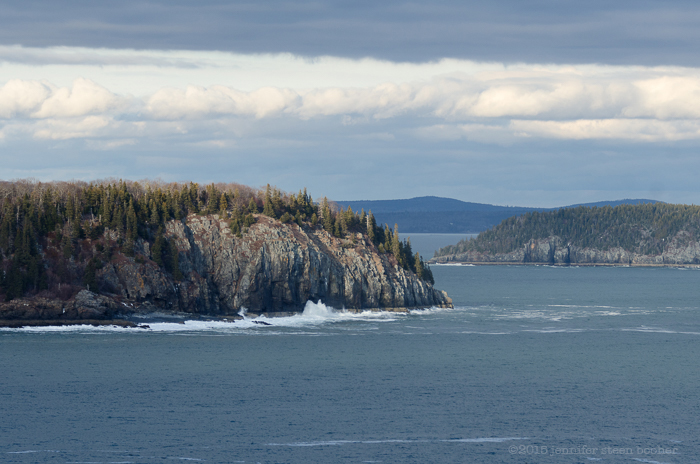
The Thrumcap


On the Saturday before Coast Walk 4, I met with Hilda Roderick, who shared some stories about the Thrumcap, a small island just off shore there, which you’ll get to read in the CW4 post, but she also said this: “‘Thrum’  is a word from the weaving community and it means the short ends after the weaving has been taken off the loom. And so these rocky little islands with some growth on top are often called ‘thrumcap.’ ”

I’d never once thought that ‘Thrumcap’ might actually mean something, although I should have known better, living on an island with such literal place names as ‘Sand Beach,’ ‘Seal Harbor,’ ‘Duck Brook,’ and ‘Bar Harbor.’ Now that Hilda had called this to my attention I started to wonder: if thrums are bits of thread, what’s a thrumcap? Well, that question led me into some fascinating corners of the internet! Who knew that there are communities of pirate re-enactors just as dedicated to historical accuracy as your average Civil War fanatic? Who knew that there are knitters stalking museum displays trying to decipher the construction of hats recovered from shipwrecks? But I digress. The internet has that effect on me.

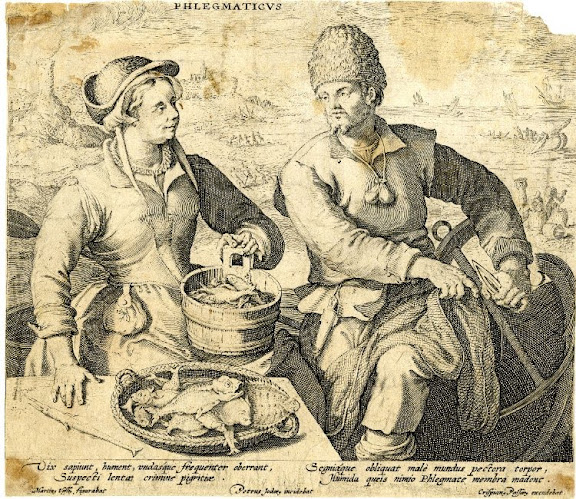
This is a thrumcap:

The sailor on the right is wearing a thrumcap. I found this image in a chat room for piracy re-enactors.

from Habiti Antichi e Moderni by Cesare Vecelli, 1600 (via Kate’s Corner)

It was known as either a thrum cap or a thrummed cap, and according to Two Nerdy History Girls, “The base was knitted of wool, and extra pieces of yarn or fleece were thrummed into the surface – either knitted in or woven in afterwards – to make the shaggy surface. Then the whole thing was fulled (much like felting) in hot water to shrink the knitted stitches, secure the thrums, and lock the wool’s fibers together. The result was a dense, sturdy, windproof hat that resembles fur (or the 18th c. version of dreads.)”

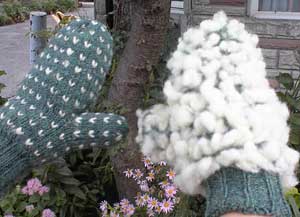
A similar technique is still used today; in fact, you probably know exactly what thrums are if you grew up in northern New England – at least once in your life you’ve had a pair of mittens that looked like this:

Right-side out on the left and inside-out on the right. [Photo by Yarn Harlot]

Although they aren’t felted when you get them, they are super warm, and by the time you’ve had a few snowball fights those thrums are pretty matted.

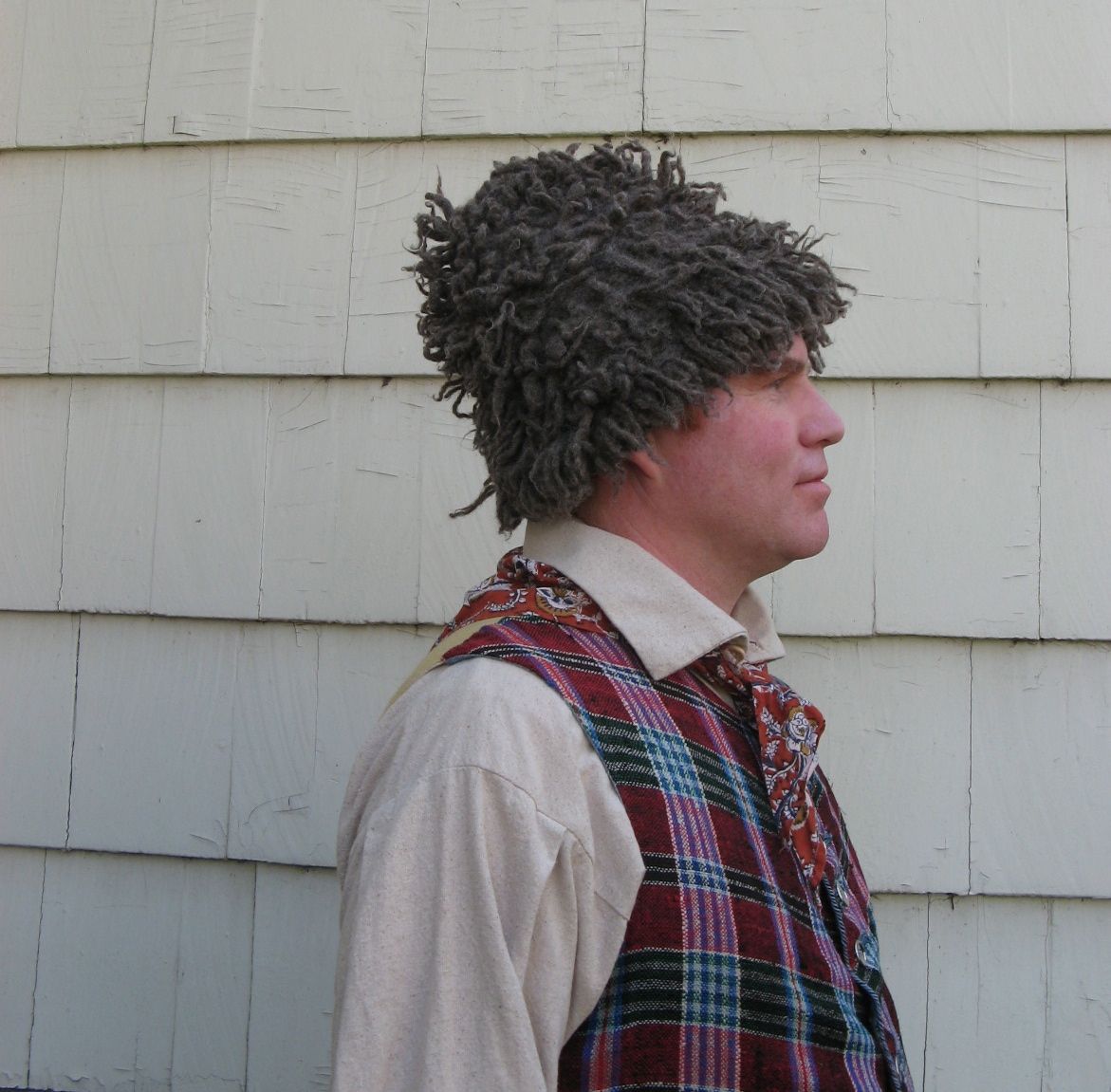
Here is a modern reproduction of a thrumcap:

This one by Neils Yard, Newfoundland, has the thrums on the inside:

I also found a marvelous song called the Ballad of the Caps:

(d’Urfey, “The Ballad of the Caps”, Wit and Mirth, or Pills to Purge Melancholy, 1719) [image courtesy of the National Library of Scotland]

“The Souldiers that the Monmouth wear
On Castle-tops their Ensigns rear:
The Sea-man with his Thrumb doth stand
On higher parts than all the land…
Any Cap, whate’er it be, is still the sign of some degree.”


After all that information the question remains: why are so many islands named Thrumcap? There’s one off South Bristol, Maine; there’s one off Georgetown, Prince Edward Island; one in Nova Scotia; Captain Cook even named a Thrum Cap Island in the eastern Tuamotu archipelago (in the South Pacific.)

I can only guess that they are all shaggy, lumpy bits of land.


Share